Key Takeaways
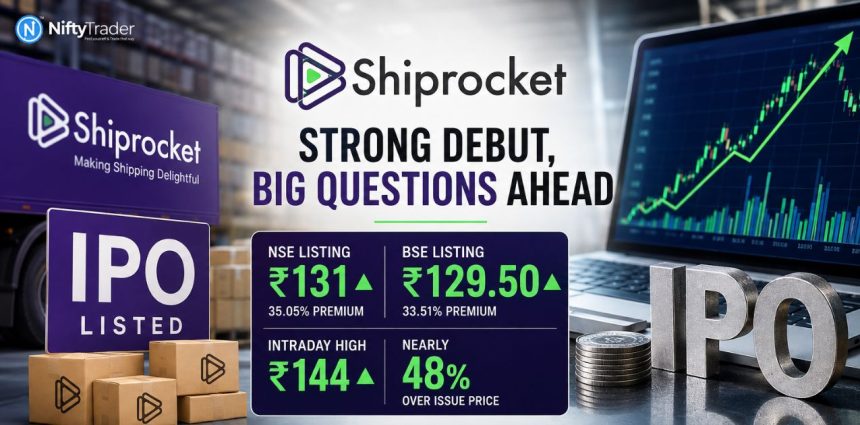
- Listing: NSE ₹131 (35.05% premium), BSE ₹129.50 (33.51%); intraday high of ₹144, nearly 48% over the issue price.
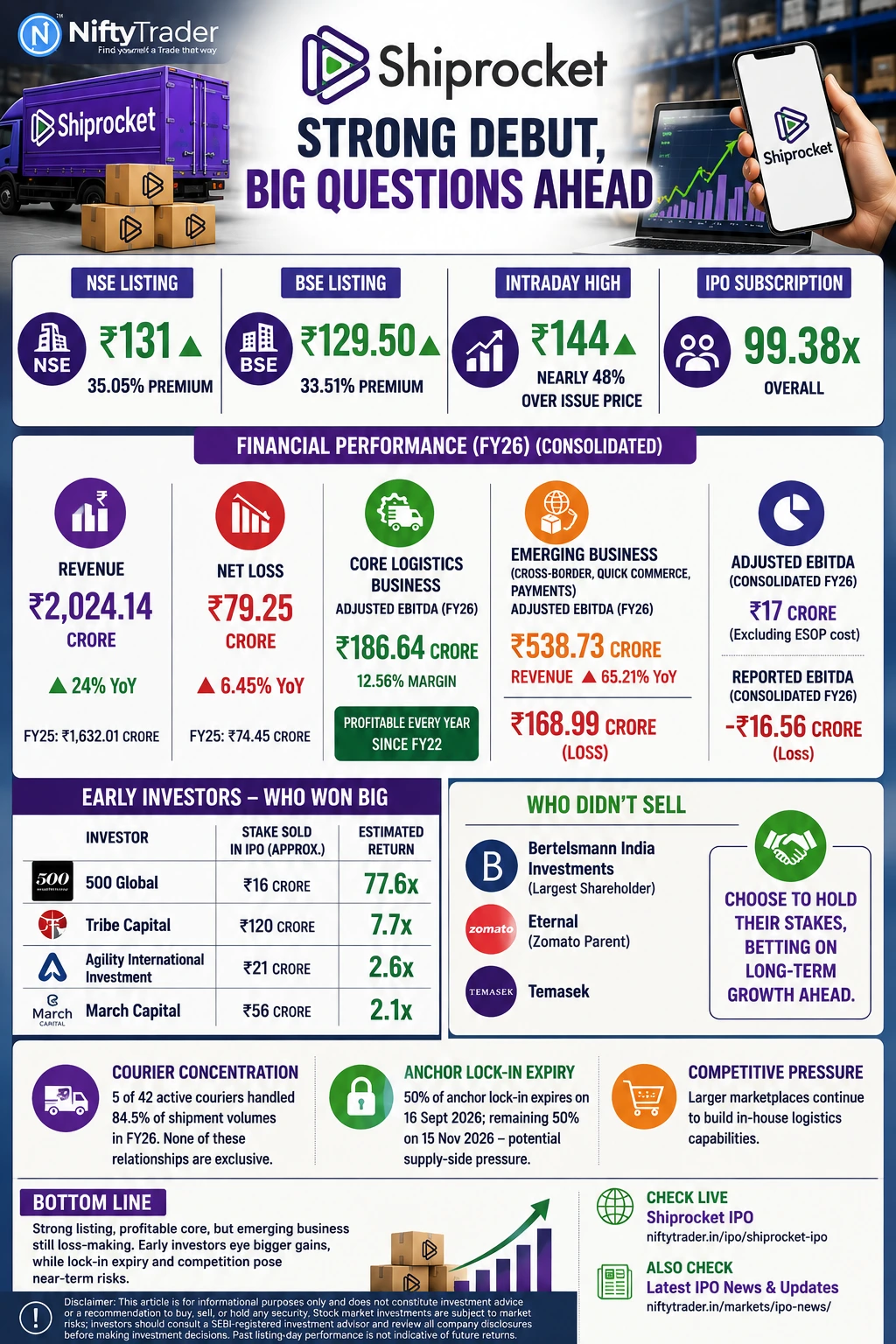
- FY26 revenue rose 24% to ₹2,024.14 crore from ₹1,632.01 crore in FY25, even as consolidated net loss widened 6.45% to ₹79.25 crore.
- Core logistics business generated ₹186.64 crore in Adjusted EBITDA in FY26 (12.56% margin) and has been profitable every year since FY22.
- The emerging business — cross-border, quick commerce, payments — grew revenue 65.21% to ₹538.73 crore but posted an Adjusted EBITDA loss of ₹168.99 crore.
- One early backer is walking away with a 77.6x return on its stake — while three of Shiprocket’s biggest shareholders chose not to sell at all.
Shiprocket’s Debut, By the Numbers
Shiprocket turned its IPO into an immediate windfall for allottees. Shares listed at ₹131 on the NSE, a 35.05% premium over the ₹97 issue price, while the BSE debut came in at ₹129.50, up 33.51%. A full lot of 154 shares, bought for ₹14,938, was worth ₹20,174 within minutes of trading opening, a listing-day gain of ₹5,236 per lot.
The stock kept climbing after the open, touching an intraday high of ₹144 on the NSE and ₹143.90 on the BSE, roughly 48% above the issue price, before easing back through the session. Trading was still underway through the afternoon, with the stock holding well above its listing price.
The underlying business has expanded materially alongside the listing. FY26 operating revenue grew 24% to ₹2,024.14 crore from ₹1,632 crore a year earlier, even as consolidated net loss widened to ₹79.25 crore from ₹74.45 crore in FY25 — a rise of about 6.45%.
Check Live: Shiprocket IPO
Demand Was Never in Doubt
The ₹1,617.48-crore issue was subscribed 99.38 times overall, with qualified institutional buyers bidding 122.80 times their reserved portion, non-institutional investors 88.99 times, and retail investors 46.42 times. Ahead of the offer, Shiprocket raised ₹727.41 crore from anchor investors on August 11, from a list that included the New York State Teachers Retirement System, Goldman Sachs Asset Management, Nomura Funds Ireland, Societe Generale, ICICI Prudential Life and Tata AIA Life.
Behind the Premium: A Profitable Core, a Loss-Making Bet
Shiprocket’s core business, domestic shipping and value-added technology offerings, grew revenue to ₹1,485.41 crore in FY26, generating ₹186.64 crore in Adjusted EBITDA, and has been profitable at the segment level every year since FY22.
The newer bets tell a different story. Emerging-business revenue, cross-border shipping, quick commerce, payments and checkout, grew 65.21% in FY26 to ₹538.73 crore, but the segment posted an Adjusted EBITDA loss of ₹168.99 crore for the year. That’s the real tension behind Wednesday’s premium: a profitable core is subsidising a fast-growing but still cash-consuming second business.
It’s worth being precise on which “EBITDA” is being discussed, since Shiprocket’s own disclosures use two distinct versions. On a reported basis, consolidated EBITDA was a loss of ₹16.56 crore in FY26, narrower than FY25’s loss but still negative.
Once ESOP (employee stock option) costs are excluded, Adjusted EBITDA turns positive at roughly ₹17 crore, the two numbers describe the same year but tell different stories depending on whether non-cash compensation is stripped out.
The net loss trend needs similar care. FY24’s ₹595 crore loss included a one-time restructuring and integration charge of ₹244 crore tied to acquired businesses, alongside ESOP costs of ₹192 crore — so FY25’s sharp narrowing to ₹74.45 crore partly reflected that one-time charge dropping out of the base, not organic improvement alone.
Who Actually Made the Money
The listing-day pop tells only part of the story. Look further back, and Shiprocket’s IPO produced some dramatically uneven outcomes for the investors who backed it early. At the ₹97 issue price, early investor 500 Global is set to walk away as the single biggest winner, realising an estimated 77.6x return on the ₹16 crore worth of shares it sold in the offer. Tribe Capital is set to earn roughly 7.7x on its ₹120 crore stake sale, while Agility International Investment and March Capital are looking at more modest 2.6x and 2.1x returns on their respective ₹21 crore and ₹56 crore exits.
What’s just as telling is who chose not to cash out. Bertelsmann India Investments, Shiprocket’s largest shareholder, was originally included in an earlier draft of the offer document but pulled out of the final sale entirely.
Zomato-parent Eternal and Temasek, both major backers, also sat out the offer-for-sale completely, choosing to hold their stakes through the listing rather than book gains today.
For a company whose long-term thesis depends on scaling a currently loss-making emerging business, that’s a signal worth reading alongside the subscription numbers: some of Shiprocket’s earliest and largest institutional backers are betting there’s more value still ahead than what Wednesday’s 35% pop already captured.
Also Check: Latest IPO News & Updates
What Could Pressure the Stock From Here
Shiprocket works with 42 active couriers, but five handled 84.5% of shipment volumes in FY26, and none of these relationships are exclusive, leaving limited bargaining power if a partner raises rates.
A more immediate date is now on the calendar: half of the anchor-investor lock-in expires on September 16, 2026, with the remaining half releasing on November 15, a potential source of supply-side pressure on the stock. Competitive intensity isn’t standing still either, with larger marketplaces continuing to build in-house logistics capacity.
Track how institutional flows are positioning around new listings like this one on NiftyTrader’s FII-DII Tracker, updated through the session.
Bottom Line
Shiprocket’s listing-day pop confirms strong investor appetite, backed by a genuinely profitable and improving core logistics business generating ₹186.64 crore in Adjusted EBITDA. But the premium also prices in the company’s newer, still loss-making bets scaling toward profitability without eroding the core’s margins, a segment currently losing nearly ₹169 crore a year.
Early-investor exits (and non-exits) suggest smart money sees room to run beyond today’s pop; courier concentration, the September–November lock-in window, and intensifying in-house logistics competition are the near-term variables that will decide who’s right.
Read Next: SEBI Reviews SME IPO and Delisting Rules: What Could Change for Small Companies
Disclaimer: This article is for informational purposes only and does not constitute investment advice or a recommendation to buy, sell, or hold any security. Stock market investments are subject to market risks; investors should consult a SEBI-registered investment advisor and review all company disclosures before making investment decisions. Past listing-day performance is not indicative of future returns.