
Need to Know
This fortnight’s FII sector rotation put financial services on top: a net Rs 6,535 crore inflow between August 1-15, reversing a Rs 2,669 crore outflow from the second half of July — a swing of Rs 9,204 crore.
Total FPI equity inflows behind this rotation hit Rs 16,621 crore in the first half of August, per a SEBI-registered Mata Securities fortnightly review of NSDL data, split into Rs 11,199 crore via secondary markets and Rs 5,422 crore through IPOs.
Automobiles (Rs 4,405 crore), consumer services (Rs 3,398 crore), healthcare (Rs 2,910 crore) and IT (Rs 2,530 crore) were the other big winners of the rotation; telecom (-Rs 3,322 crore) and capital goods (-Rs 1,556 crore) led the selling.
Despite the fortnight’s buying, FIIs remain net sellers of Rs 2,37,451 crore in Indian equities for CY2026 so far, already ahead of the entire Rs 1.66 lakh crore outflow recorded in 2025.
DIIs crossed a record Rs 5,13,124 crore in cumulative CY2026 equity buying, with mutual funds, a category included within the DII total, contributing Rs 3,33,929 crore.
Foreign portfolio investors sharply increased their buying of Indian financial stocks in the first half of August, pumping in a net Rs 6,535 crore between August 1 and 15, a sharp reversal from the Rs 2,669 crore they had pulled out just a fortnight earlier.
That Rs 9,204 crore swing made financials the biggest sectoral recipient of foreign capital this fortnight, and it anchored a broader FII rotation that also lifted automobiles, consumer services, healthcare and IT stocks, even as telecom, capital goods and power counters kept bleeding foreign money.
Set against the Rs 1,05,614 crore FIIs have pulled out of financials so far this calendar year, though, the fortnight’s Rs 6,535 crore looks almost token, barely 6 percent of the damage.
That gap is the real question hanging over this data: is August the start of a genuine FII reversal in financials, or just a tactical bounce inside a much larger 2026 foreign-selling trend?
The numbers behind this rotation are confirmed across independent trackers, not a single wire report.
A fortnightly review by SEBI-registered research firm Mata Securities, built on NSDL sectoral data, pegs total FPI equity inflows for the period at Rs 16,621 crore, split between Rs 11,199 crore via the secondary market and Rs 5,422 crore through IPO allotments.
Business Standard’s own compilation of the same NSDL dataset also reported broadly similar sectoral flows, with the financials, auto, consumer services and IT numbers lining up closely across both trackers.
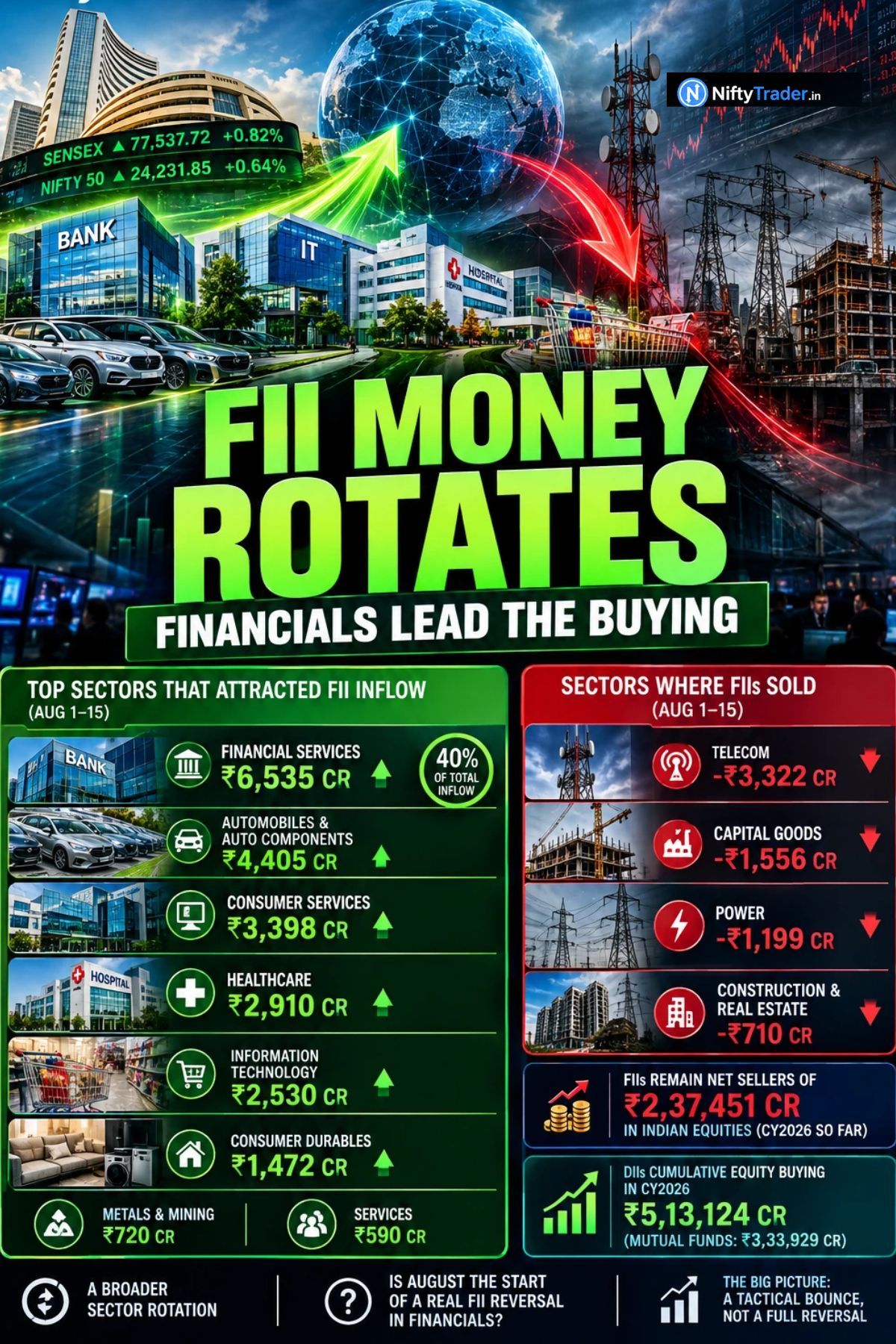
Financial Services Leads a Broad Sector Rotation
Financials alone accounted for roughly 40 percent of the fortnight’s net inflow. Automobiles and auto components followed with Rs 4,405 crore, consumer services pulled in Rs 3,398 crore, healthcare added Rs 2,910 crore, and IT stocks extended their comeback with another Rs 2,530 crore. Consumer durables (Rs 1,472 crore), metals and mining (Rs 720 crore) and the broader services category (Rs 590 crore) rounded out the buy list.
This is where the FII flows get interesting: financial services is simultaneously August’s top buy and 2026’s single biggest sell.
FIIs have offloaded a cumulative Rs 1,05,614 crore from the sector so far this calendar year, more than three times the outflow from the next-worst sector — meaning the fortnight’s Rs 6,535 crore recovers barely a twentieth of what has left the sector in 2026.
The August buying, in other words, is a partial repair job on a much deeper wound.
Until FIIs string together several more fortnights like this one, it reads more as a tactical bounce than a confirmed reversal of the FPI retreat from financials that has defined most of 2026.
IT Stocks Complete a Dramatic Round-Trip
The IT sector’s turnaround is arguably the sharper story inside this institutional rotation.
FIIs were heavy sellers of Indian IT stocks through the first half of 2026 amid concerns that generative AI could disrupt traditional services-business models, a narrative that dragged the Nifty IT index down nearly 30 percent.
That narrative flipped in July as the global AI trade cooled and investors reassessed richly valued AI and semiconductor names, the Nifty IT index jumped 16.7 percent that month alone on the back of Rs 3,298 crore of FPI buying, which has now extended into August with another Rs 2,530 crore.
Sense and Simplicity CEO Sunil Subramaniam told Business Standard that IT majors are increasingly viewed as the execution partners needed to deploy AI at scale, not victims of it, a relative-value, mean-reversion trade rather than a structural re-rating.
Why the Reversal Now
The Rs 6,535 crore-versus-Rs 1.06 lakh crore gap explains why money managers are hedging their language, calling this a rotation in direction rather than a reversal in scale.
Their reasoning points to a more specific set of drivers than the sectoral flow-of-funds numbers alone can show.
Vallum Capital CEO and Portfolio Manager Manish Bhandari attributes the turnaround to improving relative valuations, resilient corporate earnings, expectations of softer US interest rates, lower currency volatility, and some diversification away from crowded Korea-Taiwan AI trades, a trade he says had been absorbing a disproportionate share of global capital.
Trackk Co-Founder and CEO Vedant Gupte reads the August inflows as evidence that the earlier selling was driven more by global macro conditions than India-specific concerns.
With expectations of US rate cuts, softer crude and a steadier rupee removing three reasons foreign investors had stayed on the sidelines, he says FPI buying is also turning more selective — tilting toward consumption-linked sectors such as consumer durables and healthcare. “Foreign investors are underwriting the Indian household, not the Indian invoice,” Gupte said.
Bajaj Broking Deputy Vice President-Research Pabitro Mukherjee expects near-term flows to stay sensitive to crude oil prices and the ongoing US-Iran geopolitical tensions, alongside US Treasury yields and the dollar index — the same set of global cues that will determine whether this fortnight’s buying extends into September.
Where FIIs Are Still Selling
The sell side of this rotation shows FIIs continuing to retreat from capital-intensive and infrastructure-linked names.
Telecom led the outflows at Rs 3,322 crore, followed by capital goods (Rs 1,556 crore), power (Rs 1,164 crore), realty (Rs 1,014 crore), construction (Rs 404 crore) and FMCG (Rs 189 crore).
Telecom’s cumulative outflow for 2026 now stands at Rs 26,470 crore, amid ongoing investor concern around 5G capex intensity and spectrum-linked balance-sheet pressure across the sector.
Check Live: NiftyTrader: Live Options Analytics & F&O Trading Tools
The Bigger Picture: 2026 Is Still a Net-Outflow Year
Zoom out, and the fortnight’s buying looks smaller. FIIs remain net sellers of Indian equities to the tune of Rs 2,37,451 crore for calendar year 2026 through August 15, a figure that, according to PTI-sourced reporting, had already overtaken the entire Rs 1.66 lakh crore of outflows recorded in all of 2025 by early August.
Cumulative 2026 selling is led by financial services (Rs 1,05,614 crore), automobiles (Rs 31,044 crore), oil and gas (Rs 28,411 crore), IT (Rs 28,359 crore) and FMCG (Rs 27,987 crore).
On the buy side for the year, only metals and mining (Rs 18,478 crore), capital goods (Rs 13,323 crore), services (Rs 9,084 crore) and consumer durables (Rs 4,667 crore) show net inflows — meaning capital goods is a fortnight seller but a full-year buyer, one more sign of how noisy short-term flows can get against the annual trend.
FPI debt flows have been the quieter cushion through this.
Despite a marginal Rs 340 crore debt outflow in the first half of August, cumulative 2026 debt inflows stand at a strong Rs 82,105 crore, and total FPI assets under custody rose to Rs 78.66 lakh crore from Rs 78.05 lakh crore, a Rs 60,813 crore gain driven almost entirely by rising equity values rather than fresh buying.
DIIs and Mutual Funds Keep the Market Cushioned
While FIIs stayed net negative for the year, domestic institutions kept absorbing the slack through this entire episode.
DIIs invested Rs 17,287 crore in equities during August 1-15, taking cumulative CY2026 DII equity buying to a record Rs 5,13,124 crore, the first time DIIs have crossed the Rs 5 lakh crore mark in a calendar year.
Mutual funds, which are counted within the DII category rather than as a separate flow, invested Rs 27,887 crore through August 13, taking their cumulative CY2026 equity investment to Rs 3,33,929 crore.
The two fortnightly figures use different date cut-offs (the MF number runs through August 13, the DII number through August 15), so they should be read as overlapping rather than directly additive.
For live, day-by-day tracking of exactly how this tug-of-war is playing out, NiftyTrader’s FII-DII dashboard (niftytrader.in/fii-dii-data) updates cash-market activity after every session.
On August 20, the most recent session, FIIs were net sellers of Rs 583 crore in cash while DIIs bought a net Rs 3,538 crore, a fairly typical day in a year where domestic flows have consistently cushioned foreign selling.
What to Watch as the Second Half of August Unfolds
The next NSDL fortnightly print, due around September 1, will show whether financials can hold onto this buying or whether August 1-15 turns out to be another short-lived bounce in a year that has otherwise punished the sector.
Three triggers are worth tracking for the next leg of this rotation: US Federal Reserve rate-cut signals, which have already helped soften the dollar and support emerging-market flows; crude oil prices and the ongoing US-Iran tensions, which remain a swing factor for India’s import bill and rupee stability; and the pace of Q2 FY27 earnings from banks and IT majors, which will test whether the fundamental case behind this month’s buying holds up.
If financials and IT both deliver, the fortnight’s Rs 9,204-crore swing could mark an inflection point. If they don’t, 2026’s Rs 2.37 lakh crore outflow has plenty of room to grow.
Sector Rotation Snapshot: August 1-15, 2026
| Sector | FII Flow (₹ Cr) | Direction |
|---|---|---|
| Financials | +6,535 | 🟢 Inflow |
| Automobiles | +4,405 | 🟢 Inflow |
| Consumer Services | +3,398 | 🟢 Inflow |
| Healthcare | +2,910 | 🟢 Inflow |
| IT | +2,530 | 🟢 Inflow |
| Consumer Durables | +1,472 | 🟢 Inflow |
| Metals & Mining | +720 | 🟢 Inflow |
| Services | +590 | 🟢 Inflow |
| Telecom | -3,322 | 🔴 Outflow |
| Capital Goods | -1,556 | 🔴 Outflow |
| Power | -1,164 | 🔴 Outflow |
| Realty | -1,014 | 🔴 Outflow |
| Construction | -404 | 🔴 Outflow |
| FMCG | -189 | 🔴 Outflow |
Key takeaway: Financials attracted the highest FII inflow at ₹6,535 crore, while telecom saw the biggest outflow at ₹3,322 crore during August 1–15.
Bookmark NiftyTrader’s FII-DII dashboard for daily cash-market moves while this rotation plays out, and check back here for the next NSDL sector update around September 1.
Read Next: Stocks to Watch Today: HDFC Bank, RailTel, HAL and 5 Fresh Triggers
Frequently Asked Questions
What is the FII sector rotation trend for August 2026?
FIIs rotated into financials, automobiles, consumer services, healthcare and IT in the first half of August 2026, while continuing to sell telecom, capital goods, power and realty stocks.
How much did FIIs invest in financial stocks in August 2026?
FIIs invested a net Rs 6,535 crore in financial services stocks between August 1 and 15, 2026, reversing a Rs 2,669 crore outflow recorded in the second half of July.
Which sectors saw the highest FII selling in the first half of August 2026?
Telecom led FII selling at Rs 3,322 crore, followed by capital goods at Rs 1,556 crore and power at Rs 1,164 crore.
Are FIIs net buyers or net sellers of Indian equities in 2026?
Despite August’s sector rotation into financials and autos, FIIs remain net sellers of Rs 2,37,451 crore in Indian equities for calendar year 2026 through August 15, more than the entire Rs 1.66 lakh crore outflow recorded in all of 2025.
How much have DIIs and mutual funds invested in Indian equities in 2026?
DIIs have invested a cumulative Rs 5,13,124 crore in Indian equities in CY2026 through August 15, of which mutual funds, counted within the DII total, contributed Rs 3,33,929 crore through August 13.
What was the FII-DII activity in the latest trading session?
On August 20, 2026, FIIs were net sellers of Rs 583 crore in the cash segment while DIIs were net buyers of Rs 3,538 crore, according to NSE provisional data.
Why are FIIs buying Indian financials and consumption stocks again?
Money managers cite improving relative valuations, resilient corporate earnings, expectations of softer US interest rates, a steadier rupee and softer crude prices, along with diversification away from crowded Korea-Taiwan AI trades. Some also point to renewed FPI interest in consumption-linked sectors such as consumer durables and healthcare.
Disclaimer: This sector rotation analysis is based on data compiled from NSDL, NSE, Mata Securities and other publicly available institutional flow reports. It is intended for informational purposes only and does not constitute investment advice. Past FII/DII flow patterns are not indicative of future market performance. Readers should consult a SEBI-registered investment adviser before making any investment decisions.