Need to Know
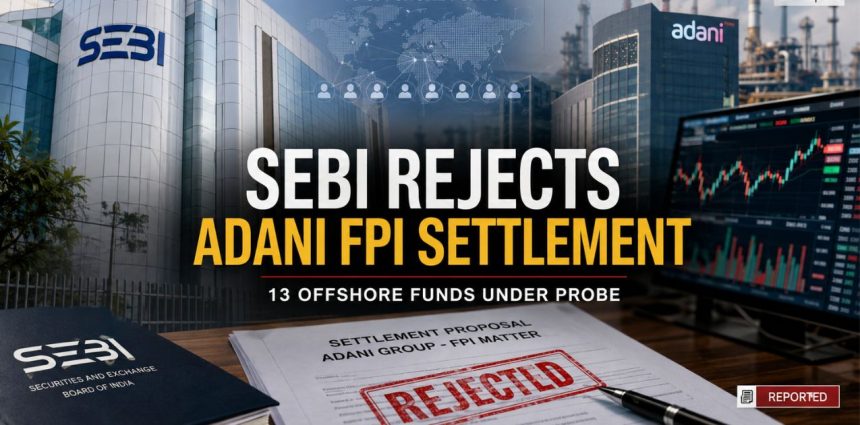
- Sebi has rejected settlement applications from FPIs holding stakes in Adani Group companies, per an Economic Times report citing people familiar with the matter, not yet confirmed by Sebi or the funds
- The probe into these 13 offshore funds dates to October 2020, when Sebi’s surveillance systems flagged unusually concentrated Adani Group holdings
- Reasons for rejection: some funds wouldn’t share information Sebi wanted; others resisted disgorging money the regulator sought
- The rejection lands ~3 weeks after five of the same funds withdrew a separate SAT challenge against Sebi, with plans to refile amended petitions
- This case is distinct from the main Adani-Hindenburg matter, which Sebi closed in September 2025 with no violations found against Adani Group or Gautam Adani
Sebi has rejected settlement applications filed by a group of foreign portfolio investors holding stakes in Adani Group companies, after their proposed terms failed to match what the regulator wanted, according to a report by the Economic Times citing people familiar with the matter.
The regulator communicated the rejection to the FPIs’ representatives last week, reviving a case that traces back to October 2020, when Sebi’s surveillance systems first flagged unusually concentrated offshore holdings in Adani Group stocks.
As many as 13 overseas funds had sought to settle the case, which centres on whether they were genuine public shareholders or vehicles linked to the Adani Group founders. Sebi’s investigation examined the ultimate beneficial ownership of these funds and whether their exposure breached FPI investment limits at the time.
The development adds a fresh, and so far unremarked, wrinkle: it lands roughly three weeks after five of these very funds withdrew a separate procedural challenge against Sebi at the Securities Appellate Tribunal, choosing instead to refile amended petitions. Two fronts of the same fight both hit a reset within a month of each other.
Check Live: ADANI ENTERPRISES Options Chart
Why Sebi Said No
Under Sebi’s settlement regulations, entities facing show-cause notices can pay a monetary amount and agree to the regulator’s directions without admitting or denying the underlying allegations. It’s a routine mechanism, but Sebi retains full discretion to accept or reject the proposed terms.
Per the report, the funds’ proposed settlement terms failed on two counts: some funds were unwilling to provide information Sebi considered necessary to close the matter, while others resisted Sebi’s demands that they disgorge money the regulator believed they owed.
Neither Sebi nor the funds have issued an on-record confirmation, and this account has not been independently corroborated beyond the original report.
Which Funds Are Under the Scanner
Sebi has, at various points since 2024, sent show-cause notices to at least seven of the 13 flagged FPIs by name. All seven were separately named by short-seller Hindenburg Research in its January 2023 report on the Adani Group.
Their combined exposure to Adani Group stocks has declined from 2021 levels, when several of these funds were at the centre of an NSDL account-freeze scare that briefly wiped out a large chunk of group market value before being clarified as unrelated to the Adani matter.
| Fund | Named By Hindenburg (2023) | 2026 Legal Status |
|---|---|---|
| Albula Investment Fund | Yes | SAT plea withdrawn Aug 3; refiling |
| Cresta Fund | Yes | SAT plea withdrawn Aug 3; refiling |
| LTS Investment Fund | Yes | SAT plea withdrawn Aug 3; refiling |
| APMS Investment Fund | Yes | SAT plea withdrawn Aug 3; refiling |
| Asia Investment Corp. (Mauritius) | Yes | SAT plea withdrawn Aug 3; refiling |
| Elara India Opportunities Fund | Yes | Lost separate SAT appeal on Sebi’s UBO disclosure circular |
| Vespera Fund | Yes | Lost separate SAT appeal on Sebi’s UBO disclosure circular |
A Parallel Legal Track Just Went Cold
Five of the named funds, LTS, Cresta, Asia Investment Corporation (Mauritius), APMS and Albula, had separately moved the SAT in June 2026, arguing Sebi skipped a mandatory procedural step under Rule 4(3) of its adjudication rules before proceeding against them. That case dragged through adjournments on June 22 and July 15, before a hearing listed for August 3.
On August 3, the tribunal allowed the five funds to withdraw their pending appeals so they could file revised petitions with amendments, effectively resetting that legal track just weeks before news of the settlement rejection surfaced.
Separately, the tribunal had earlier upheld a Sebi circular requiring FPIs to disclose ownership structures down to the ultimate beneficiary level, rejecting appeals on that specific point from Elara India Opportunities Fund and Vespera Fund.
Read together, the sequence suggests these funds have been running settlement talks and a procedural challenge in parallel, and both routes hit friction within the same month.
Not the Same as the Hindenburg Clean Chit
It’s worth separating this from the broader Hindenburg-linked investigation into Adani Group companies. Sebi closed that main probe in September 2025, issuing twin orders finding no violation of related-party transaction norms or fraudulent trading practices by Adani Enterprises, Adani Power, Adani Ports and Adani Group promoters, including Gautam Adani.
This FPI ownership case is narrower and remains open. It concerns whether these specific offshore funds accurately disclosed their beneficial owners and stayed within FPI investment limits, not the wider stock-manipulation or accounting-fraud allegations the main case addressed.
A Supreme Court-appointed expert committee had earlier noted Sebi had “drawn a blank” on establishing the ultimate ownership of some of these entities, a gap this investigation has tried to close since.
Why It Matters for FII Flows
The rejection fits a pattern building through 2026. Sebi turned down a separate settlement plea from Anil Ambani and Reliance Infrastructure in June over an alleged fund-diversion case, and rejected another Ambani settlement bid tied to Yes Bank investments in August.
Taken together, these decisions suggest a regulator less inclined to let high-profile, market-wide cases close through consent terms, and more willing to push them into full adjudication where penalties and findings become public.
For India’s FII-DII dynamic, this is a reminder that Sebi’s post-2023 push for granular, ultimate-beneficiary disclosure from FPIs concentrated in a single corporate group remains active — even years after the headline Hindenburg matter was resolved. Offshore funds with concentrated single-group exposure are likely to stay under closer watch as this case moves toward adjudication.
Check Live to explore: FII DII DATA ON NIFTYTRADER
What Comes Next
With settlement off the table, Sebi’s adjudicating officer will need to weigh the funds’ responses to the original show-cause notices and decide whether to proceed to a formal inquiry, a step the funds have already contested once at the tribunal and are expected to contest again once they refile.
The outcome could matter beyond Adani Group: a firm Sebi order on ultimate-beneficial-ownership standards for FPIs concentrated in a single corporate group would set a template other conglomerate-linked offshore funds get measured against, long after the Hindenburg report that started this six-year thread has faded from the headlines.
Read Next: 24 Aug Stocks to Watch: Reliance’s Explosives Entry, Power Grid ₹822 Cr Win
FAQs
What is the Sebi-Adani FPI settlement case about?
It concerns 13 offshore funds Sebi has investigated since 2020 over whether they were genuine public shareholders in Adani Group companies or effectively linked to the group promoters, and whether they breached FPI disclosure and investment-limit rules.
Why did Sebi reject the settlement applications?
Per the ET report, some funds wouldn’t share information Sebi wanted, while others declined to disgorge money the regulator had sought, so the proposed terms didn’t meet Sebi’s requirements.
Is this the same as the Hindenburg Research case against Adani Group?
No. Sebi closed the main Hindenburg-linked probe into Adani Group companies and Gautam Adani in September 2025 with no violations found. This FPI ownership case is separate and remains open.
What happens next to these FPIs?
With settlement rejected, the matter is expected to move to formal adjudication. Five of the funds are also expected to refile amended petitions at the SAT after withdrawing their earlier pleas on August 3.
Has Adani Group responded?
Adani Group has consistently denied any links to these offshore funds throughout the investigation. There’s no fresh comment from the group on this specific development yet.