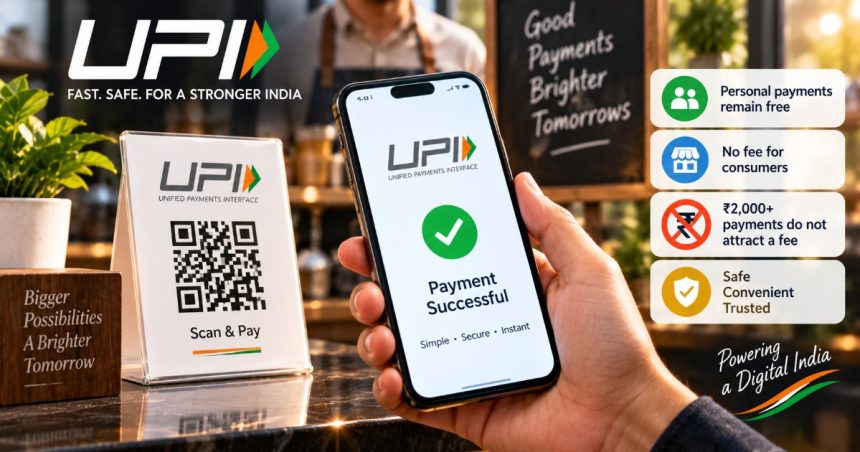
UPI Fee Confusion Cleared: Government Clarifies Rs 2,000 Rule for Millions of Users
Imagine paying ₹5,000 through UPI and wondering whether an extra charge will suddenly appear. That concern has spread among millions of users after discussions around UPI charges and Merchant Discount Rate (MDR) resurfaced.
But the government’s latest clarification brings an important distinction: UPI users are not required to pay a transaction fee simply because a payment crosses ₹2,000.
Track Live : Opening Price Clues – What Pre-Market Data Says Today
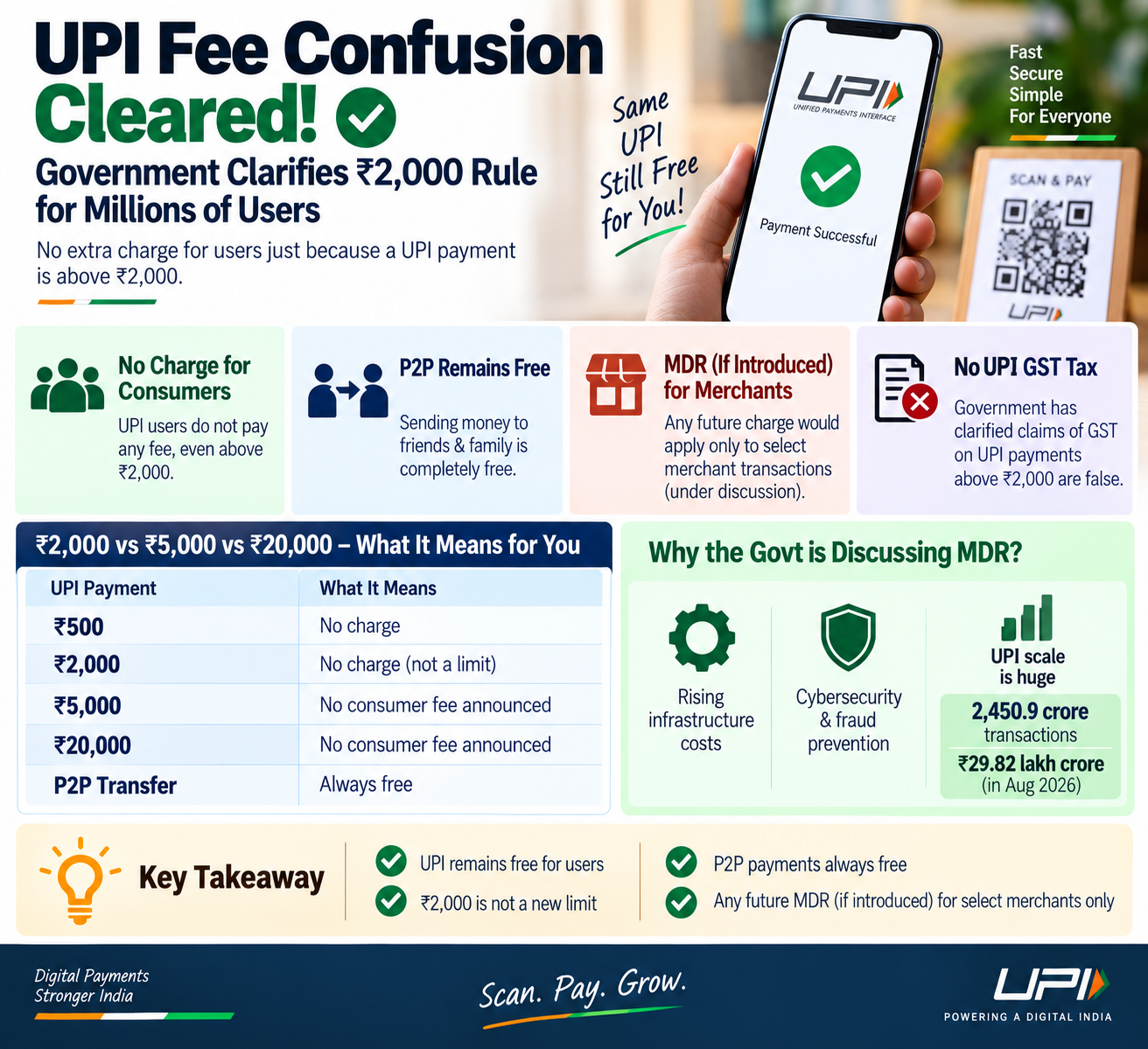
UPI Fee Confusion: Why the ₹2,000 UPI payment limit is creating confusion
The ₹2,000 figure has become the centre of the UPI charges debate, but it does not represent a new limit for free UPI payments.
The threshold has been used within the digital-payment framework for determining certain benefits and protections related to small-value merchant transactions.
It does not mean that UPI payments become chargeable once the transaction exceeds ₹2,000.
So, whether you pay ₹500, ₹2,000, ₹5,000 or ₹20,000 from your bank account using UPI, there is currently no announced consumer transaction fee that automatically applies simply because of the payment amount.
Will you pay a UPI charge on a ₹5,000 payment?
For ordinary users, no—not simply because the payment is ₹5,000.
If you scan a merchant QR code and pay ₹5,000 through UPI, the government has clarified that consumers will not face a transaction charge merely for crossing the ₹2,000 threshold.
The same principle applies to larger payments such as ₹10,000 or ₹20,000.
This is why users should not confuse a possible MDR charge with a direct fee charged to customers.
₹2,000 vs ₹5,000 vs ₹20,000: What the Latest UPI Rule Means
| UPI payment | What the latest rule means |
|---|---|
| ₹500 | No bank/system-provider charge under the notified protection |
| ₹2,000 | No bank/system-provider charge under the notified protection |
| ₹5,000 | No UPI fee has been announced yet; any future MDR could apply to eligible merchant transactions |
| ₹20,000 | No consumer fee has been announced; treatment would depend on any future MDR framework |
| P2P transfer | Government says person-to-person UPI transactions will remain free |
The key point is that ₹2,000 is the specific no-charge threshold notified by the government. It does not mean that a fee has now been imposed on payments above ₹2,000. The government has not yet announced a final MDR rate or a consumer fee for higher-value UPI payments.
What exactly is MDR and why does it matter?
MDR means Merchant Discount Rate, and it is important to distinguish it from a fee charged directly to consumers.
Reuters reports that authorities are discussing possible charges on person-to-merchant transactions above ₹2,000, with a possible MDR around 0.4%, although the final rate and fee-sharing arrangement had not been decided as of September 15. P2P transactions are expected to remain free.
Important: Don’t present 0.4% as final. It is a reported proposal/possible rate, not an officially notified final MDR.
Track Live : Gap Up / Gap Down Stocks – Today’s NSE Opening Gaps
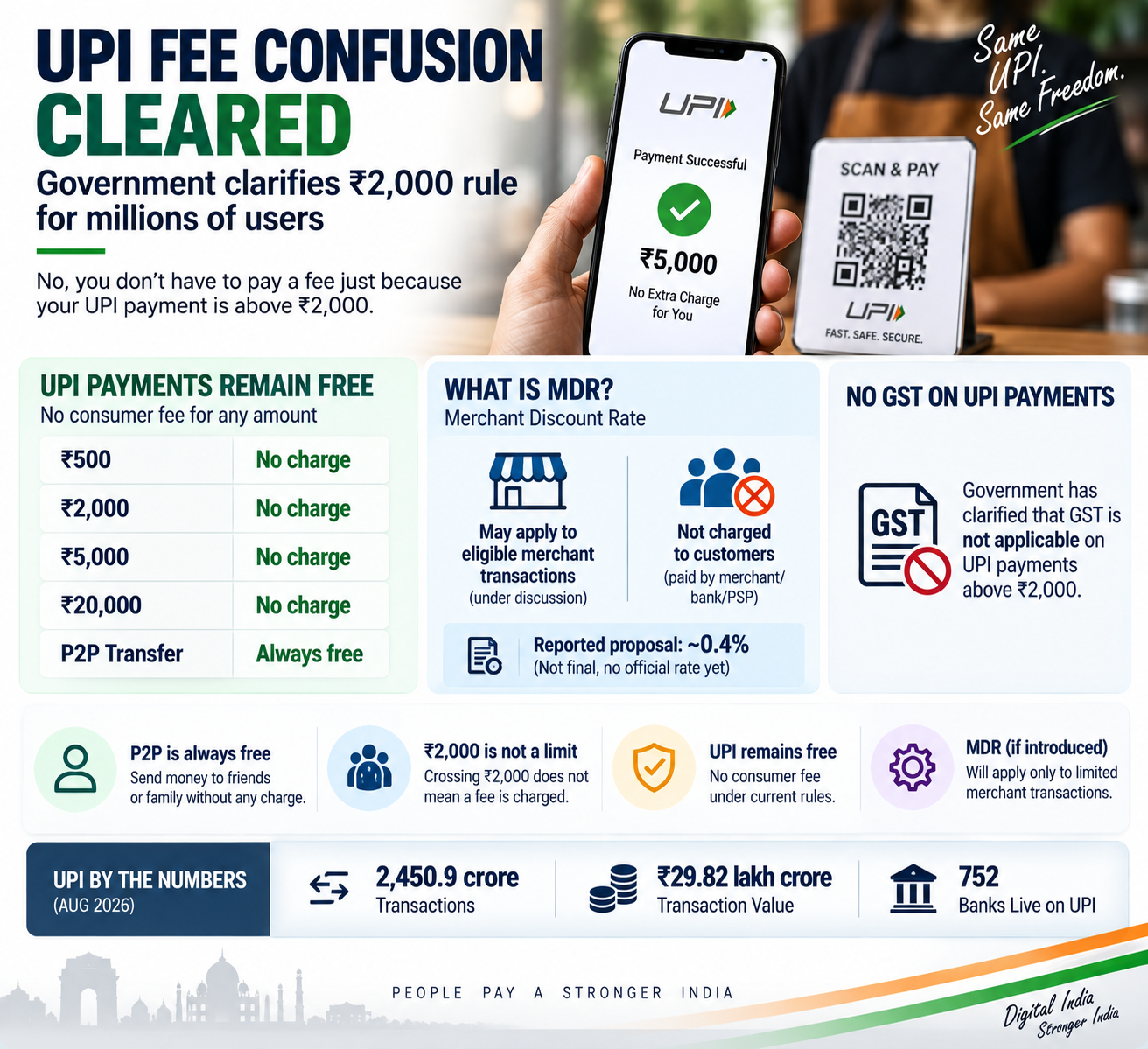
Deconstructing the ₹2,000 Rumour
- Person-to-Person (P2P) transfers are free: Sending money to your friends, family, or any individual’s bank account will always remain completely free, no matter the amount.
- Person-to-Merchant (P2M) transfers are free for you: When you scan a QR code at a shop or pay an online business, you face zero charges.
- The ₹2,000 threshold is for the ecosystem: The government is considering a framework where a nominal, future MDR might apply only to a limited category of commercial merchants for high-value transactions. This is a cost handled between the merchant, their bank, and the payment service provider—never passed down as a customer fee.
- No “UPI GST Tax”: The government has firmly dismissed viral claims that a Goods and Services Tax (GST) applies to UPI transactions above ₹2,000.
Person-to-person UPI payments will remain free
The government has also clarified the position on person-to-person, or P2P UPI payments.
If you transfer ₹5,000 to a friend or send ₹20,000 to a family member through UPI, the transaction will continue to remain free.
Therefore, the MDR discussion should not be confused with everyday money transfers between individuals.
Read More : Gold Prices Retreat Below $4,300-Mark as Middle East Oil Risks Stoke Inflation Fears
Why the government is looking at UPI charges now
UPI has grown into one of India’s most important digital payment networks.
According to NPCI data, UPI processed around 2,450.9 crore transactions worth nearly ₹29.82 lakh crore in August 2026, compared with about 2,365.8 crore transactions in July. The number of banks live on the platform also increased to 752.
That enormous scale comes with rising infrastructure costs.
Banks, fintech companies and payment service providers must keep systems operational around the clock while spending heavily on cybersecurity, fraud prevention and technology.
The government therefore wants to create a sustainable framework without making UPI expensive for ordinary users.
Is the government imposing GST on UPI payments above ₹2,000?
No. This is another area where misinformation has caused confusion.
The government has previously clarified that claims about GST being imposed on UPI transactions above ₹2,000 were false and misleading.
GST can apply to certain charges, such as MDR, where applicable. But this does not mean a customer paying ₹5,000 through UPI will automatically have GST added to the payment.
What UPI users should remember before making payments
For users, the situation can be reduced to four simple points:
- UPI remains free for consumers under the current clarification.
- P2P UPI payments remain free, regardless of whether the amount is above ₹2,000.
- ₹2,000 is not a new free-payment limit. Crossing it does not automatically trigger a UPI fee.
- Any future MDR would apply to a limited category of merchant transactions, rather than becoming an automatic consumer charge.
Here’s what happened today and why users reacted
The renewed debate over UPI charges is less about consumers suddenly paying for UPI and more about how India’s massive digital-payment ecosystem will remain financially sustainable.
For ordinary users, there is no reason to assume that a ₹2,500 or ₹5,000 UPI payment will automatically attract a transaction fee.
For merchants, banks and payment companies, however, any future MDR framework could have a bigger impact because it could change the economics of processing certain transactions.
What this means for UPI users and the payment market
For now, UPI payments above ₹2,000 remain free for consumers under the government’s clarification.
The bigger issue is what happens to MDR in the future and which merchant transactions could fall within such a framework.
For users, the takeaway is simple: there is no new UPI charge just for paying more than ₹2,000.
As UPI continues processing billions of transactions every month, the debate over who should bear the cost of India’s digital-payment infrastructure is likely to continue. For now, however, consumers can continue using UPI without worrying that crossing the ₹2,000 mark will automatically increase the amount they pay.