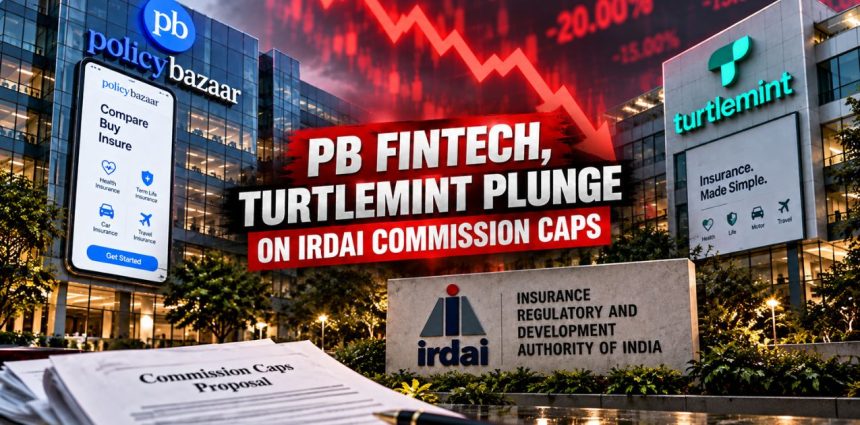
PB Fintech, the parent of Policybazaar, was locked in a 20% lower circuit at Rs 1,508.90 on the NSE, while Turtlemint Fintech Solutions was down 20% at Rs 109.04 on September 24 (as of 10:36 AM IST). PB Fintech closed Wednesday at Rs 1,886.30.
The fall came after the insurance regulator proposed product-wise and channel-wise caps on distributor commissions. Turtlemint’s price is its lowest since listing in June 2026. The next key regulatory date is October 25, when stakeholder feedback on the proposals closes.
CHECK LIVE: PB FINTECH Option Chain (NSE) — Live OI, PCR & Greeks
Need to Know
- PB Fintech hit its 20% lower circuit, and Turtlemint fell 20% after IRDAI’s commission-cap draft.
- The draft limits commissions by product and channel and tightens insurers’ expense limits over five years.
- Jefferies says a 10% cut in new-business commission rates translates to a 10-12% fall in earnings for PB Fintech and Turtlemint.
- These are proposals, not final rules. Comments are open until October 25.
What IRDAI Has Proposed
The Insurance Regulatory and Development Authority of India (IRDAI) released a consultation paper titled “Recalibrating Economics of Insurance Distribution” on September 23. Instead of one uniform structure, commission limits would reflect the segment, line of business, distribution channel, product complexity and the effort involved in selling and servicing a policy. The main ceilings reported by Business Standard are below.
Health insurance: For first-time sales of individual policies, commissions are proposed at about 15% for distribution entities and 20% for agents. On renewals, the caps are 5% and 10%.
Life insurance: For individual non-linked and linked products, intermediaries would earn 5% to 20% depending on the premium payment term, and agents 6.25% to 25%. For payment terms of 10 years or more, the first-year cap is 20% for distribution entities and 25% for agents. Pure-term plans would earn 25% for intermediaries and 30% for agents in the first year, with renewals at 7.5% and 10%. Single-premium savings products would be limited to roughly 1-2%.
Motor insurance: Distributors would earn nothing on third-party motor cover, while agents and associates would get 2.5%. For own-damage, personal accident and legal liability covers on new vehicles, the proposal is 5% for intermediaries and 10% for agents and associates.
Loan-linked insurance: IIFL Securities said the draft’s all-inclusive caps are a fraction of current payouts: 2% on credit life versus 28% now, nil on loan-packaged motor third-party cover versus 16%, 5% on own-damage versus 16%, and 5% on health versus 40%. IRDAI has also proposed prohibiting compulsory bundling of insurance with loans and volume-linked incentives for bank and NBFC staff selling insurance.
Across the health and life schedules, limits for distribution entities such as brokers and banks are lower than those for agents and associates.
Insurers face limits too. Life insurers would have to bring the company-level expense of management (EoM) down to 15% of gross direct premium income within two years and 12.5% within five. For general insurers, the limit would fall from 30% to 20% over five years, with the benchmark shifting to domestic gross direct premium income.
The Fine Print: Curbs on Digital Sales Tactics
IRDAI wants product features and pricing shown in a standard format without asking for personal details first. It called the current practice a dark pattern seen on most insurer and distributor websites and at odds with consumer protection guidelines. Upstox linked Turtlemint’s sharp fall to the proposed changes in distribution costs and the curbs on certain digital sales practices.
The paper also goes further on accountability. It would tie each policy to the individual who sold it, allow commission clawbacks where mis-selling is established, and require cost audits of insurers’ expenses and of distributors with insurance revenue above Rs 100 crore. Distributors would be grouped into three categories: Insurance Distribution Entities, Insurance Distribution Persons and Market Infrastructure Institutions.
Where the Earnings Risk Sits
Jefferies said the paper proposes deep commission cuts in health, term and motor insurance and noted that the tighter caps are proposed from FY28. Bernstein called the proposed cuts much harsher than expected. It said PB Fintech would be hit hardest because caps on take rate and the share of premium a platform keeps as commission would squeeze health and motor economics. It also expects significant industry pushback.
Emkay Global, as reported by Business Today, said PB Fintech’s business model will come under question because of sharp cuts to health renewal and porting commissions, first-year term life commissions, motor own-damage and third-party commissions.
Lenders and Insurers Caught in the Sell-Off
The selling spread well beyond the two distributors. Max Financial Services, Canara HSBC Life and L&T Finance fell up to 12% intraday, while ICICI Prudential Life, HDFC Life, Cholamandalam Investment, Info Edge, Bajaj Finance, Axis Bank and Bajaj Finserv fell 3% to 8%. The Sensex was down 0.73% at 74,284 at 9:30 AM. Rising global bond yields and Brent crude above $102 a barrel also weighed on the market.
IIFL Securities estimated a 1-12% hit to NBFCs’ profit before tax if the draft is implemented as is, assuming half the impact is mitigated. L&T Finance would be hit hardest at 12%, and SHFL the least at 1%.
Insurers moved unevenly. HDFC Life fell more than 7%, while LIC gained. Brokerages see a split between agency-led and distributor-led models. Bernstein said LIC and SBI Life are better placed because of lower costs and a higher agency and ULIP mix.
Motilal Oswal expects insurers’ margins to improve over the medium term but warned that near-term growth could face disruption across channels. ICICI Securities said banks could lose distribution fee income.
A Warning Shot in December
This is not the first regulatory scare for the stock. In December 2025, PB Fintech fell 5.35% to Rs 1,821.45 after a media report said the Insurance Laws (Amendment) Bill could empower IRDAI to cap agent commissions through formal regulations. The September 24 move is far sharper in percentage terms, and it follows a detailed commission framework rather than a bill-level report.
What to Watch Next
Three developments will be important for listed insurance distributors from here.
First, how much of the draft survives feedback. The consultation period closes on October 25, after which IRDAI will consider stakeholder feedback, and Bernstein expects strong pushback. Second, the timeline. The expense-limit glide path runs two to five years, and Jefferies flags FY28 for tighter commission caps, which decides how quickly distributor economics change. Third, management commentary from PB Fintech and Turtlemint on how they plan to offset lower commission rates. IIFL’s NBFC estimate assumes half the impact is mitigated, which shows how much rides on offsets.
Bottom Line
The sell-off prices are in a draft, not a rule. But the draft is specific, product-wise, and, according to Bernstein, steeper than expected. The market is already sorting commission-dependent distributors and lenders from agency-heavy insurers such as LIC and SBI Life.
If the final framework stays close to these caps, it would shrink the commission pool available to distributors, and the final rules will decide how much of that reaches earnings.
Read Next: NSE Share Price Hits ₹1,878 After ₹1,800 Debut: Valuation, Earnings and Risks
FAQs
Why did PB Fintech shares hit the lower circuit today?
IRDAI proposed product-wise and channel-wise commission caps. Brokerages say the cuts to health and motor payouts, core to online distributors, are deep, and Bernstein expects PB Fintech to be hit hardest.
Are the IRDAI commission caps final?
No. IRDAI has invited comments until October 25, and Jefferies notes the tighter caps are proposed from FY28.
How much could earnings fall?
Jefferies estimates a 10% cut in new-business commission rates would reduce PB Fintech’s and Turtlemint’s earnings by 10-12%. IIFL sees a 1-12% profit-before-tax impact for NBFCs under its assumptions.
Disclaimer: This article is for informational purposes only and does not constitute investment advice or a recommendation to buy, sell or hold any security. Investments in securities market are subject to market risks. Read all related documents carefully before investing.