
Jio Built Its Own 5G From Scratch. What Does It Plan to Do With It?
A decade after disrupting India’s telecom market, Jio is now chasing a much bigger opportunity: becoming a technology company rather than simply a telecom operator.
The strategy is moving beyond cheaper data and a larger subscriber base. Jio is building technology across 5G, AI, cloud, network software, devices and enterprise platforms, with ambitions to take some of those capabilities to global markets.
Track Live : Gap Up / Gap Down Stocks – Today’s NSE Opening Gaps
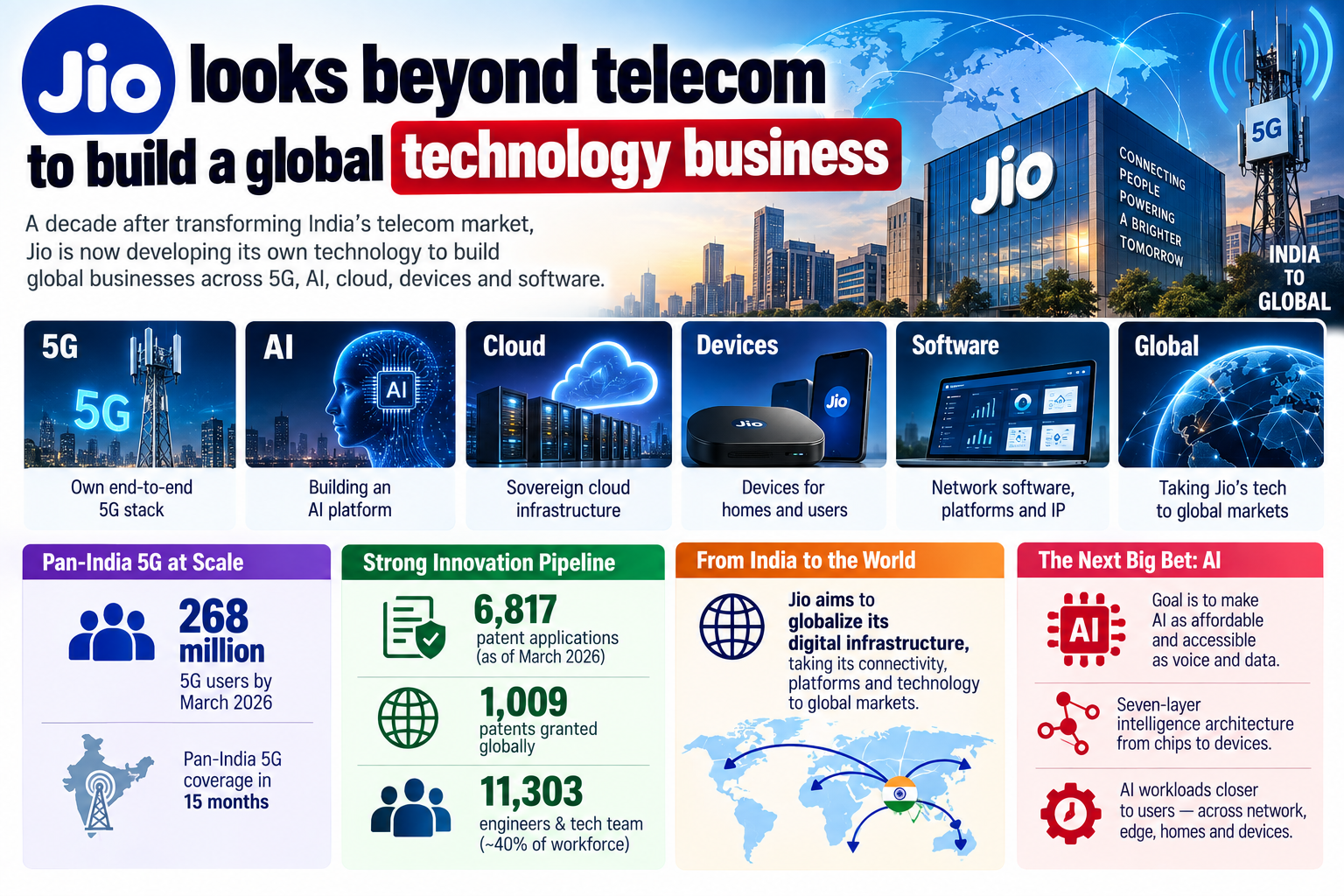
Jio is building its own technology stack
Jio has developed its own 5G core and network-management software and subsequently built an end-to-end 5G stack covering the core network, radio equipment and software.
The scale is significant. Jio achieved pan-India 5G coverage within 15 months of launch and had more than 268 million 5G users by March 2026.
“This vertical integration provides greater control over technology development and innovation cycles, while supporting an efficient operating model,” said Ashwinder Sethi, a partner at Analysys Mason.
The company’s technology development is also reflected in its intellectual property. Jio Platforms and its units had filed 6,817 patent applications as of March 31, covering 4G, 5G, 6G, AI and cloud, with 1,009 patents granted globally.
Jio’s shift from telecom to a global TechCo
Jio Platforms is increasingly positioning its technology capabilities as a business in their own right. The company has built proprietary capabilities across 5G networks, cloud, devices, operating systems, AI and digital applications, with the stated ambition of taking technology developed for its Indian operations into international markets.
The Evolution: From Buying Technology to Building It
Jio’s technology strategy has changed significantly since its entry into India’s telecom market. Instead of relying primarily on external vendors, the company has been building more of the technology that runs its network, including its 5G core, radio systems and network software. This gives Jio greater control over how quickly it can develop, test and deploy new technology.
- Massive 5G Scale: Jio achieved pan-India 5G coverage within 15 months of launching the service. By March 2026, its 5G customer base had reached 268.5 million. With 5G accounting for around 55% of Jio’s wireless data traffic, the network also gives the company a huge real-world environment to test and improve its technology.
- Patents and Technology Workforce: As of March 31, 2026, Jio Platforms and its subsidiaries had filed 6,817 patent applications across areas including 4G, 5G, 6G, AI and cloud technologies, with 1,009 patents granted globally. Its engineering and technology organisation has 11,303 employees, accounting for roughly 40% of its workforce, according to the latest report.
- From Internal Technology to Global Products: Jio’s proprietary technology is no longer being developed only for its own network. The company has indicated that its mobile connectivity, home broadband and managed connectivity stacks are ready for global monetisation. That opens the possibility of offering technology, software and managed services to other telecom operators and enterprises.
Jio wants to turn telecom technology into global products
Jio’s technology could eventually become a business in its own right.
Neil Shah, vice president at Counterpoint Research, said Jio’s strategy is to transform from a traditional telco into a vertically integrated “TechCo” that controls technology from infrastructure to services.
Jio has indicated that its mobile connectivity, home broadband and managed autonomous connectivity stacks are ready for global monetisation.
For investors, this could create a new growth narrative around Jio Platforms if technology developed for its own network can eventually be sold to other operators and enterprises.
Track Live : FII DII Data Today | NSE F&O Lot Size
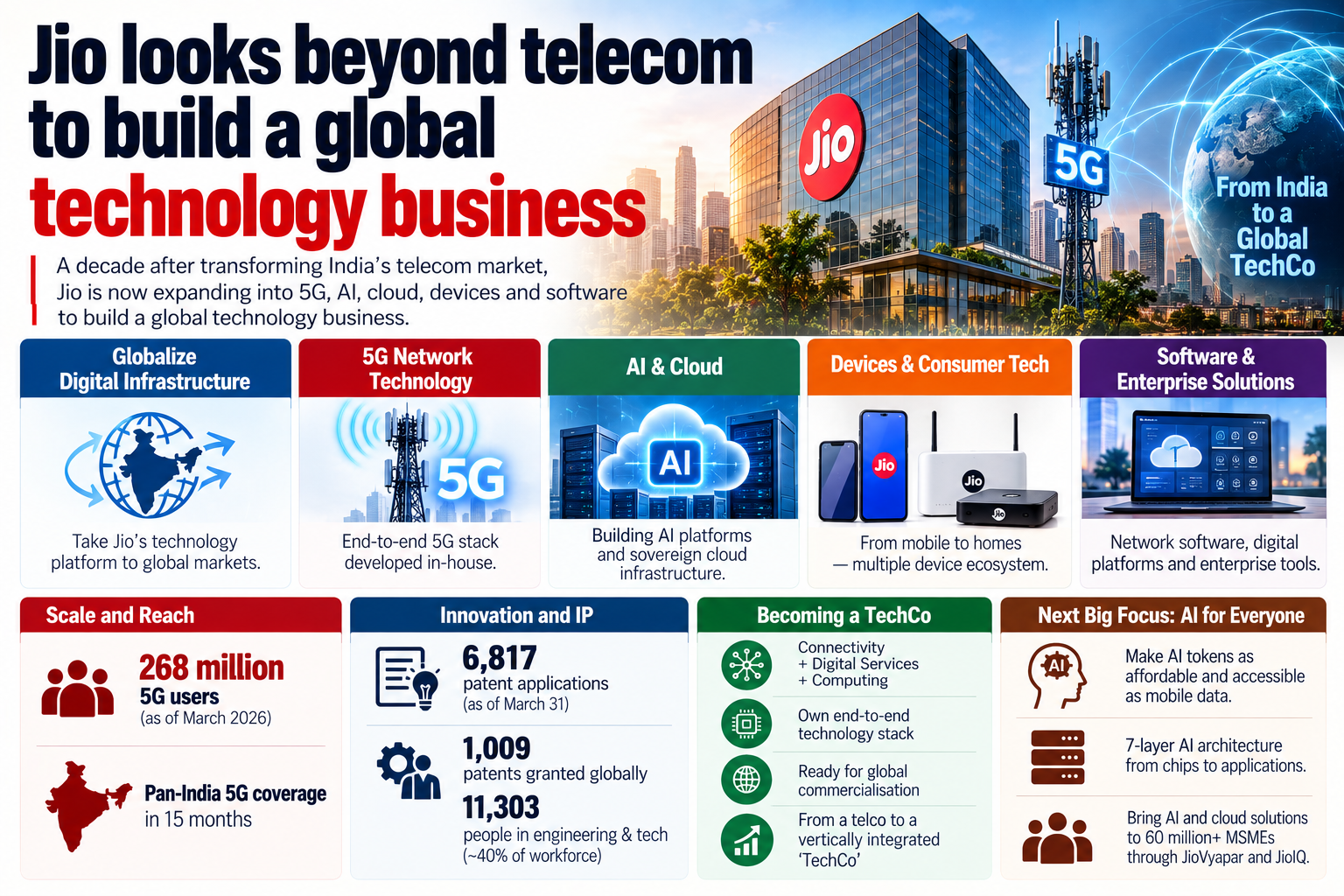
From buying technology to building its own stack
Jio’s strategy has evolved from primarily deploying telecom infrastructure to developing more of the underlying technology itself. Its proprietary stack covers the 5G core, radio, network software and OSS/BSS, giving it greater control over development and deployment.
Jio says its technology can potentially be offered to other telecom operators and enterprises through partnerships, managed services or licensing arrangements in selected overseas markets.
The scale behind this strategy is significant:
- 524.4 million customers served by Jio’s mobile business as of March 31, 2026
- 268.5 million 5G customers
- 6,817 patent applications filed globally
- 1,009 patents granted globally
- 11,303 employees in engineering and technology, around 40% of the workforce
Jio also entered the global top 20 in WIPO’s 2025 PCT patent-applicant ranking, reflecting its increasing patent activity in areas including 5G, 6G, AI, cloud-native platforms and network automation.
AI could become Jio’s next major growth engine
The bigger disruption may come from Jio AI.
At Mobile World Congress in March, Reliance President Mathew Oommen said Jio wants to make AI tokens as affordable and accessible as the company once made voice and mobile data.
The company is developing a seven-layer intelligence architecture spanning physical and chip layers, models, applications, orchestration and devices.
Its approach also focuses on moving AI inference closer to users through edge data centres, enterprises, homes and devices rather than depending entirely on centralised data centres.
Jio is also building an AI and cloud ecosystem
Jio’s cloud and computing ambitions could further expand its technology business.
Neil Shah pointed to the company’s 1-Gigawatt Jamnagar green datacentre roadmap, NVIDIA high-density architectures and platforms such as JioBrain as investments that could reduce dependence on traditional hyperscalers.
Over time, this could position Jio as an Indian “neocloud” player.
Platforms such as JioVyapar and JioIQ, powered by Jio Cloud, could also bring cloud, commerce and AI services to India’s more than 60 million MSMEs.
Read More : FPIs Are Selling Stocks but Buying IPOs: What Are They Up To in India?
Why the 5G network matters
Jio’s nationwide network provides something many technology companies do not have: a live, large-scale environment in which to develop and test technology.
The company says it achieved pan-India 5G coverage within 15 months of launch. By March 2026, it had more than 268 million 5G customers.
That creates the possibility of developing technology internally, deploying it across millions of users, refining it and eventually packaging it for external customers.
What Jio’s technology push means for investors
The Jio story is increasingly moving beyond telecom subscribers and mobile data.
If the company can successfully commercialise its network technology, cloud infrastructure and AI platforms globally, its addressable market could expand substantially.
India’s digital economy is projected to reach $1.4 trillion by FY31, according to Analysys Mason.
For investors, the key developments to watch will be Jio’s global technology monetisation, AI adoption, cloud expansion and the pace at which internally developed technology becomes a standalone business opportunity.