
SEBI CAS Rules May Change: F&O Settlement Could Move to Last 30-Minute VWAP
SEBI May Ease CAS Rules: BSE, NSE and Capital Market Stocks Rise
The market got an early signal on October 6 that could matter far beyond one trading session. SEBI may partly roll back its new Closing Auction Session (CAS) framework, and capital market stocks quickly responded.
Shares of BSE, NSE, Motilal Oswal Financial Services, Angel One and Groww moved higher as traders assessed what the possible rule change could mean for derivatives pricing and market activity.
Track Live : NSE F&O Lot Size | FII DII Data Today
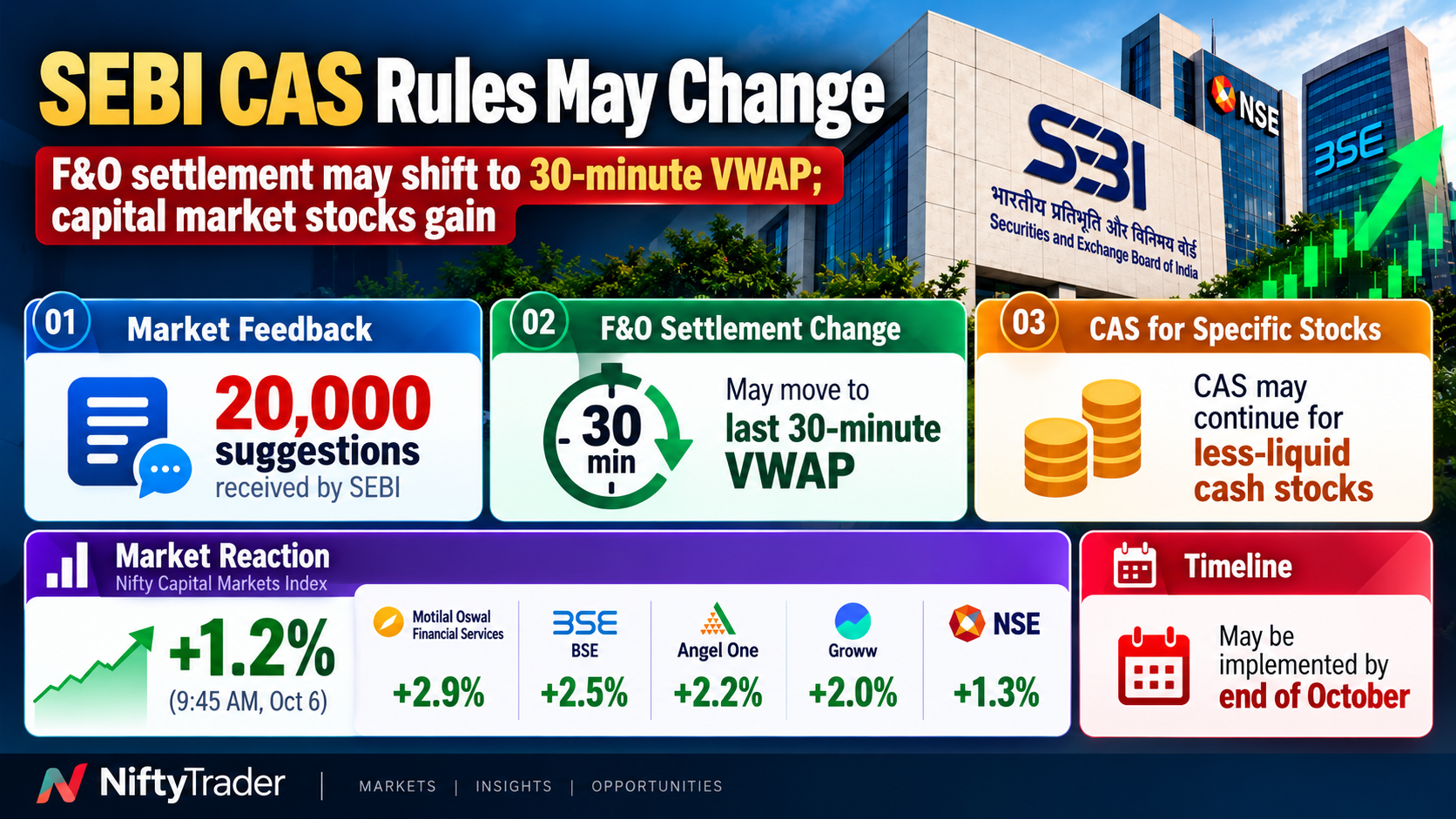
SEBI CAS Rules : Why SEBI is reconsidering the closing auction system
SEBI introduced the CAS mechanism in August for stocks with linked futures and options contracts.
The idea was to use a short auction near the end of the trading session to determine the stock’s closing price. However, the system has reportedly contributed to sharp movements in derivatives prices, particularly on expiry days.
That has prompted SEBI to reconsider parts of the framework.
The regulator said over the weekend that it had received around 20,000 suggestions on changes to the rules after issuing a consultation paper last month.
Sources cited by Reuters said SEBI may now use the last 30-minute VWAP for derivatives pricing instead.
SEBI CAS rules: What is changing?
SEBI is reportedly preparing to partly reverse its recently introduced Closing Auction Session (CAS) mechanism, particularly for the purpose of calculating derivative settlement prices. The change follows sharp expiry-day price movements and extensive feedback from market participants. Reuters reported that SEBI could stop using CAS for derivatives settlement for at least one year and instead return to the VWAP of the final 30 minutes of trading.
Importantly, this is not a complete rollback of CAS. The auction mechanism could continue to determine closing prices for less-liquid underlying stocks in the cash market, while derivatives would use a separate settlement methodology.
What exactly is CAS?
The Closing Auction Session is an auction-based process introduced by SEBI for stocks that have associated futures and options contracts.
Instead of relying solely on continuous trading to establish the closing price, orders are accumulated during a short auction window and matched to determine a closing price.
SEBI introduced the mechanism in August 2026, but the system was followed by concerns about sharp movements in derivative prices around expiry. That prompted the regulator to review how derivative settlement prices should be calculated.
The Proposed Changes: CAS vs. 30-Minute VWAP
SEBI received around 20,000 comments on its consultation paper covering CAS, market timings and derivatives settlement methodologies. The consultation closed on October 3, and SEBI is now expected to finalise the framework.
| Market Segment | Reported / Proposed Mechanism | Why It Matters |
|---|---|---|
| Derivatives (F&O) settlement | 30-minute VWAP | Replaces CAS-based settlement, spreading price discovery across 30 minutes instead of relying on a short auction. |
| Less-liquid cash-market stocks | Closing Auction Session (CAS) | CAS would continue to establish the end-of-day price where continuous trading may not provide sufficient liquidity. |
| CAS for derivatives | Likely paused for at least 1 year | Intended to address sharp expiry-day swings seen after the new mechanism was introduced. |
| Indicative index value during CAS | Likely retained | Feedback indicated that removing it could reduce transparency without necessarily solving manipulation concerns. |
| Regular cash trading | 3:30 p.m. | Feedback favoured retaining the existing timetable. |
| Derivatives trading | 3:45 p.m. | Keeping the timing broadly unchanged could help align derivatives and cash-market price discovery. |
The key distinction is that SEBI is not reportedly scrapping CAS altogether. Instead, the emerging framework separates the cash-market closing price mechanism from the derivatives settlement-price mechanism.
What the possible SEBI rule change means for traders
For traders, the proposed change could reduce the influence of a single closing auction on derivatives settlement prices.
A VWAP-based mechanism would spread price discovery across a longer period instead of relying heavily on one auction.
This could become particularly important on F&O expiry days, when trading volumes and price swings can increase sharply.
For brokers, exchanges and other capital market companies, any rule that improves trading activity and reduces uncertainty around derivatives settlement could influence investor sentiment.
Track Live : Opening Price Clues – What Pre-Market Data Says Today
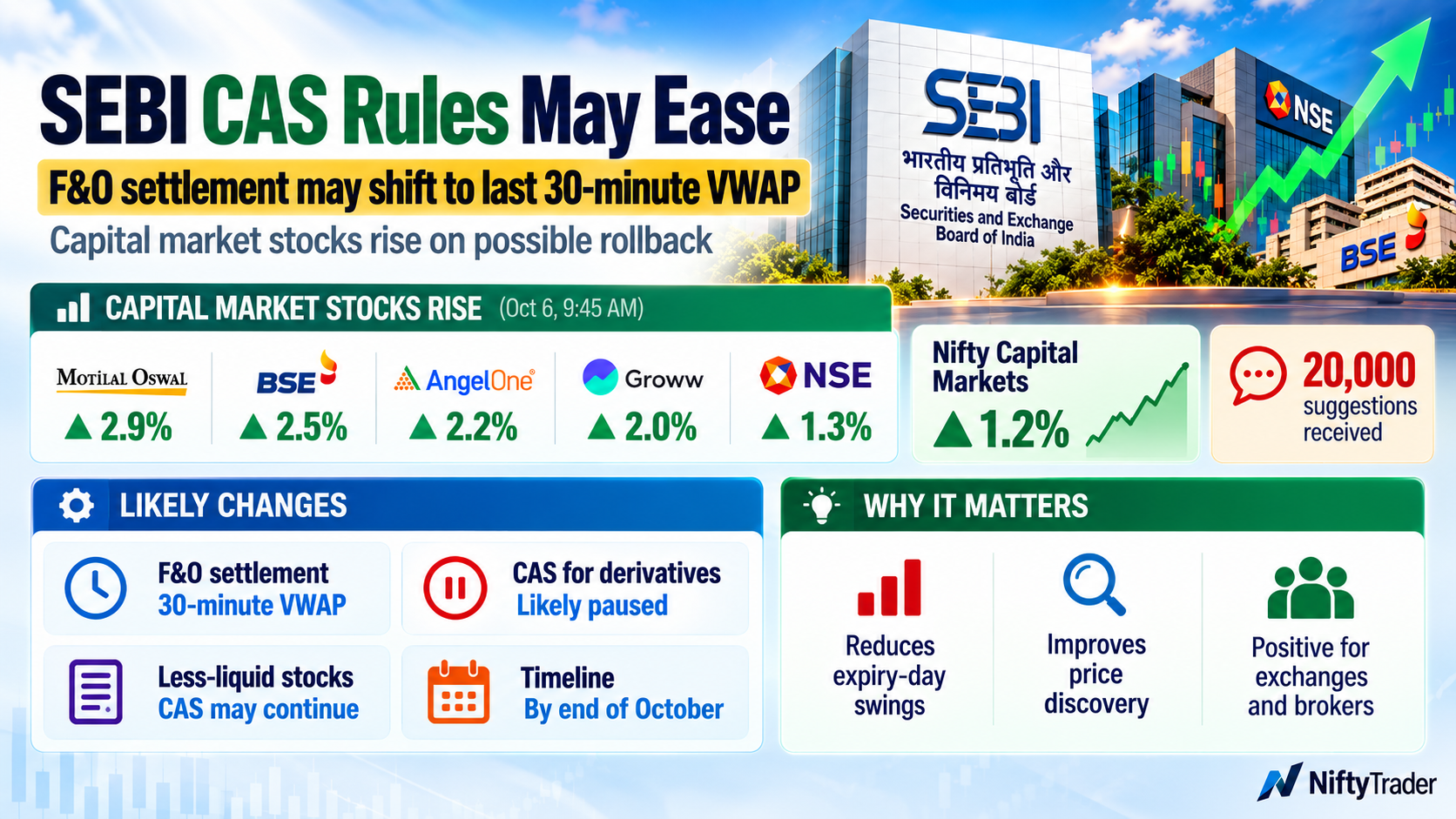
Why did BSE, NSE and capital-market stocks rise?
The market interpreted the reported changes as potentially positive for exchanges and capital-market intermediaries, because a modification of CAS could reduce uncertainty surrounding derivatives settlement and expiry-day trading.
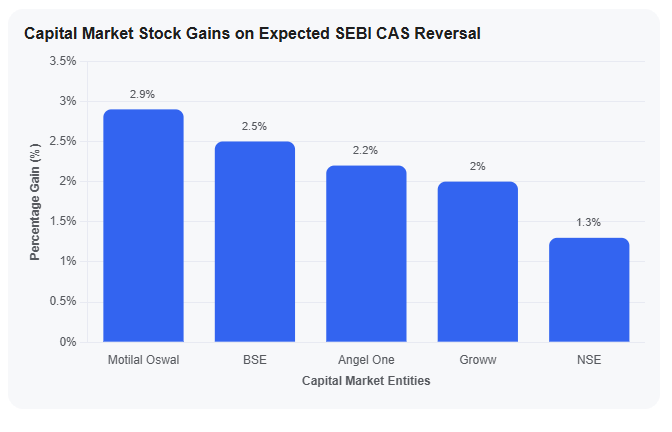
On October 6, the Nifty Capital Markets index was up about 1.2% around 9:45 am, while several stocks posted larger gains:
- Motilal Oswal Financial Services: +2.9%
- BSE: +2.5%
- Angel One: +2.2%
- Groww: +2.0%
- NSE: +1.3% at around ₹1,746
These are the market movements reported at that point in the trading session, rather than full-day returns.
SEBI may keep auctions for less-liquid stocks
The proposed change may not completely remove closing auctions.
According to the report, a closing auction could still be used for underlying stocks where the cash market is less liquid. This means SEBI could adopt a more targeted approach rather than abandoning CAS altogether.
The changes are reportedly expected to be implemented by the end of October.
Read More : TCS Q2 FY27 Results: Stock Down 35% in 2026, Dividend Decision on Oct 8
Here’s what happened today and why traders reacted
At 9:45 am, the Nifty Capital Markets index was up 1.2%. Motilal Oswal Financial Services gained 2.9%, BSE rose 2.5%, Angel One advanced 2.2%, while Groww was up 2%.
Newly listed NSE shares also gained 1.3% to Rs 1,746.
The immediate trigger was a report suggesting that SEBI could stop using closing auctions to calculate derivatives settlement prices for at least a year.
Instead, the regulator may use the volume-weighted average price (VWAP) of the final 30 minutes of trading.
That possibility has put capital market stocks in focus.
What investors should watch from here
SEBI had also proposed changes to information displayed during the 10-minute CAS window.
One proposal was to stop publishing the indicative value of an index while continuing to publish indicative prices for individual stocks.
However, feedback reportedly showed concerns that removing the index value could reduce transparency because sophisticated trading desks can independently reconstruct it.
The broader feedback also favoured keeping the existing timetable, with cash-market trading until 3:30 pm and derivatives trading until 3:45 pm.
For investors, the key takeaway is that the final SEBI decision could influence trading volumes, derivatives activity and sentiment toward BSE, NSE, brokers and other capital market stocks.
The October 6 rally shows that traders are already treating a possible adjustment to CAS rules as a positive development, but investors will now watch closely for SEBI’s final framework.