
India Just Signed a US-Led Pact excess capacity initiative amid Section 301 scrutiny
India has joined a 15-country US-led initiative on excess manufacturing capacity, putting its industrial ambitions under a sharper international spotlight. The move comes as Washington separately examines India’s manufacturing policies under a US Section 301 investigation.
The initiative covers strategically important sectors such as automobiles, electric vehicles, batteries, chemicals, semiconductors and solar panels. For India, the key question is whether greater cooperation with the US can protect its export interests without creating additional pressure on its domestic manufacturing push.
Track Live : Opening Price Clues – What Pre-Market Data Says Today
India Just Signed a US-Led Pact effort to address manufacturing excess
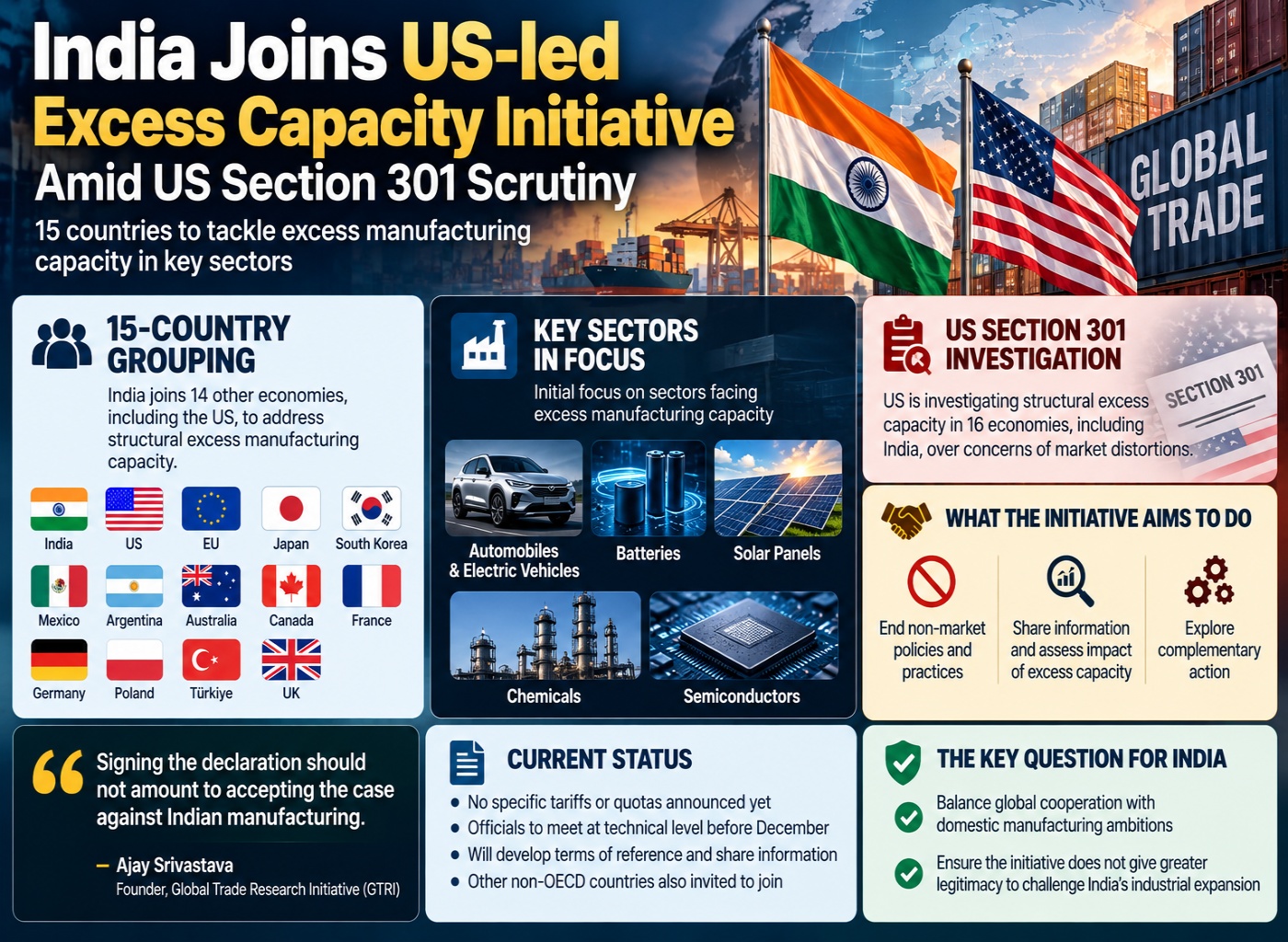
India was among 14 economies that joined the US in signing a Joint Ministerial Statement on October 7, following discussions at the G20 Trade Ministers’ meeting in Milwaukee on September 30 and October 1.
The grouping also includes the European Union, Japan, South Korea, Mexico, Argentina, Australia, Canada, France, Germany, Poland, Türkiye and the United Kingdom.
The countries have agreed to work together on policies and practices that create market distortions and contribute to structural excess manufacturing capacity.
The statement said cooperation, information sharing and complementary action could make individual efforts to protect industries, workers and economies more effective.
The Section 301 angle is the biggest risk
The US has already launched a Section 301 investigation examining structural excess capacity and production across multiple economies, including India.
The US investigation argues that government interventions can sustain production beyond what market demand would justify, resulting in excess supply, trade surpluses and pressure on manufacturing in other countries.
Therefore, India’s participation in the initiative should not automatically be interpreted as India accepting the US case against its manufacturing policies.
In fact, India’s position remains that its industrial expansion is fundamentally different from state-supported overcapacity that results in dumping.
That gives New Delhi an important negotiating objective: cooperate on genuine global distortions without surrendering policy space for industrialisation.
The Policy Dilemma for New Delhi
- The Irony of Section 301: India joined this US-led coalition while simultaneously being a subject of the active US Section 301 investigation into its own industrial and manufacturing policies launched in March.
- Defending Domestic Ambitions: New Delhi has firmly maintained that its manufacturing capacity (boosted by policies like Production Linked Incentive schemes) is built to meet legitimate global and domestic demand, not to distort markets.
- The Consistency Question: Trade think tanks like the Global Trade Research Initiative (GTRI) warn that India must ensure this signature isn’t weaponized by Washington to give legitimacy to future challenges against India’s own domestic industrial expansion.
Automobiles, batteries and semiconductors take centre stage
The initiative will initially concentrate on automobiles and electric vehicles, batteries, chemicals, foundational semiconductors and solar panels.
Dedicated sectoral platforms will be created to exchange information and examine possible joint action. The focus will be on understanding how excess capacity affects domestic industries, workers and supply chains.
For India, these are particularly important areas because the country is simultaneously trying to expand domestic manufacturing and strengthen its position in global supply chains.
Track Live : Gap Up / Gap Down Stocks – Today’s NSE Opening Gaps

India faces a delicate balancing act
The development becomes more significant because India itself is under a US Section 301 investigation into structural excess capacity. The US launched the investigation in March covering 16 economies.
Trade policy think tank Global Trade Research Initiative said India must be cautious about how it approaches the new arrangement.
“The initiative also exposes a question of consistency,” GTRI founder Ajay Srivastava said, pointing to concerns about trade-rule violations and market distortions.
He added that participating in the initiative should not weaken India’s position on its own manufacturing policies.
“Signing the declaration should not amount to accepting the case against Indian manufacturing,” Srivastava said.
Read More : Stock Market Crash Today: Why Sensex and Nifty Are Falling Sharply Amid RBI Rate Hike and FII Selling
Potential impact on Indian sectors
| Sector | Potential impact | Investor implication |
|---|---|---|
| Auto & EVs | Greater scrutiny of production incentives, exports and capacity expansion | Monitor companies with aggressive capacity-expansion plans |
| Batteries | Global supply-demand imbalance could attract greater trade scrutiny | Domestic demand and localisation become more important |
| Solar | Potential pressure on pricing and imports | Domestic manufacturers could benefit if trade barriers increase, but export opportunities may face greater scrutiny |
| Chemicals | Excess global supply can pressure prices and margins | Companies with differentiated products may be better positioned |
| Semiconductors | Strategic importance increases as countries seek supply-chain diversification | Potential long-term beneficiary for Indian manufacturing |
| Capital goods | New manufacturing investments could continue if India retains policy support | Positive for equipment and industrial-capex companies |
US wants action against production beyond global demand
US Trade Representative Jamieson Greer said the initiative is aimed at addressing production that exceeds global demand and is supported by government policies.
“Left unchecked, these issues will continue to cripple domestic industries, displace local production,” Greer said.
The US argues that persistent excess capacity can hurt domestic producers and workers by creating distortions in global markets.
No new tariffs or quotas announced so far
Importantly for businesses and investors, the initiative has not introduced any new tariffs, quotas or other trade restrictions.
Senior officials are expected to hold technical-level discussions before December. These talks will focus on developing terms of reference, sharing non-confidential data, assessing the impact of excess capacity and identifying gaps in available information.
Countries outside the OECD have also been invited to participate.
What does the move mean for Indian industry?
For India, the immediate impact is likely to be more about trade policy and future manufacturing conditions than an immediate change in tariffs or market access.
Indian companies in automobiles, EVs, batteries, chemicals, semiconductor manufacturing and solar equipment will need to watch the discussions closely. Greater cooperation could improve coordination with major trading partners, but investors will also be watching whether the US Section 301 scrutiny eventually leads to additional trade pressure.
The bigger test for New Delhi will be maintaining international cooperation while ensuring that India’s domestic manufacturing ambitions and industrial policies remain protected.