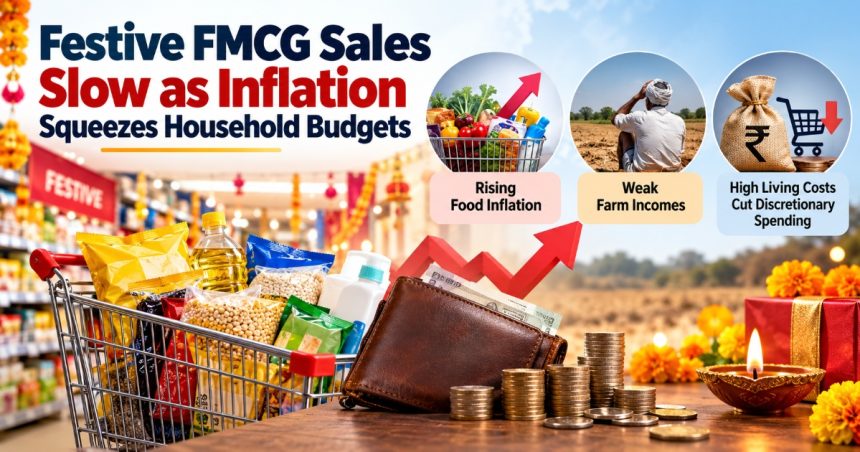
5.54% Inflation Bites Before Diwali: FMCG Festive Sales Slow as Inflation Squeezes Household Budgets
India’s festive season is usually a crucial period for consumer goods companies, but this year, the expected shopping rush is yet to arrive. Rising food prices, pressure on household budgets and weak rural incomes are keeping consumers cautious, raising concerns about the growth outlook for the fast-moving consumer goods (FMCG) sector.
FMCG companies and distributors have reported subdued sales since Ganesh Chaturthi, with demand failing to pick up during Navratri. The slowdown is particularly visible in rural markets and smaller towns, where weaker farm incomes and uneven rainfall are adding to financial pressure.
The concern for investors is that even everyday essentials are showing signs of softer demand. If the trend continues through Diwali, FMCG companies could miss the festive-season boost that has traditionally supported quarterly sales.
Track Live : Opening Price Clues – What Pre-Market Data Says Today
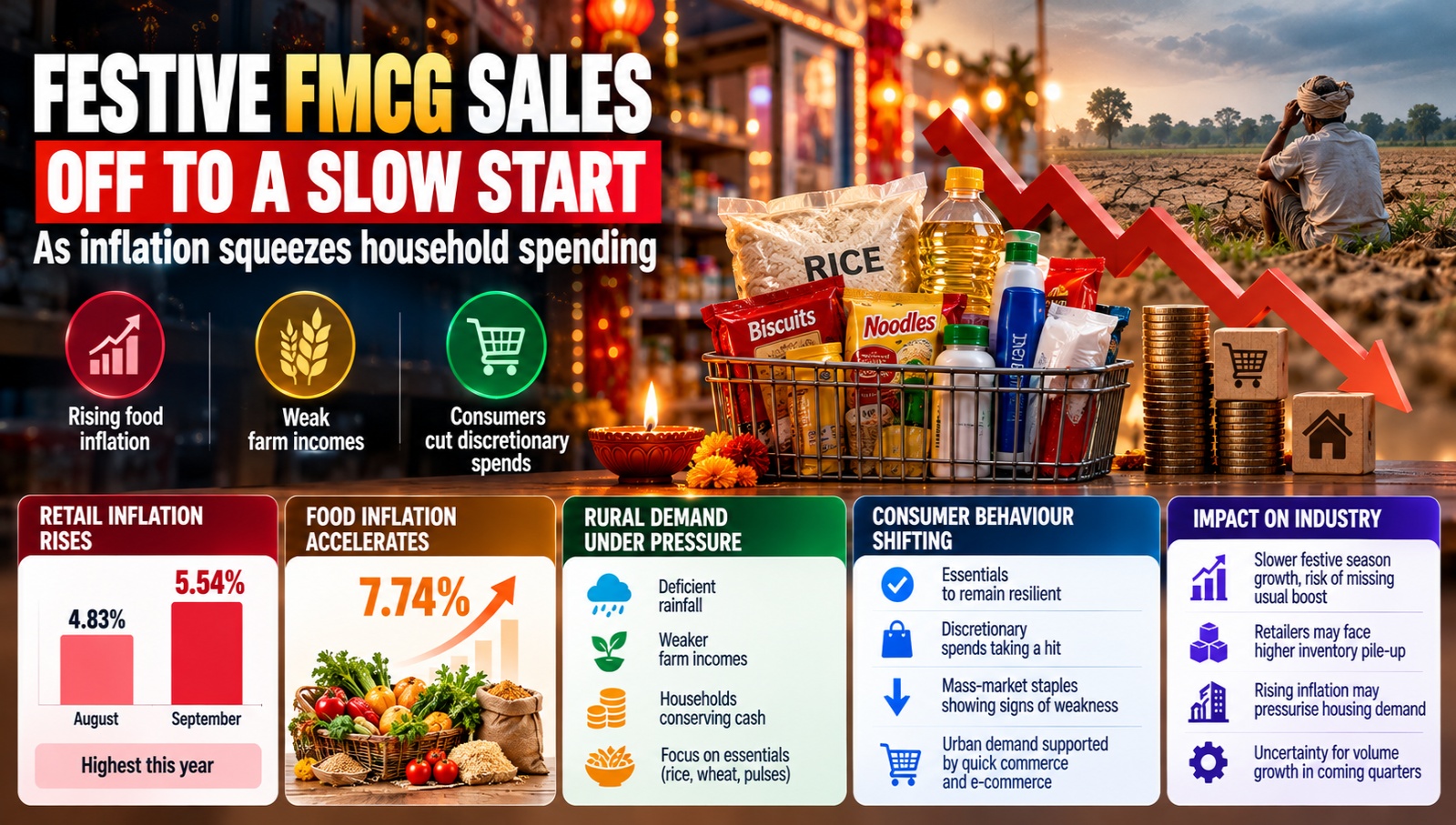
5.54% Inflation Bites Before Diwali: Rising food inflation is forcing consumers to cut spending
Higher living costs are emerging as a major challenge for India’s consumer goods industry. Retail inflation climbed to 5.54% in September from 4.83% in August, reaching its highest level of the year. Food inflation accelerated to 7.74%, according to the data cited in the report.
Dhairyashil Patil, president of the All India Consumer Products Distributors Federation (AICPDF), said the market slowdown began around Ganesh Chaturthi.
“We expected demand to pick up during Navratri, but that does not seem to be happening,” Patil said.
He also attributed the pressure to price increases of 25–30% without a corresponding rise in salaries. According to him, subsequent price increases have eroded the benefits consumers received from earlier GST cuts.
For households, this means a larger share of monthly income is going towards essentials, leaving less room for discretionary purchases.
Key Developments at a Glance: Inflation and Monsoon Pressure on FMCG Demand
India’s September 2026 inflation data and deficient monsoon highlight three important pressures on household budgets: rising retail prices, faster food-price increases and the risk of weaker agricultural incomes. These factors could weigh on festive-season consumption, particularly in rural markets and smaller towns.
1. Key economic indicators
| Indicator | Latest figure | Previous figure / benchmark | Why it matters |
|---|---|---|---|
| Retail inflation (September 2026) | 5.54% | 4.83% in August | Overall household expenses are rising faster. |
| Food inflation (September 2026) | 7.74% | 5.97% in August | Food purchases take up more of household budgets. |
| Rural retail inflation | 6.08% | 5.24% in August | Rural consumers face particularly strong price pressures. |
| Urban retail inflation | 4.88% | 4.31% in August | City households are also experiencing higher inflation. |
| RBI inflation target | 4% | Upper tolerance limit: 6% | Inflation is above the central bank’s target and closer to its upper limit. |
| Southwest monsoon rainfall | 12.6% below normal | Long-period average | Rainfall deficiency may affect crop output, farm earnings and future food supplies. |
Sources: Ministry of Statistics and Programme Implementation (MoSPI), RBI reporting and the India Meteorological Department (IMD), as reported by Reuters, Financial Express and Hindustan Times.
Why Diwali sales could determine the FMCG sector’s outlook
The remaining festive shopping period has become increasingly important for consumer goods manufacturers and distributors.
Patil warned that if demand remains subdued through Diwali, FMCG companies may struggle to achieve the double-digit volume growth in the third quarter that has been typical over the past eight to ten years.
Distributors of established brands, including Hindustan Unilever and Dabur, have also reported a slower-than-expected festive sales pickup.
A distributor cited by Moneycontrol said rising expenses, including petrol and milk prices, were straining household budgets despite the usual seasonal increase in purchases.
The slowdown could also create inventory challenges. Retailers may be left holding unsold products, particularly from newer brands that have expanded into traditional retail channels.
Santosh Sreedhar, partner at Avalon Consulting, said excess inventory could be gradually cleared during the winter, Christmas and New Year periods. However, he cautioned that estimating actual consumer purchases remains difficult.
Track Live : NSE Option Chain — Live | BSE Option Chain — Live Sensex & Bankex Options Data Today
Retail inflation rises to a 23-month high
-
What happened: Retail inflation increased by 0.71 percentage points, from 4.83% in August to 5.54% in September.
-
Why it matters: Consumers need to spend more to maintain the same level of household consumption, leaving less money for savings and non-essential purchases.
-
FMCG impact: Households may switch to cheaper brands, smaller packs or discounted products.
-
Policy implication: Inflation is approaching the RBI’s 6% upper tolerance limit, increasing pressure on monetary policy.
Food inflation accelerates to 7.74%
-
What happened: Food inflation rose from 5.97% in August to 7.74% in September.
-
Major price pressures: Onion inflation reached 108.09% year-on-year, garlic inflation was 54.62%, and ginger prices rose 62.85%.
-
Consumer impact: Higher grocery bills can reduce discretionary spending on packaged snacks, personal care products and other non-essential FMCG categories.
-
Important qualification: Not every food item became more expensive; potato and tomato prices remained below their year-earlier levels.
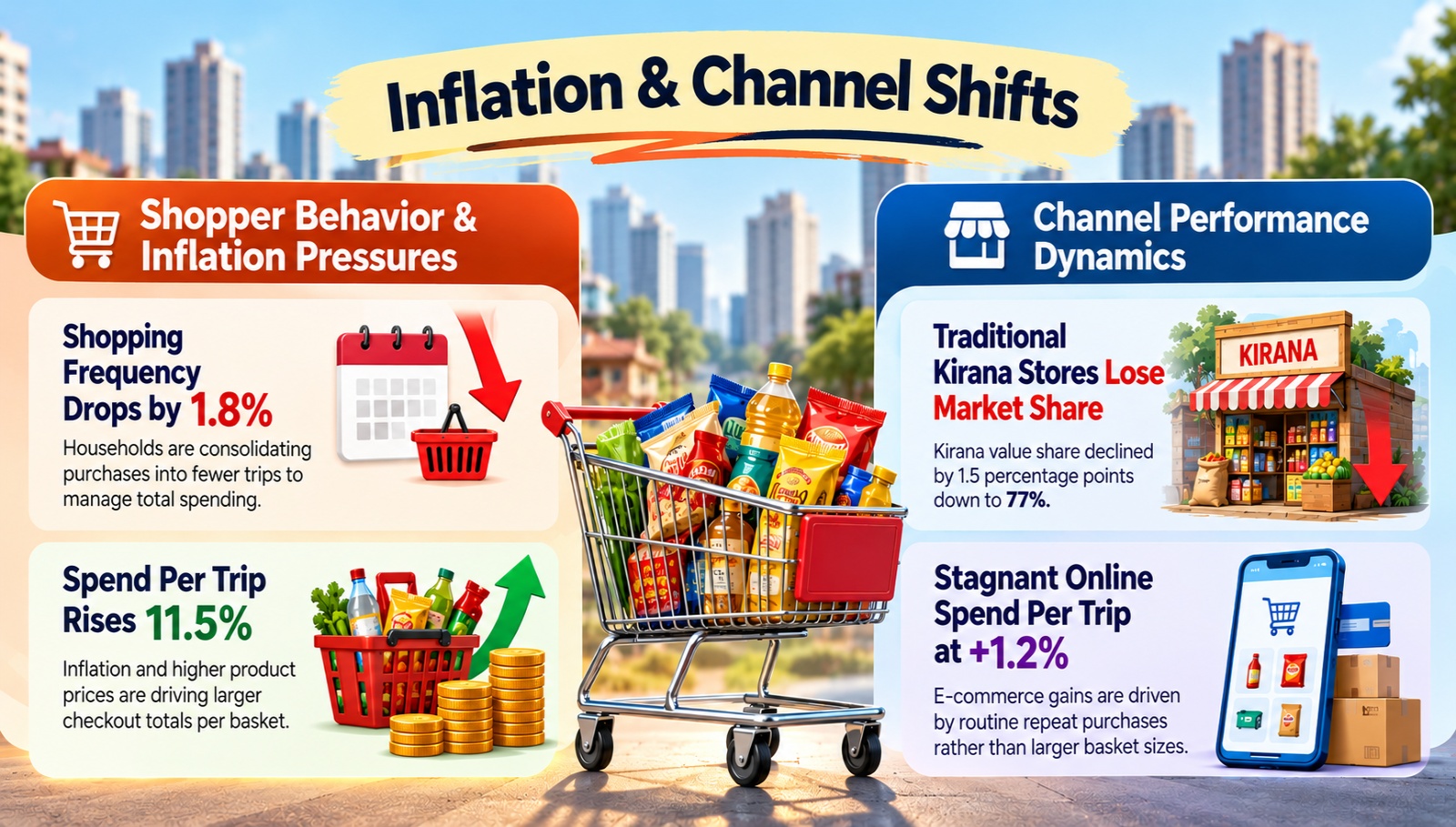
Rural demand remains the biggest concern for FMCG companies
Rural consumption has supported FMCG growth in recent quarters, but that momentum is now facing fresh challenges. Deficient rainfall, concerns over agricultural earnings and rising prices are making rural households more cautious about spending.
Mayank Shah, chief marketing officer at Parle Products, said demand for essential products was unlikely to decline significantly, but discretionary categories could face greater pressure.
“Wallet share for discretionary spend may reduce, especially in the rural areas as farm incomes come under pressure due to monsoon deficit,” Shah said. He expects high single-digit growth during the ongoing festival season.
Sandeep Ghosh, business head for spices at DS Group, which makes Pulse candy and Catch spices, also pointed to softer volume growth in mass-market staples.
He attributed the weakness to uneven rainfall, local economic pressures and cautious household spending amid higher raw material costs. However, he noted that quick commerce and e-commerce were helping sustain urban demand.
Rural inflation is higher than urban inflation
| Indicator | Rural India | Urban India |
|---|---|---|
| Retail inflation | 6.08% | 4.88% |
| Food inflation | 8.06% | 7.18% |
| Food and beverages weight in CPI | 42% | 30.3% |
Read More : Rupee Gains 2% in 5 Days: How RBI’s Forex Clampdown Is Paying Off
Weak farm activity could extend the consumption slowdown
Agricultural conditions are adding to the uncertainty surrounding rural demand. According to a Dun & Bradstreet India white paper, kharif sowing as of October 5 was 1.1% lower than a year earlier, while foodgrain acreage declined 1.6%.
Rice acreage fell 3.5% year-on-year, while maize acreage declined 2.9%. Lower agricultural production could affect farm earnings and purchasing power, while reduced maize availability may also create challenges for industries such as poultry, livestock, aquaculture, processed foods and ethanol.
The combined effect could extend beyond the festive season if rural incomes remain under pressure.
Southwest monsoon ends with a 12.6% rainfall deficit
-
Rainfall recorded: Approximately 759.4 mm during June–September 2026.
-
Long-period average: Approximately 868.6 mm.
-
Shortfall: Around 109 mm below the benchmark.
-
Agricultural concern: Lower rainfall and depleted soil moisture could affect crop yields, reservoir levels and the next rabi sowing season.
-
Consumption risk: If farm earnings weaken, rural households may postpone purchases of discretionary goods.
What the three indicators mean together
| Economic pressure | Immediate effect | Possible FMCG consequence |
|---|---|---|
| Higher retail inflation | Household purchasing power comes under pressure | Slower sales volumes |
| Faster food inflation | More income goes towards groceries | Lower spending on discretionary products |
| Deficient monsoon | Agricultural income and crop risks increase | Weaker rural demand and greater uncertainty |
What FMCG demand means for stock market investors
For investors tracking FMCG stocks, the immediate focus will be on sales volumes, pricing power, margins and management commentary in upcoming earnings updates.
Companies with strong distribution networks, affordable product portfolios and the ability to protect volumes may be better positioned to navigate weaker consumption. However, persistent inflation and higher input costs could pressure margins where companies cannot fully pass on expenses to consumers.
Investors should also watch whether established companies such as Hindustan Unilever and Dabur report weaker-than-expected demand or signs of inventory accumulation. Slower volume growth could affect earnings expectations and influence sector valuations.
The inflation pressure may also affect housing demand. Vivek Rathi, national director of research at Knight Frank India, said sustained inflation could make households more cautious about large purchases and potentially weaken housing affordability if borrowing costs rise. He added that investment-led property demand could remain relatively resilient