
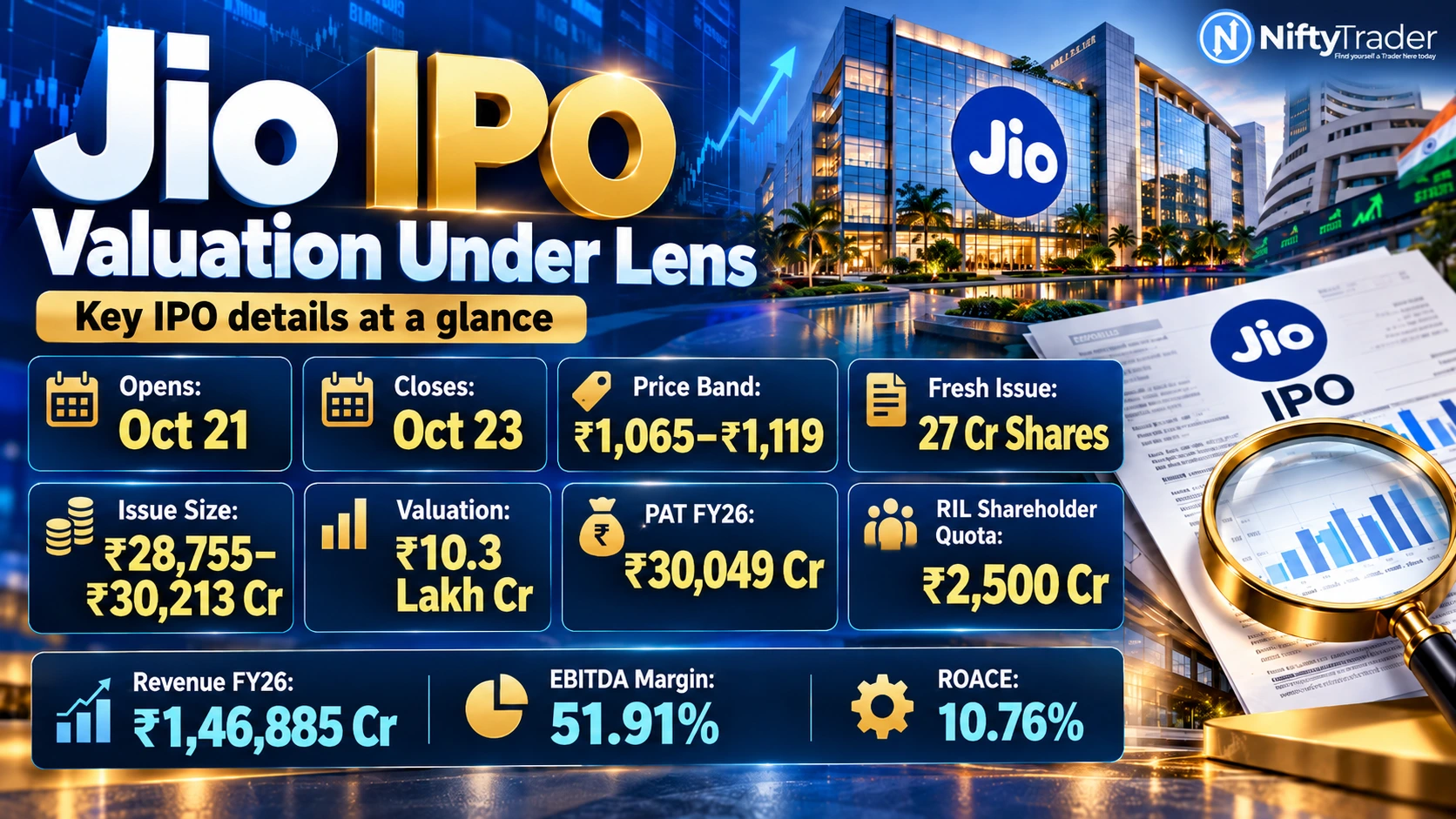
Jio Platforms’ reported ₹10.3 lakh crore valuation faces a test as FY26 profit rises 15.1%, but return on average capital employed falls to 10.76%. The ₹2,500 crore RIL shareholder quota adds another key detail for investors.
Jio Platforms’ IPO now has a schedule, but the bigger question is how much investors should pay for its growth. The company reported FY26 profit after tax of ₹30,049.1 crore, an EBITDA margin of 51.91% and lower net leverage. Yet its return on average capital employed fell to 10.76% from 12.50% a year earlier.
That contrast matters as Jio Platforms prepares for a public valuation of around ₹10.3 lakh crore, according to reports. Investors are being offered exposure to one of India’s largest digital businesses, but the earnings multiple and capital-efficiency trend leave room for debate over whether the reported pricing adequately rewards shareholders for the risks.
The Jio IPO will open for subscription on October 21 and close on October 23, following anchor investor bidding on October 19. The offer comprises up to 27 crore fresh equity shares and includes a reservation of up to ₹2,500 crore for eligible Reliance Industries (RIL) shareholders. The reported price range is ₹1,065–₹1,119 per share, subject to formal price-band confirmation.
Jio IPO Dates, Price Band and Issue Size
Jio Platforms filed its red herring prospectus (RHP) on October 14, taking the proposed listing a step closer to the market. Reuters reported the schedule and pricing range following the filing.
| IPO detail | Current information |
|---|---|
| RHP filing | October 14, 2026 |
| Anchor investor bidding | October 19, 2026 |
| IPO opening date | October 21, 2026 |
| IPO closing date | October 23, 2026 |
| Fresh issue | Up to 27 crore shares |
| Reported price band | ₹1,065–₹1,119 |
| Potential issue size | ₹28,755–₹30,213 crore |
| RIL shareholder reservation | Up to ₹2,500 crore |
| Eligible employee reservation | Up to ₹500 crore |
| Expected listing | October 28, subject to confirmation |
The price band and issue-size figures should be treated as reported terms until the formal price-band announcement confirms them. The issue-size estimates are NiftyTrader calculations based on 27 crore shares multiplied by the reported prices.
At ₹1,119 per share, the potential proceeds would reach approximately ₹30,213 crore. At ₹1,065, the amount would be about ₹28,755 crore.
At the upper end, the offering would surpass Hyundai Motor India’s ₹27,870 crore IPO in 2024, potentially making Jio the largest public issue in India’s market history.
Also Read: Jio Platforms IPO: ₹30,200 Crore Issue Targets ₹10.3 Lakh Crore Valuation
₹30,049 Crore Profit: Why Capital Returns Matter More
Jio Platforms’ FY26 financial performance provides the starting point for evaluating the reported valuation. The company’s draft-prospectus disclosures show that revenue, EBITDA and profit increased, while net leverage declined.
| Financial metric | FY26 | FY25 |
|---|---|---|
| Revenue from operations | ₹1,46,885.3 crore | ₹1,28,218.4 crore |
| EBITDA | ₹76,255.4 crore | ₹64,170 crore |
| EBITDA margin | 51.91% | 50.05% |
| Profit after tax | ₹30,049.1 crore | ₹26,109 crore |
| ARPU per month, exit-quarter measure | ₹214 | ₹206.2 |
| Net leverage | 0.36x | 0.71x |
| Return on average capital employed | 10.76% | 12.50% |
Source: Jio Platforms’ draft prospectus financial disclosures hosted on SEBI’s website. Figures should be cross-checked against the latest filed offer document.
Revenue from operations rose approximately 14.6% year on year, while profit after tax increased about 15.1%. EBITDA grew approximately 18.8%, lifting the margin to 51.91% from 50.05%.
The balance sheet also improved. Net leverage, measured as net debt divided by EBITDA, declined to 0.36x from 0.71x. EBITDA less cash capital expenditure increased to ₹42,071.1 crore from ₹19,902 crore.
However, return on average capital employed moved in the opposite direction, declining from 12.50% to 10.76%.
That does not, by itself, establish that Jio is overvalued. It does raise a question about how effectively the company is converting its substantial infrastructure and capital base into returns. Investors will need to assess whether future earnings growth, monetisation and cash generation can improve that measure.
At the reported valuation of ₹10.3 lakh crore, Jio’s market value would equal approximately 34.3 times FY26 profit after tax. This is NiftyTrader’s indicative calculation using the reported valuation and FY26 earnings, not an officially stated IPO P/E ratio.
The valuation debate, therefore, is not only about subscriber growth. It is also about whether Jio can sustain its margins and turn that scale into stronger returns on capital.
₹27,500 Crore Debt Repayment: Where the IPO Money Goes
The reported offer is entirely a fresh issue, without an offer-for-sale component. Existing shareholders are not using this issue to sell their holdings to the public.
According to the draft-prospectus disclosures, up to ₹27,500 crore of net proceeds is earmarked for repaying or prepaying borrowings, mainly associated with Reliance Jio Infocomm Limited. The balance is intended for general corporate purposes.
This distinction is important. Jio Platforms is the company preparing to list, while Reliance Jio Infocomm operates the core telecom business associated with the stated borrowing-repayment plan.
Debt reduction could lower financing costs and provide greater financial flexibility. However, because most of the planned proceeds are directed towards borrowings rather than a dedicated expansion programme, investors will also be assessing the growth prospects of the existing business.
The prospectus summary reports 524.4 million customers as of March 31, 2026, alongside rising average revenue per user and increasing cash generation. Continued subscriber monetisation, tariff changes and expansion in broadband and digital services will help determine whether the company can sustain its growth beyond the IPO.
Jio IPO RIL Shareholder Quota: Who Can Apply?
The Jio IPO includes a reservation of up to ₹2,500 crore for eligible Reliance Industries shareholders and up to ₹500 crore for eligible employees.
The shareholder category is relevant because Jio Platforms is currently part of Reliance Industries, whose investors have long looked for greater visibility into the value of the group’s digital and telecom business.
Reports indicate that eligibility depends on meeting the RIL shareholder criteria linked to the October 14 RHP filing date. Investors should read the filed RHP carefully to establish the qualifying holding date, application limits and other eligibility conditions. Purchasing RIL shares before the Jio IPO opens should not be assumed to confer eligibility.
The reservation is not a guarantee of allotment. If eligible applications exceed the shares available, allotment will be governed by the applicable offer rules.
Investors should also avoid relying on conflicting lot-size figures circulating on IPO-tracking websites. The final lot size and application amount should be taken from the formal price-band announcement.
Jio IPO GMP: Why Unofficial Premiums Need Caution
Jio IPO grey market premium (GMP) estimates have attracted attention ahead of the subscription window. On October 14, reported readings varied around ₹210–₹218 per share across trackers and news coverage.
These figures are unofficial. They are not exchange-published prices, and differences can arise from the source and the time at which a quote is recorded.
A premium over the reported upper price band may indicate speculative interest, but it cannot establish the final listing price or guarantee a listing gain. GMP can change sharply as the price band, institutional demand, market conditions and subscription figures become clearer.
Three indicators need to be kept separate:
- GMP: An unofficial, potentially volatile sentiment measure.
- IPO subscription: Applications recorded during the actual offer period.
- Listing price: The market-determined price once the shares begin trading.
For Jio, the valuation question makes that distinction particularly important. Strong unofficial demand does not automatically make a reported price attractive relative to earnings or capital returns.
Check Live: Jio Platforms IPO
Will Jio’s Listing Unlock Value for RIL Shareholders?
A separate listing could give Jio Platforms an independent market valuation, allowing investors to assess its contribution to Reliance Industries more directly.
But value visibility and value creation are not the same thing.
Reliance Industries is expected to retain a substantial stake after the fresh issue. The benefit for RIL shareholders will depend on Jio’s final valuation, its post-listing performance and the market’s assessment of Reliance’s other businesses and obligations.
A small public float can also limit immediate value unlocking. Even after listing, Jio’s market price may not eliminate the holding-company discount applied to Reliance Industries.
The IPO could make comparisons easier and bring greater transparency to the conglomerate’s digital operations. Whether that results in a sustained re-rating of RIL shares remains uncertain.
What Investors Should Watch Before October 21
The next milestones will provide more concrete evidence about the offer.
Price-band announcement: The formal notice should settle the issue price range, lot size and final issue calculations. Valuation estimates based on the currently reported band may need updating.
October 19 anchor book: Institutional participation will provide an early indication of demand, although it will not establish the final subscription outcome.
October 21–23 subscription: Demand across qualified institutional buyers, non-institutional investors, retail investors and eligible RIL shareholders will help show how different investor categories respond to the pricing.
Expected listing: October 28 has been reported as the anticipated listing date, but investors should look for definitive confirmation in the applicable offer schedule.
Broader market conditions will matter as well. Foreign institutional selling, domestic institutional buying and wider equity-market volatility can influence appetite for a large public offering. Readers can follow the changing institutional-flow picture through the NiftyTrader FII-DII Tracker.
Jio’s subscriber scale, higher ARPU, stronger EBITDA margin and lower leverage support its growth case. The counterpoint is its declining return on capital employed and a reported valuation that already reflects substantial earnings power.
The price-band notice and anchor book will provide the next evidence. Ultimately, the test for Jio Platforms is whether future earnings and cash generation can justify the valuation; for RIL shareholders, it is whether a separate listing translates into lasting value for the parent company.
Read Next: Transformers & Rectifiers’ Q2 Boom Leaves One Test: Can ₹7,237 Crore Become Revenue?
Disclaimer: This article is for informational and educational purposes only and is not investment advice or a recommendation to apply for an IPO. Reported IPO terms, unofficial grey-market premiums and valuation estimates can change. Investors should read the final offer documents and assess the risks before making an investment decision.