
Axis Bank Q2 FY27 Results: Shares Fall 4% After Mixed Q2 Earnings
Axis Bank shares tumbled 4% on Monday, October 19, emerging as the top loser on both the Nifty 50 and Bank Nifty after the private sector lender announced its Q2 FY27 results. Despite strong year-on-year profit growth, concerns about margins, operating expenses and funding requirements weighed on investor sentiment.
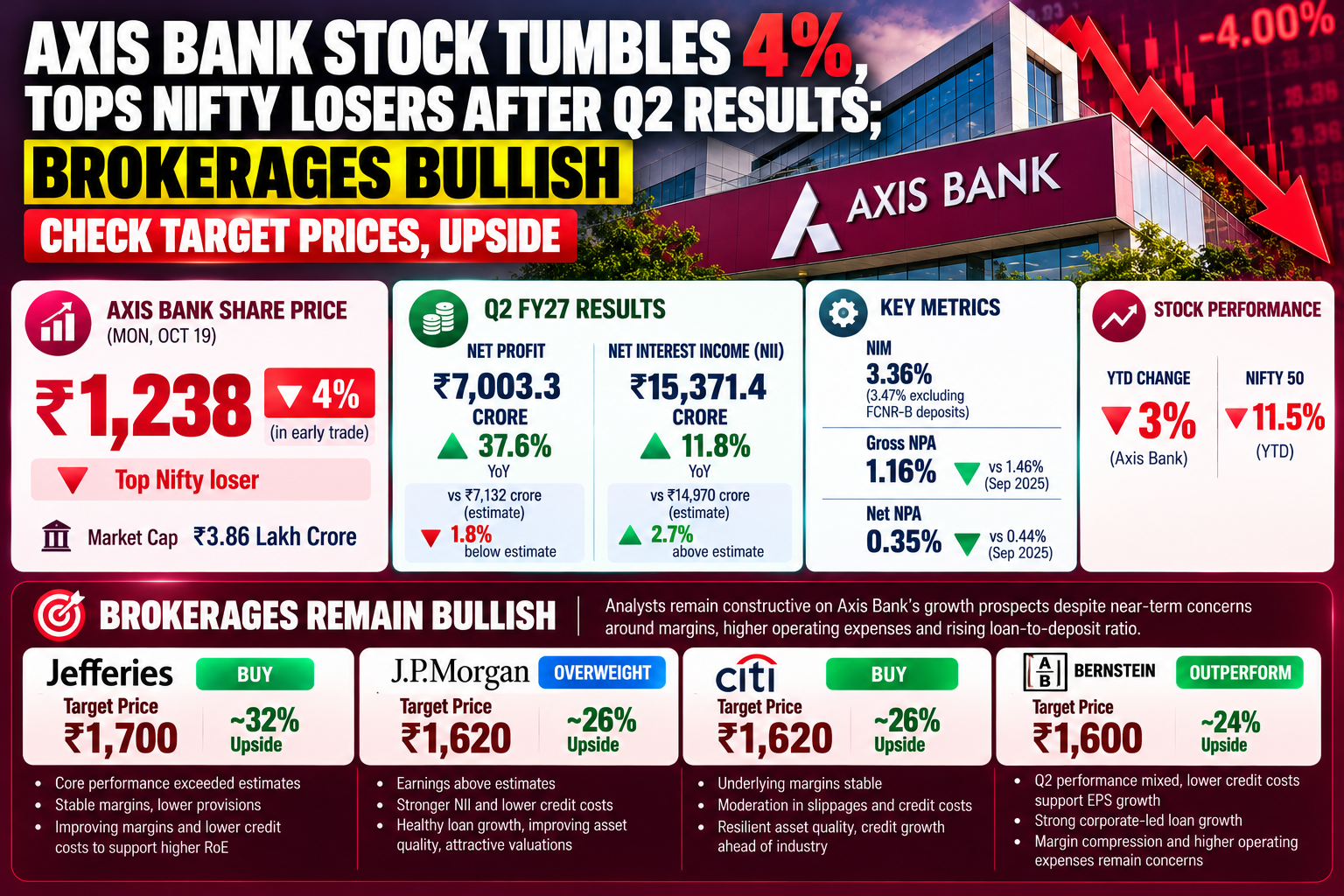
The stock fell to Rs 1,238 in morning trade, taking its year-to-date decline to around 3%. Axis Bank’s market capitalisation stood at approximately Rs 3.86 lakh crore.
However, the sharp fall did not prompt major brokerages to turn bearish. Jefferies, JPMorgan, Citi and Bernstein maintained positive ratings, with target prices suggesting potential upside from Friday’s closing price of Rs 1,290. The key question for investors is whether the bank can sustain loan growth while improving core profitability.
Track Live : Nifty Levels Today | Sensex Levels Today
Axis Bank Q2 FY27 Results Show Strong Profit Growth but Margin Concerns
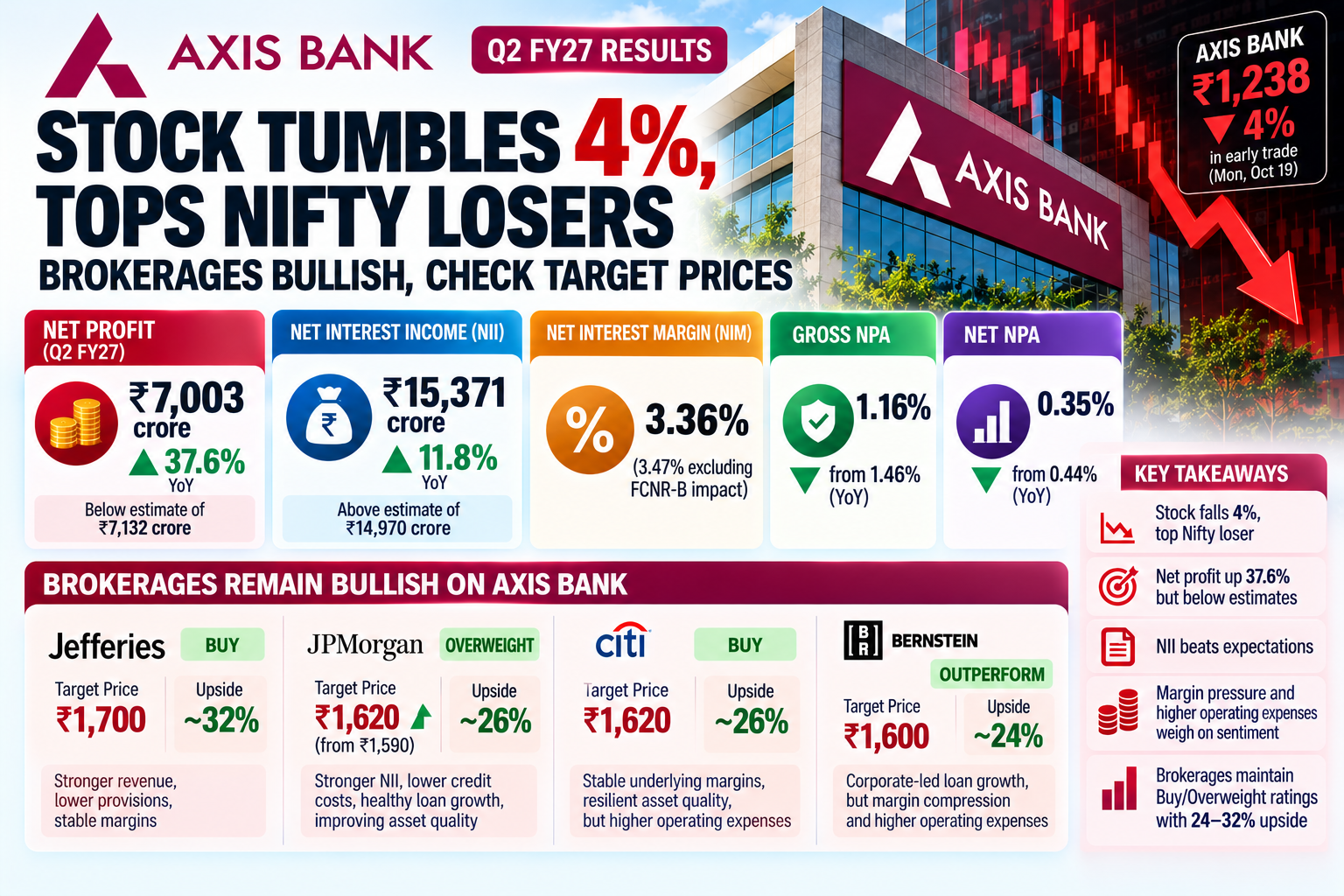
Axis Bank reported a 37.6% year-on-year increase in net profit to Rs 7,003.3 crore for the September quarter. However, the result fell short of the CNBC TV18 poll estimate of Rs 7,132 crore.
Net interest income (NII) increased 11.8% to Rs 15,371.4 crore, beating the estimated Rs 14,970 crore. This indicated healthy growth in the bank’s core interest income, although the overall earnings picture remained mixed.
The net interest margin (NIM) stood at 3.36%. Excluding the impact of FCNR-B deposits, the margin was 3.47%, highlighting the pressure on reported profitability.
Asset quality improved during the period. The gross non-performing asset ratio declined to 1.16% from 1.46% a year earlier, while the net NPA ratio fell to 0.35% from 0.44%.
For investors, the combination of stronger NII and improving asset quality is encouraging. However, margin pressure and elevated expenses remain important factors to monitor.
Key Financial Performance (Q2 FY27)
- Net Profit: Surged 37.6% YoY to ₹7,003.3 crore (missing the CNBC-TV18 poll estimate of ₹7,132 crore).
- Net Interest Income (NII): Grew 11.8% YoY to ₹15,371.4 crore, beating market expectations of ₹14,970 crore.
- Net Interest Margin (NIM): Reported headline NIM stood at 3.36%. Excluding the short-term drag from FCNR-B deposits, the core underlying NIM was healthier at 3.47%.
- Asset Quality Peak: Both Gross and Net NPA ratios fell dramatically. Gross NPA fell to 1.16% (vs 1.46% last year) and Net NPA dropped to 0.35% (vs 0.44% last year).
Axis Bank Share Price Targets Point to Potential Upside
Brokerages maintained positive recommendations, although their assessments of the bank’s operating performance differed.
Jefferies: Buy, target Rs 1,700
Jefferies expects improving margins, lower credit costs and a rebalancing of the loan portfolio to support return on equity next year. Its target implies approximately 32% upside from Friday’s close of Rs 1,290.
JPMorgan: Overweight, target Rs 1,620
JPMorgan raised its target from Rs 1,590 to Rs 1,620. It highlighted stronger NII, lower credit costs, healthy loan growth and improving asset quality, while pointing to attractive valuations.
Citi: Buy, target Rs 1,620
Citi said underlying margins remained stable after excluding the FCNR-B impact. However, it flagged elevated operating expenses as a drag on pre-provision operating profit.
Bernstein: Outperform, target Rs 1,600
Bernstein described the results as mixed. It noted that a 52% year-on-year decline in credit costs supported 37% earnings-per-share growth, but flagged higher expenses, weaker net operating income and margin compression. Corporate-led loan growth also pushed the loan-to-deposit ratio to approximately 95%.
These targets are brokerage estimates, not guaranteed returns.
Axis Bank brokerage ratings and target prices
Upside is calculated against the October 16 closing price of ₹1,290.
| Brokerage | Rating | Target Price | Potential Upside |
|---|---|---|---|
| Jefferies | Buy | ₹1,700 | 31.8% |
| JPMorgan | Overweight | ₹1,620 | 25.6% |
| Citi | Buy | ₹1,620 | 25.6% |
| Bernstein | Outperform | ₹1,600 | 24.0% |
Track Live : NSE Option Chain — Live | BSE Option Chain — Live Sensex & Bankex Options Data Today
Why did Axis Bank shares fall despite 37.6% profit growth?
Four factors help explain the market reaction.
-
Profit missed estimates: Net profit of ₹7,003.3 crore was below analysts’ expectations, despite strong year-on-year growth.
-
Margin pressure: Reported NIM was 3.36%, affected by the cost of FCNR-B deposits. The margin excluding this impact was 3.47%.
-
Higher operating expenses: Elevated costs weighed on operating profitability, while weaker treasury income also affected results.
-
High loan-to-deposit ratio: Corporate-led loan growth pushed the ratio to around 95%, raising questions about the bank’s ability to sustain lending growth while managing deposits and funding costs.
Is Axis Bank a buying opportunity?
The results offer both positives and risks. Strong NII growth, improving asset quality and lower credit costs support the constructive brokerage view. However, margin pressure, elevated costs and funding considerations mean the stock’s recovery is not assured.
For long-term investors, the key question is whether margins and operating profitability improve over the coming quarters. Short-term traders should avoid treating the 4% decline alone as a buy signal.
The ₹1,600–₹1,700 targets represent potential upside of roughly 24%–32% from ₹1,290, but actual returns depend on the entry price, future earnings and market conditions. These targets are estimates, not promises.
Here’s What Happened Today and Why Traders Reacted
The market reaction reflected concerns about the quality and sustainability of Axis Bank’s earnings growth rather than profit growth alone.
Higher operating expenses, pressure on reported margins and a loan-to-deposit ratio approaching 95% raised questions about how comfortably the bank can fund further lending. The ratio measures loans against deposits, making it an important indicator of funding conditions.
At the same time, improving asset quality and lower credit costs offered some support to the bank’s outlook. Traders will likely watch whether these positives can offset margin pressure in the coming quarters.
Read More : HDFC Bank Shares Slip 2% After Q2, but 6 Brokerages Aren’t Backing Off. What’s Going On?
What Axis Bank Investors Should Watch Next
Axis Bank’s near-term share price performance will depend on its ability to sustain credit growth without putting further pressure on margins and funding conditions.
Investors should track NIM trends, deposit growth, operating expenses, credit costs and asset quality. Continued improvement in these areas could strengthen confidence in the bank’s earnings outlook, while persistent margin pressure could limit the stock’s recovery.
For traders, the 4% decline highlights the risk of relying on headline profit growth alone. Long-term investors may focus more closely on core profitability, valuations and the sustainability of loan expansion.