
Without SBI’s August estimate, the corporate loan pipeline cited by four other state-run lenders is about ₹2.8 lakh crore, and only part of it is sanctioned.
October 19, 2026
Public sector banks are signalling a corporate loan pipeline of about ₹7.8 lakh crore, but nearly two-thirds of it rests on one estimate made in August. The Economic Times reported on October 19 that state-run lenders, including Punjab National Bank (PNB), Canara Bank, Indian Bank, Central Bank of India and State Bank of India (SBI), are seeing stronger corporate credit demand.
NiftyTrader’s tally of the five figures cited comes to ₹7.8 lakh crore. SBI’s share is an estimate of up to ₹5 lakh crore that Chairman CS Setty gave ET in an interview on August 28, about 64% of the total. The other four lenders account for roughly ₹2.8 lakh crore.
That matters because the pipeline is being read as proof of a private capex revival. The banks count loans at different stages, and a sanction is not a disbursement: money is released in tranches as borrowers meet milestones.
What Each Bank Reported
PNB reported a corporate pipeline of ₹1.58 lakh crore. Management said it sanctioned more than ₹2.5 lakh crore of corporate loans in the first half of FY27, against about ₹4 lakh crore in all of FY26. The reported figure is not split by stage.
Canara Bank‘s ₹47,000 crore pipeline comprises ₹30,000 crore sanctioned and ₹17,000 crore under examination, Managing Director Brajesh Kumar Singh said. He expects credit growth above 19% year-on-year in the third quarter.
Indian Bank‘s ₹63,000 crore splits into ₹30,000 crore sanctioned, ₹10,000 crore with in-principle approval and ₹23,000 crore under review, according to Managing Director Binod Kumar.
Central Bank of India‘s ₹12,000 crore includes ₹7,000 crore sanctioned and awaiting disbursement and ₹5,000 crore under process, CEO Kalyan Kumar told ET. Corporate loans make up ₹1.18 lakh crore, or 32%, of its book.
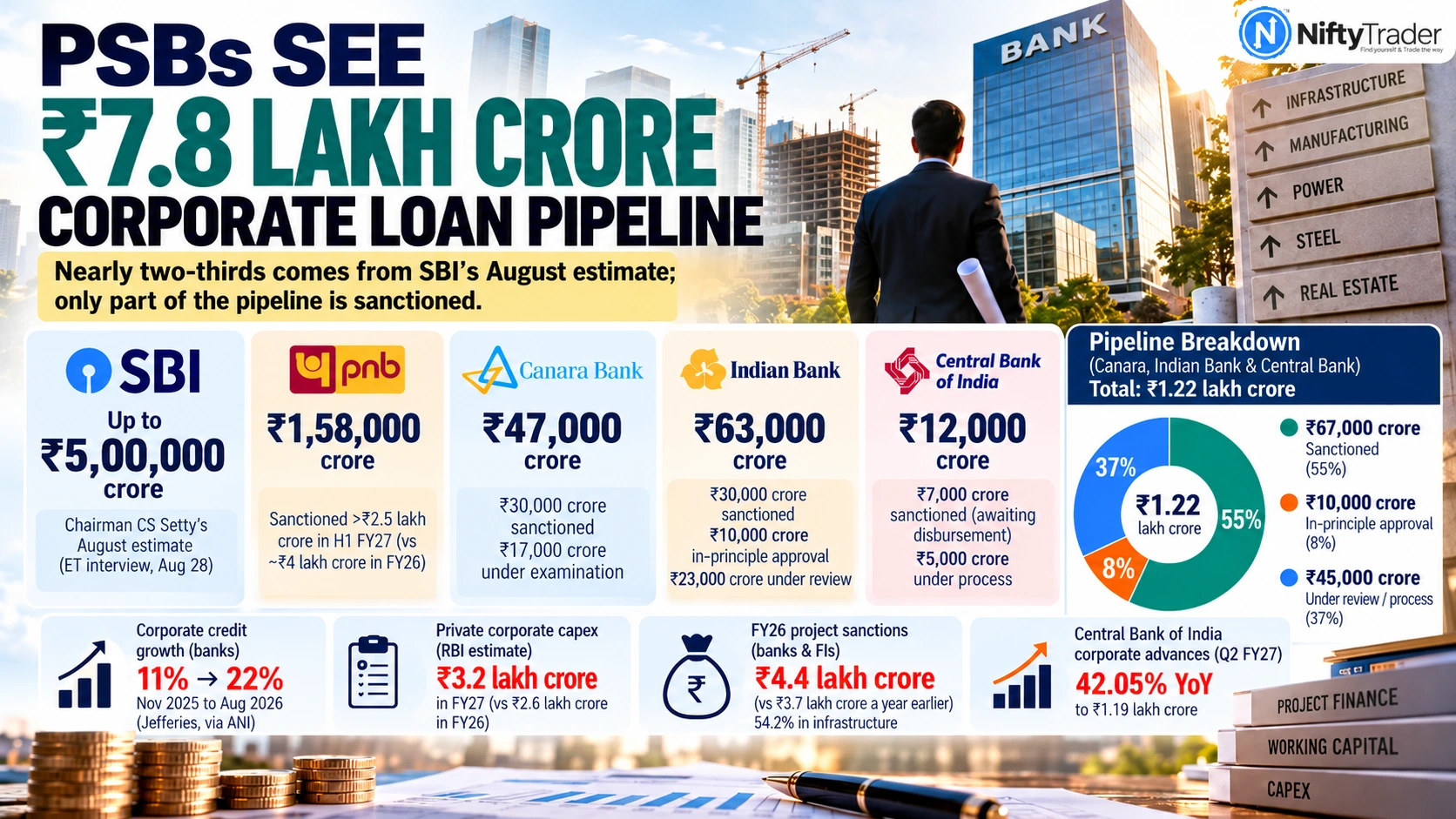
Only About 55% of the Disclosed Pipeline Is Sanctioned
Canara, Indian Bank and Central Bank gave stage-wise detail, and their pipelines total ₹1.22 lakh crore. About ₹67,000 crore, or 55%, is sanctioned. Another ₹10,000 crore, or 8%, has in-principle approval, and ₹45,000 crore, or 37%, is still under review or in process. This is a NiftyTrader calculation from management commentary, and banks may define the stages differently.
Bond Yields Are Pulling Borrowers to Banks
Not all of this demand is new investment. A Jefferies report, reported by ANI on October 14, found that banks supplied 81% of fresh credit between November 2025 and August 2026 as bond, commercial paper and external borrowing became relatively more expensive. Bank credit growth to corporates rose from 11% in November 2025 to 22% in August 2026.
Canara and Indian Bank executives also pointed to rising bond yields as a support for loan demand, with the two banks citing ₹1.10 lakh crore of pipeline between them. Loans taken because bonds became costlier add to credit growth without necessarily adding plants or power capacity, and the reported pipeline figures do not separate the two. Jefferies expects bank credit growth to moderate from December 2026 or January 2027 as a higher base takes effect.
RBI Data Shows Intent, Not Yet Spending
RBI’s September Bulletin estimated private corporate capex at ₹3.2 lakh crore in FY27, up from ₹2.6 lakh crore in FY26 on a comparable basis. Banks and financial institutions sanctioned projects costing a record ₹4.4 lakh crore in FY26, against ₹3.7 lakh crore a year earlier. Infrastructure took 54.2% of that cost, led by power.
Two details temper the headline. RBI said its FY27 outlook rests on projects sanctioned in earlier years because FY27 sanction data is incomplete, so this year’s new bank pipelines are not yet in the ₹3.2 lakh crore. It also said 43.2% of the cost of projects sanctioned in FY26 was scheduled for investment by the end of that year, leaving the larger share for later periods.
Corporate Credit Growth Is Broad, But Not Pure Capex
In Q2 FY27, Central Bank of India’s corporate advances rose 42.05% year-on-year to ₹1.19 lakh crore. Among private lenders, Axis Bank’s corporate loans grew 34% to ₹4.69 lakh crore, and ICICI Bank’s domestic corporate portfolio grew 30.6%. Portfolio growth can include working capital and refinancing, so these rates are not clean measures of new capex.
Also Read: Central Bank of India Q2 FY27 Results: Advances Jump Nearly 30%, But Who Is Funding the Growth?
What It Means for Bank Earnings
Faster corporate lending supports interest income only if loan yields stay ahead of funding costs. Canara and Indian Bank executives both said they are working to narrow the gap between credit and deposit growth. Investors tracking institutional flows into banking stocks can follow the NiftyTrader FII-DII Tracker at niftytrader.in/fii-dii-data.
What to Watch Next
First, conversion. The Q3 FY27 updates should show how much of the ₹67,000 crore sanctioned at Canara, Indian Bank and Central Bank has become drawn loans.
Second, SBI’s next disclosure on its corporate book will show whether the August estimate of up to ₹5 lakh crore holds, narrows or is broken down by stage.
Third, the funding backdrop. If corporate credit growth holds after the moderation Jefferies expects, that would point to genuine investment rather than a bond-to-loan switch.
The Bottom Line
The ₹7.8 lakh crore figure is a useful sign of credit demand but a weak measure of capex. Nearly two-thirds is one bank’s August estimate, and where stage-wise detail exists, only about 55% is sanctioned.
The test is now measurable: how much of the ₹67,000 crore sanctioned at three lenders is drawn by the next quarterly updates, whether SBI’s estimate firms up, and whether corporate credit growth holds as bond-driven demand fades, all while banks keep margins and asset quality intact.
Read Next: RBI Allots ₹1 Lakh Crore as Repo Bids Hit ₹1.51 Lakh Crore
Disclaimer: This article is for informational purposes only and does not constitute investment advice. [Replace with NiftyTrader’s standard SEBI disclaimer.