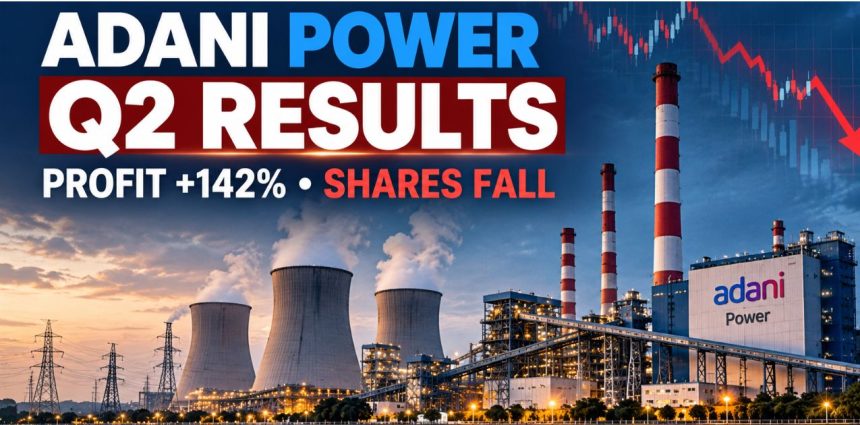
Adani Power reported a 142% jump in Q2 FY27 consolidated profit, but its shares closed 1.74% lower. A ₹2,422 crore prior-period revenue adjustment, a tax reversal and an investment-sale gain added complexity to the earnings picture, while NiftyTrader futures data showed rising open interest during the decline.
October 23, 2026
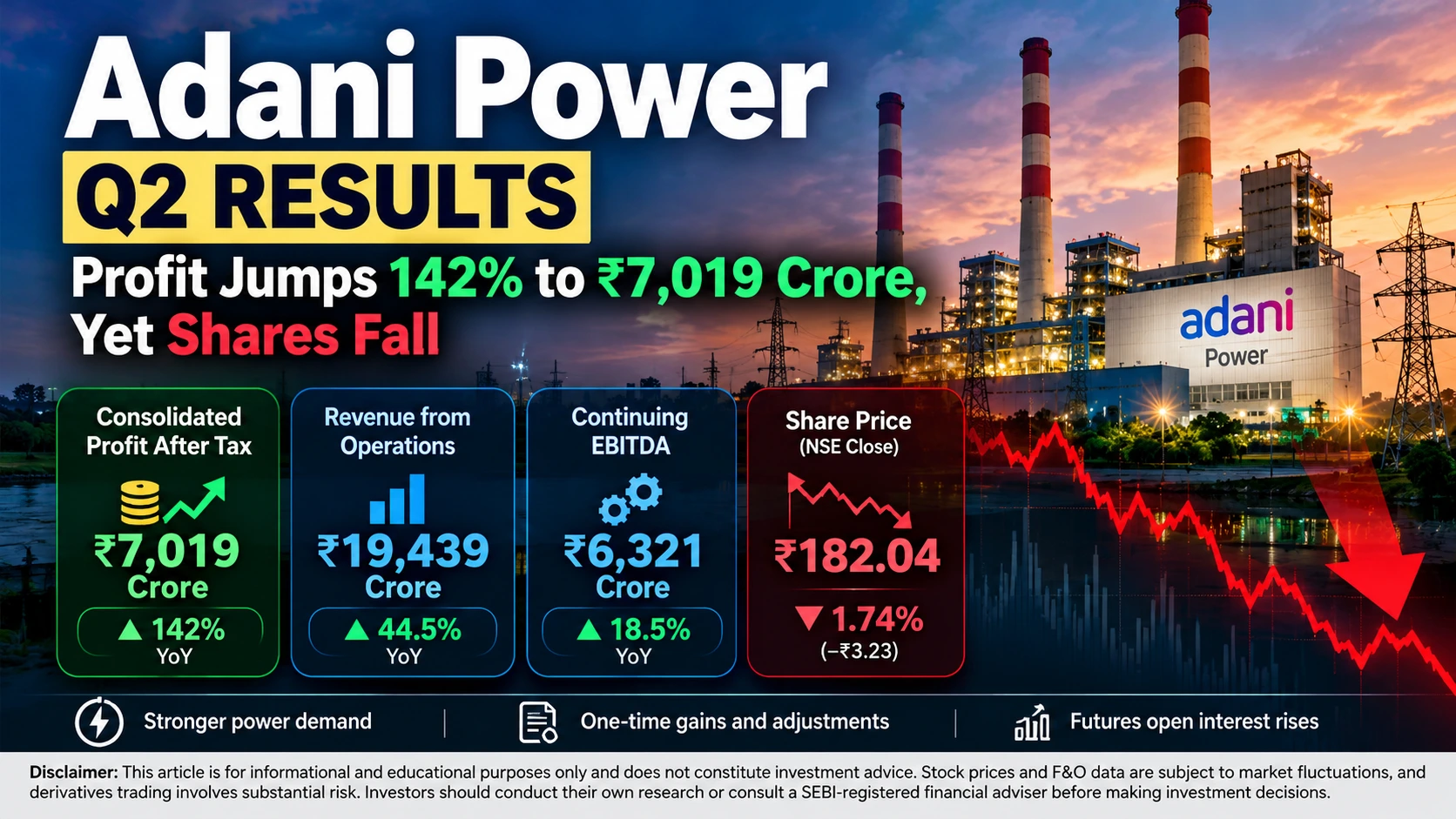
Adani Power reported a 141.5% year-on-year increase in consolidated profit after tax to ₹7,019.32 crore for the quarter ended September 30, 2026, compared with ₹2,906.46 crore a year earlier. Revenue from operations rose 44.5% to ₹19,438.68 crore, supported by stronger electricity demand and higher power realisations.
Despite the sharp profit growth, Adani Power shares closed at ₹182.04 on the NSE on Friday, October 23, down 1.74%. The stock had declined to ₹175.31 during intraday trading before recovering part of its losses.
The earnings announcement revealed a significant difference between reported profit and continuing operating performance. While consolidated PAT surged 142%, the company’s continuing EBITDA increased by a more moderate 18.5%.
Several accounting adjustments also influenced reported earnings, making the underlying financial performance an important area of attention for investors.
Track Live: Adani Power Option Chain (ADANIPOWER) — Live OI & IV
Why Did Adani Power’s Q2 Profit Jump 142%?
According to Adani Power’s official Q2 FY27 results release, the company recognised ₹2,422.25 crore in prior-period revenue, primarily related to revisions in historical energy charges under certain power purchase agreements (PPAs).
The corresponding figure in Q2 FY26 was ₹668.53 crore, representing a year-on-year increase of approximately ₹1,754 crore in revenue recognised from earlier periods.
The company’s detailed financial disclosures also identify other significant items affecting the quarter.
A reversal of approximately ₹1,211 crore in earlier tax expenses followed the amalgamation of ten wholly owned subsidiaries with Adani Power. The amalgamation became effective on September 25, 2026.
The company also reported an investment-sale gain of approximately ₹536 crore related to the disposal of its stake in Chandenvalle Infra Park (CIPL).
These items are important when evaluating the substantial increase in net profit. However, they represent different accounting measures and should not simply be added together as an after-tax contribution to earnings.
Adani Power’s reported EBITDA increased 45.7% to ₹8,743.22 crore, while continuing EBITDA rose 18.5% to ₹6,320.97 crore.
The company’s continuing EBITDA measure excludes prior-period income and expenses. It does not necessarily eliminate every non-recurring item, including the investment-sale gain.
Consequently, continuing EBITDA is a useful comparison with the prior year, but it should not automatically be treated as a completely normalised measure of recurring power-generation earnings.
Adani Power Q2 FY27 Results: Key Financial Highlights
| Financial metric | Q2 FY27 | Q2 FY26 | YoY change |
|---|---|---|---|
| Revenue from operations | ₹19,438.68 Cr | ₹13,456.84 Cr | +44.5% |
| Total reported revenue, including other income | ₹19,950.60 Cr | ₹14,307.79 Cr | +39.4% |
| Continuing EBITDA | ₹6,320.97 Cr | ₹5,332.71 Cr | +18.5% |
| Reported EBITDA | ₹8,743.22 Cr | ₹6,001.24 Cr | +45.7% |
| Continuing PBT | ₹4,369.51 Cr | ₹3,297.68 Cr | +32.5% |
| Consolidated PAT | ₹7,019.32 Cr | ₹2,906.46 Cr | +141.5% |
Source: Adani Power’s Q2 FY27 consolidated financial disclosures for the quarter ended September 30, 2026.
The results also showed profit attributable to shareholders of ₹6,919.45 crore, compared with ₹2,952.78 crore a year earlier, an increase of approximately 134.3%.
This distinction explains why some earnings reports cite a 134% profit increase while others report 142%. The ₹7,019 crore figure represents total consolidated PAT, whereas ₹6,919 crore represents profit attributable to the company’s owners.
Also Check: ADANI POWER Options Chart | Nifty Trader
Haryana Revenue Adjustment Adds Another Layer to Earnings
Another important accounting disclosure concerns revenue associated with Haryana electricity distribution companies.
Adani Power reported derecognition of ₹1,971.96 crore in revenue on a prudent basis amid unresolved compensation claims.
Derecognition means the company removed revenue previously recognised in its accounts. It should not be interpreted as an equivalent cash payment or an additional expense automatically deducted from the reported PAT figure.
The adjustment also demonstrates why interpreting quarterly profit through individual exceptional items requires care.
Adani Power’s reported revenue and profit already reflect the combined accounting impact of the relevant recognised and derecognised items.
The more useful comparison for investors is therefore between reported financial performance, continuing operating earnings and actual electricity sales.
Strong Power Demand Supports Adani Power’s Operations
Beyond the accounting adjustments, Adani Power reported stronger operating performance during the September quarter.
Consolidated electricity sales increased 11.5% year-on-year to 26.4 billion units, compared with 23.7 billion units in Q2 FY26.
The company’s plant load factor (PLF), which measures power-generation capacity utilisation, improved to 70.1% from 62.8%.
Power sales under long-term and medium-term PPAs increased 29.7% to 23.4 billion units.
Continuing PPA tariff realisation improved 12.7% to ₹6.4 per unit, while merchant and short-term tariff realisation increased 33.1% to ₹7.2 per unit.
However, higher generation activity also increased costs.
Fuel expenditure rose 41.8% year-on-year to ₹10,229.38 crore, compared with ₹7,216.23 crore in the corresponding quarter last year.
According to the company, higher electricity volumes and increased landed costs of imported coal contributed to the increase.
These operating figures indicate that Adani Power’s core business expanded during the quarter, although its continuing earnings grew more slowly than headline consolidated PAT.
Adani Power Share Price Falls 1.74% Despite Strong Q2 Results
Adani Power shares opened at ₹185.27 on October 23, matching the previous session’s closing price.
The stock traded between ₹175.31 and ₹185.90 during the session before closing at ₹182.04, down ₹3.23 or 1.74%.
The decline occurred on the same day as the company’s earnings announcement, although the price movement alone does not establish that the results caused the selling.
The contrast between reported profit growth and continuing earnings provides useful context for evaluating the financial performance, but it cannot independently explain the market reaction.
NiftyTrader F&O Data Shows Short-Build-Up Pattern
Derivatives positioning provided an additional perspective on Adani Power’s results-day trading.
According to NiftyTrader’s Adani Power stock futures data, the October 27, 2026 futures contract showed falling prices alongside rising open interest.
The following figures were recorded in the October 23, 2026 snapshot updated at 4:00 PM IST.
| F&O indicator | October futures |
|---|---|
| Futures price | ₹181.92 |
| Futures price change | −1.56% |
| Open interest | 15,91,78,450 |
| Change in open interest | +30,17,500 |
| Open interest change | +1.93% |
| Spot price | ₹182.04 |
| Contract expiry | October 27, 2026 |
The combination of declining futures prices and increasing open interest is conventionally associated with a short-build-up pattern.
It indicates that outstanding positions increased while the futures contract declined in price.
However, the pattern does not establish the identity of market participants or guarantee further downside.
NiftyTrader data also showed a 57.18% increase in open interest in Adani Power’s November futures contract, expiring on November 23, 2026.
With October derivatives expiry approaching, part of the change in next-month positioning may be associated with the movement of positions between contracts.
Traders should therefore assess both contracts rather than interpreting a single open-interest change as a directional forecast.
What Should Investors Watch After Adani Power’s Results?
Adani Power is pursuing a major capacity-expansion programme involving the addition of 23,720 MW of thermal power generation capacity.
The company reported grid synchronisation of the first 660 MW unit at its Korba Phase-II project during the quarter.
It also received a Letter of Award for a 25-year power supply agreement with Uttarakhand Power Corporation, covering 1,320 MW of gross capacity.
In hydropower, Adani Power was selected as the successful resolution applicant for GVK Energy, which owns and operates the 330 MW Alaknanda hydroelectric project. The selection should not be interpreted as confirmation that the acquisition has been completed.
The company has also entered into a shareholders’ agreement with Bhutan’s Druk Green Power Corporation for the proposed 770 MW Chamkarchhu hydropower project.
Adani Power reported net debt of ₹45,845.92 crore as of September 30, 2026, compared with ₹45,022.02 crore at the end of March.
Future earnings will depend partly on electricity demand, tariff realisations, fuel costs, execution of new power projects and financing requirements.
An investor and analyst interaction is scheduled for October 26, 2026, ahead of the October 27 derivatives expiry.
For investors, the principal question is whether growth in continuing operating earnings can remain strong as the company expands capacity.
For F&O traders, changes in futures prices and open interest around expiry will provide additional information about market positioning.
The key takeaway: Adani Power’s Q2 FY27 results showed strong electricity demand and higher continuing operating earnings, alongside significant accounting adjustments that influenced reported profitability. The distinction between 142% PAT growth and 18.5% continuing EBITDA growth is central to assessing the quarter, while the share-price decline and rising futures open interest provide the trading context.
Read Next: Swiggy Share Price Crashes 16.75% After Q2 Results; F&O Open Interest Jumps 25%
Disclaimer: This article is for informational and educational purposes only and does not constitute investment advice. Stock prices and F&O data are subject to market fluctuations, and derivatives trading involves substantial risk. Investors should conduct their own research or consult a SEBI-registered financial adviser before making investment decisions.