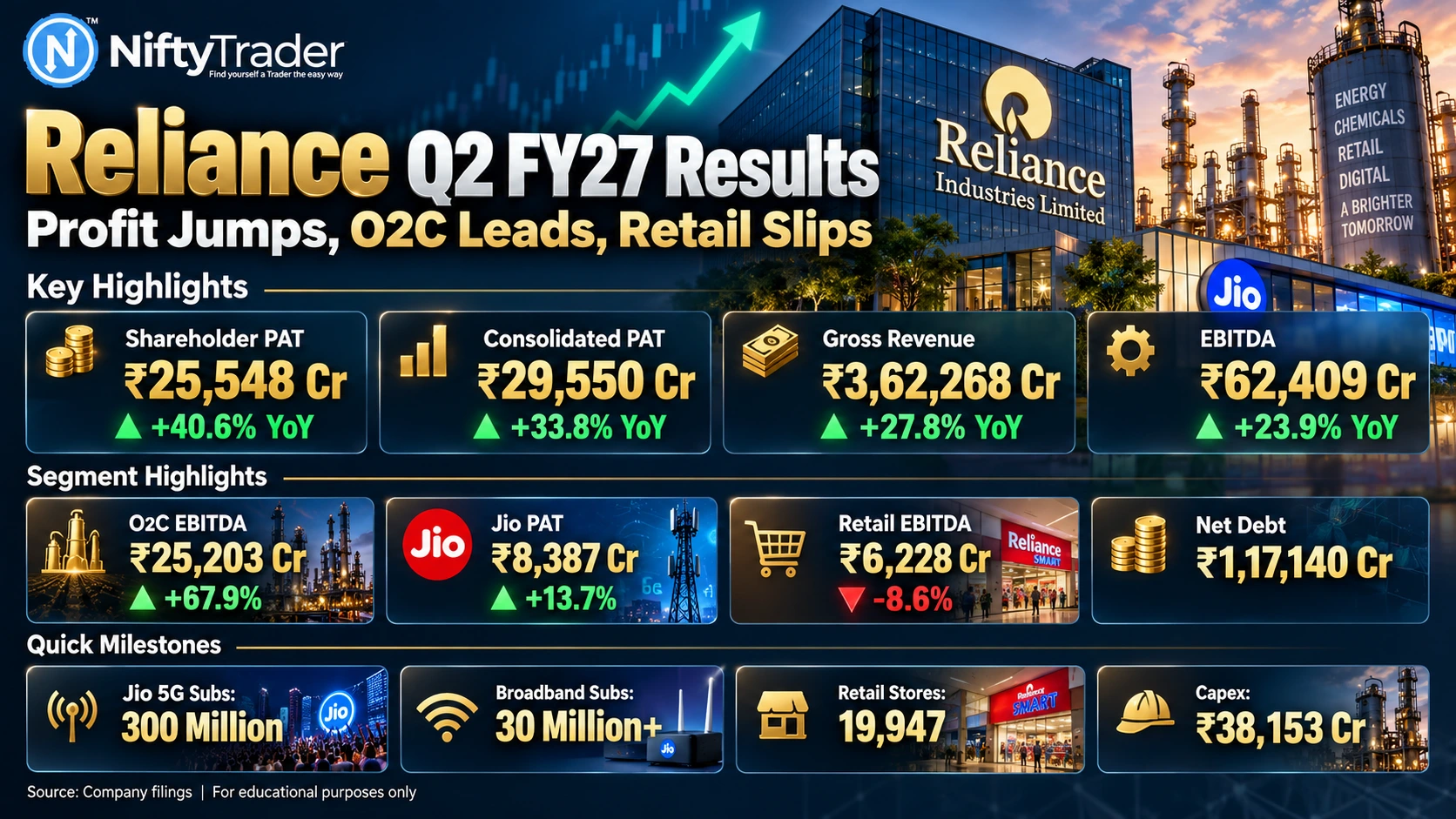
Reliance Industries has delivered a record-breaking September quarter, but the real story lies beneath its headline profit growth. Profit attributable to shareholders jumped 40.6% year-on-year (YoY) to ₹25,548 crore, while its oil-to-chemicals (O2C) business recorded an extraordinary 67.9% surge in EBITDA. Jio Platforms continued to expand its digital business, but Reliance Retail reported an 8.6% decline in EBITDA and a 24.3% fall in profit.
The numbers reveal a striking difference in the performance of Reliance’s major businesses. Refining and petrochemical margins provided a powerful earnings boost, while higher operating costs and investments weighed on retail profitability. The challenge for investors now is to determine whether the record earnings momentum can continue once the exceptional energy-market conditions normalise.
Mukesh Ambani-led Reliance Industries Ltd (RIL) announced its Q2 FY27 results on Friday, October 30, for the quarter ended September 30. The company reported revenue from operations of approximately ₹3.33 lakh crore, up 28.6% YoY, while consolidated gross revenue increased 27.8% to a record ₹3,62,268 crore.
There are two important profit figures to understand: Profit attributable to shareholders stood at ₹25,548 crore, up 40.6% from ₹18,165 crore. Separately, total consolidated profit after tax (PAT), including the share of profits from associates and joint ventures, reached ₹29,550 crore, up 33.8% from ₹22,092 crore.
Track Live: Reliance Option Chain Live – RIL Options Data
Reliance Industries Q2 FY27 Results: Complete Financial Snapshot
| Financial Metric | Q2 FY27 | Q2 FY26 | YoY Change |
|---|---|---|---|
| Gross Revenue | ₹3,62,268 crore | ₹2,83,548 crore | +27.8% |
| Revenue from Operations | ₹3,32,861 crore | ₹2,58,898 crore | +28.6% |
| EBITDA | ₹62,409 crore | ₹50,367 crore | +23.9% |
| EBITDA Margin | 17.2% | 17.8% | -60 bps |
| Profit Before Tax | ₹38,613 crore | ₹29,124 crore | +32.6% |
| PAT before share of associates and JVs | ₹29,250 crore | ₹22,146 crore | +32.1% |
| Consolidated PAT including associates and JVs | ₹29,550 crore | ₹22,092 crore | +33.8% |
| Profit Attributable to Shareholders | ₹25,548 crore | ₹18,165 crore | +40.6% |
| Finance Costs | ₹8,481 crore | ₹6,827 crore | +24.2% |
| Capital Expenditure | ₹38,153 crore | ₹40,010 crore | -4.6% |
Figures in ₹ crore. Growth rates are year-on-year. Revenue from operations and gross revenue are separate reporting measures. Shareholder-attributable PAT should not be confused with total consolidated PAT.
The consolidated EBITDA increased 23.9% to ₹62,409 crore, marking a record quarterly performance. However, the reported EBITDA margin moderated by 60 basis points to 17.2% from 17.8% a year earlier, even though it improved from 15.9% sequentially.
Total consolidated PAT also increased from ₹23,196 crore in Q1 FY27 to ₹29,550 crore in Q2, reflecting a 27.4% quarter-on-quarter improvement.
For the first half of FY27, consolidated PAT, including associates and joint ventures, crossed ₹50,000 crore to reach ₹52,746 crore, compared with ₹43,951 crore in the first half of FY26.
The earnings improvement came despite higher financing expenses and taxes. Consolidated finance costs increased 24.2% to ₹8,481 crore, while tax expenses climbed 34.2% to ₹9,363 crore.
O2C Business Drives Reliance Q2 Earnings as EBITDA Jumps 68%
Reliance’s oil-to-chemicals business emerged as the biggest contributor to its earnings growth during Q2 FY27, delivering its strongest-ever quarterly operating performance.
The segment reported revenue of ₹2,31,601 crore, an increase of 44.2% from ₹1,60,558 crore in the corresponding quarter last year. More importantly, EBITDA surged 67.9% to ₹25,203 crore against ₹15,008 crore in Q2 FY26.
| O2C Performance | Q2 FY27 | Q2 FY26 | YoY Change |
|---|---|---|---|
| Revenue | ₹2,31,601 crore | ₹1,60,558 crore | +44.2% |
| Exports | ₹1,04,250 crore | ₹70,955 crore | +46.9% |
| EBITDA | ₹25,203 crore | ₹15,008 crore | +67.9% |
| EBITDA Margin | 10.9% | 9.3% | +160 bps |
The improvement was largely supported by favourable global refining conditions and stronger downstream petrochemical margins.
The Middle East conflict disrupted energy supply chains, pushing crude oil prices up 40.6% year-on-year during the quarter. Transportation fuel prices increased between 50% and 78%, while prices of most downstream chemical products rose 25% to 35%.
One of the biggest contributors was the sharp improvement in transportation fuel cracks, which increased three to 3.7 times year-on-year and reached historic highs during the quarter.
The polyester chain also recorded a strong recovery, with margins improving 33% to a three-year high. Paraxylene (PX) deltas increased 15%, while purified terephthalic acid (PTA) deltas rose 52%.
Reliance also highlighted its feedstock-sourcing flexibility and ability to optimise product placement across the value chain as important contributors to profitability.
However, the segment continued to face higher crude oil premiums, elevated freight rates, Special Additional Excise Duty (SAED)-related expenses and under-recoveries in domestic fuel retailing.
Investor angle: O2C is currently Reliance’s strongest earnings engine, but its exceptional quarterly performance also reflects unusually favourable global refining economics. Any cooling in fuel cracks or petrochemical spreads could moderate the segment’s contribution in subsequent quarters.
Jio Platforms Q2 Results: Profit Up 13.7%, ARPU Reaches ₹218.80
Reliance’s digital services business continued its growth momentum, supported by subscriber additions, improving average revenue per user (ARPU) and higher data consumption.
Jio Platforms Ltd (JPL) reported gross revenue of ₹47,485 crore in Q2 FY27, an increase of 11.3% from ₹42,652 crore in the year-ago quarter. Revenue from operations rose 11.4% to ₹40,475 crore.
EBITDA increased 16.6% to ₹21,879 crore, while the EBITDA margin expanded 250 basis points to 54.1% from 51.6%.
| Jio Platforms Performance | Q2 FY27 | Q2 FY26 | YoY Change |
|---|---|---|---|
| Gross Revenue | ₹47,485 crore | ₹42,652 crore | +11.3% |
| Revenue from Operations | ₹40,475 crore | ₹36,332 crore | +11.4% |
| EBITDA | ₹21,879 crore | ₹18,757 crore | +16.6% |
| EBITDA Margin | 54.1% | 51.6% | +250 bps |
| Profit After Tax | ₹8,387 crore | ₹7,379 crore | +13.7% |
| Monthly ARPU | ₹218.80 | ₹211.40 | +3.5% |
Jio’s total customer base increased to 542.4 million from 506.4 million a year earlier. The company added 9.1 million net subscribers during the quarter, while monthly churn remained stable at 1.6%.
ARPU improved to ₹218.80 from ₹211.40, indicating higher average monetisation per customer.
Jio also crossed two major operational milestones during the quarter:
- Its 5G subscriber base reached 300 million.
- Its fixed broadband subscriber base crossed 30 million.
Monthly data consumption increased to 44.2 GB per customer from 38.7 GB a year earlier, while overall data traffic grew 22.1%.
Despite the improvement in operating profitability, Jio Platforms’ profit growth remained slower than its EBITDA expansion. Depreciation increased 14% to ₹7,611 crore, while finance costs rose 40.3% to ₹3,009 crore, partly reflecting the capitalisation of 5G assets in March 2026.
Another significant development was Jio Platforms’ ₹30,188-crore IPO, which completed its stock market listing on October 28, marking a major milestone in Reliance’s digital business.
Track Live: JIO PLATFORMS IPO | NIFTYTRADER
Reliance Retail Q2 Results: EBITDA Falls 8.6%, PAT Declines 24%
Reliance Retail emerged as the biggest contrast to the strong operating performance of O2C and Jio Platforms.
Reliance Retail Ventures Ltd (RRVL) reported gross revenue of ₹91,716 crore for Q2 FY27, increasing 6.4% year-on-year, after adjusting for the demerger of its Consumer Brands business.
However, EBITDA before the one-time impairment charge declined 8.6% to ₹6,228 crore from ₹6,816 crore a year earlier. Its EBITDA margin contracted 120 basis points to 7.8% from 9%.
Profit after tax, including the share of associates and joint ventures, fell 24.3% to ₹2,611 crore from ₹3,451 crore.
| Reliance Retail Performance | Q2 FY27 | Q2 FY26 | YoY Change |
|---|---|---|---|
| Gross Revenue | ₹91,716 crore | ₹86,169 crore | +6.4% |
| Revenue from Operations | ₹80,220 crore | ₹75,836 crore | +5.8% |
| EBITDA before impairment | ₹6,228 crore | ₹6,816 crore | -8.6% |
| EBITDA Margin | 7.8% | 9.0% | -120 bps |
| PAT including associates and JVs | ₹2,611 crore | ₹3,451 crore | -24.3% |
The company attributed the pressure on retail profitability to the shift in the festive calendar to the December quarter, investments in digital commerce and input-cost inflation that it absorbed for customers.
The cost pressure was also visible in the segment’s expense profile. Depreciation increased 18.1% year-on-year to ₹1,820 crore, while finance costs climbed 53.9% to ₹905 crore due to higher borrowings and interest rates.
Reliance Retail opened 303 stores during the quarter. After accounting for closures of unproductive outlets, its total store count stood at 19,947, while its retail area reached 77.5 million square feet.
The business recorded 7% growth in customer transactions despite the absence of the major festive weeks during the September quarter.
JioMart and Consumer Electronics Offer Growth Opportunities
Despite the decline in overall retail profitability, some digital and consumer categories continued to perform well.
JioMart reported a 42% year-on-year increase in revenue, driven by higher average order values and a 24% increase in units per order. The digital commerce share of B2C grocery revenue increased 270 basis points.
Its network expanded across more than 5,000 stores in over 1,000 cities, while the company continued to scale quick delivery and marketplace services.
Reliance Retail’s consumer electronics business reported 8% like-for-like revenue growth, while its fashion and lifestyle business recorded 3% growth.
The festive calendar is particularly important this year. Reliance’s investor presentation noted that Navratri fell on October 11 and Diwali on November 8 in 2026, compared with September 22 and October 20, respectively, in the previous year.
This places the main festive selling period in Q3 FY27 rather than Q2. Consequently, the December-quarter results will provide a more meaningful test of retail demand and the company’s ability to convert digital scale and higher customer activity into improved margins.
JioStar Q2: JioHotstar MAUs Increase 10%, Profitability Remains Weak
Reliance’s media and entertainment business, JioStar, reported revenue from operations of ₹6,806 crore, up 10.1% year-on-year.
However, higher revenue did not translate into higher operating earnings.
EBITDA from operations declined 10.5% to ₹1,372 crore, while total EBITDA, including investment income, fell 13.6% to ₹1,502 crore. Profit after tax declined 13.2% to ₹1,147 crore.
JioHotstar averaged approximately 440 million monthly active users (MAUs), representing 10% year-on-year growth.
The streaming platform was relaunched under the JioHotstar brand in Singapore, the UK and Canada during September. Active subscriber volumes in these international markets increased approximately 30% following the launch.
Entertainment watch-time grew more than 15% year-on-year, while the six language editions of Bigg Boss collectively reached over 90 million viewers in their first three weeks.
The company also reported that its average connected-TV viewer consumed three times more content than a mobile viewer.
The audience growth is encouraging, but the decline in JioStar’s EBITDA and profit highlights the difference between expanding viewership and monetising that audience profitably.
Oil and Gas Business Faces Pressure from Lower KG-D6 Production
Reliance’s oil and gas exploration and production segment recorded a relatively subdued performance.
Revenue declined 0.6% year-on-year to ₹6,020 crore from ₹6,058 crore. EBITDA fell 2% to ₹4,901 crore, while the EBITDA margin contracted 120 basis points to 81.4%.
The company attributed the decline primarily to lower production and gas price realisation from the KG-D6 fields.
Average KG-D6 gas price realisation decreased to $8.88 per MMBtu from $9.97 per MMBtu in Q2 FY26.
The impact was partly offset by higher condensate prices and improved coal bed methane (CBM) prices and volumes. Average CBM gas price realisation increased to $13.24 per MMBtu from $9.53 per MMBtu.
Reliance reported average KG-D6 production of 24 million standard cubic metres per day of gas and approximately 15,903 barrels per day of oil and condensate during the quarter.
Lower KG-D6 production remains a pressure point, although improved CBM production offers some support to the segment.
Reliance Industries Capex, Cash and Debt: Balance Sheet Remains Comfortable
Reliance continued to make substantial investments in its operating businesses and long-term projects during the September quarter.
Capital expenditure stood at ₹38,153 crore, compared with ₹40,010 crore in Q2 FY26. The company said the spending was largely directed towards O2C and new energy projects under implementation, along with infrastructure and distribution expansion across its consumer businesses.
The company’s cash position also improved, helping it maintain a lower net debt position despite an increase in outstanding debt.
| Balance Sheet Metric | September 2026 | September 2025 |
|---|---|---|
| Cash and Cash Equivalents | ₹2,67,812 crore | ₹2,29,685 crore |
| Outstanding Debt | ₹3,84,952 crore | ₹3,48,230 crore |
| Net Debt | ₹1,17,140 crore | ₹1,18,545 crore |
| Net Debt to Annualised EBITDA | 0.47x | 0.59x |
Cash and cash equivalents increased to approximately ₹2.68 lakh crore from ₹2.30 lakh crore a year earlier. Net debt declined marginally to ₹1.17 lakh crore from ₹1.19 lakh crore.
The net debt-to-EBITDA ratio improved to 0.47 times from 0.59 times, indicating a stronger net leverage position.
However, outstanding debt increased to ₹3.85 lakh crore from ₹3.48 lakh crore. This makes sustained cash generation and disciplined capital allocation important as Reliance continues to fund its O2C expansion, digital infrastructure, retail network and new energy investments.
Reliance Industries Q2 Results: Three Things Investors Should Watch
Reliance’s Q2 earnings have strengthened its financial performance, but the sustainability of that growth will depend on how its major businesses perform over the next few quarters.
1. Whether O2C margins can remain elevated
The O2C business benefited from exceptional refining cracks and stronger petrochemical spreads. Investors will monitor whether global supply disruptions and tight refining conditions continue to support margins or whether a normalisation in energy markets moderates the segment’s earnings momentum.
2. Whether Reliance Retail can recover profitability
Retail revenue continued to expand, but EBITDA and PAT contracted. The December quarter will be crucial because the festive calendar shifted into this period. A recovery in sales alone may not be enough; the improvement must also reflect in margins and operating profit.
3. Whether Jio can convert subscriber scale into higher earnings
Jio’s subscriber base, 5G adoption and broadband reach continue to expand. However, higher depreciation and finance costs show that monetisation must keep pace with the investments made in network infrastructure and digital services.
JioStar faces a similar challenge: audience growth will need to translate into stronger advertising, subscription revenue and operating profitability.
Also Check: Reliance Futures Live – RIL Futures Price, OI & Expiry
Bottom Line: Record Reliance Profit, but Growth Remains Uneven
Reliance Industries’ Q2 FY27 results highlight the strength of its diversified business portfolio, with shareholder-attributable profit rising 40.6% to ₹25,548 crore and total consolidated PAT, including associates and joint ventures, increasing 33.8% to ₹29,550 crore.
The O2C business was the standout performer, with EBITDA surging 67.9% to ₹25,203 crore. Jio Platforms also delivered steady growth, supported by higher ARPU, subscriber additions and improved operating margins.
However, declining retail profitability, weaker oil and gas earnings and rising financing costs show that the record headline profit does not represent uniform growth across the group.
The next quarterly results will provide a clearer indication of whether the O2C earnings strength can be sustained and whether the festive-season recovery can improve retail profitability.
For investors, the central question is no longer just how quickly Reliance is growing, but how consistently its different businesses can convert that growth into sustainable earnings and cash flows.
Read Next: F&O Build-Up Oct 30: 124 Stocks Show Short Build-Up as Nifty Rises; Sagility OI Jumps 60%
Disclaimer: This article is for informational and educational purposes only and should not be considered investment advice or a recommendation to buy or sell Reliance Industries shares. Investors should independently verify company disclosures and consult a SEBI-registered financial advisor before making investment decisions. Stock market investments are subject to market risks.