China’s Exports Up Crosses $1 Trillion as Exports Deliver a Major Boost
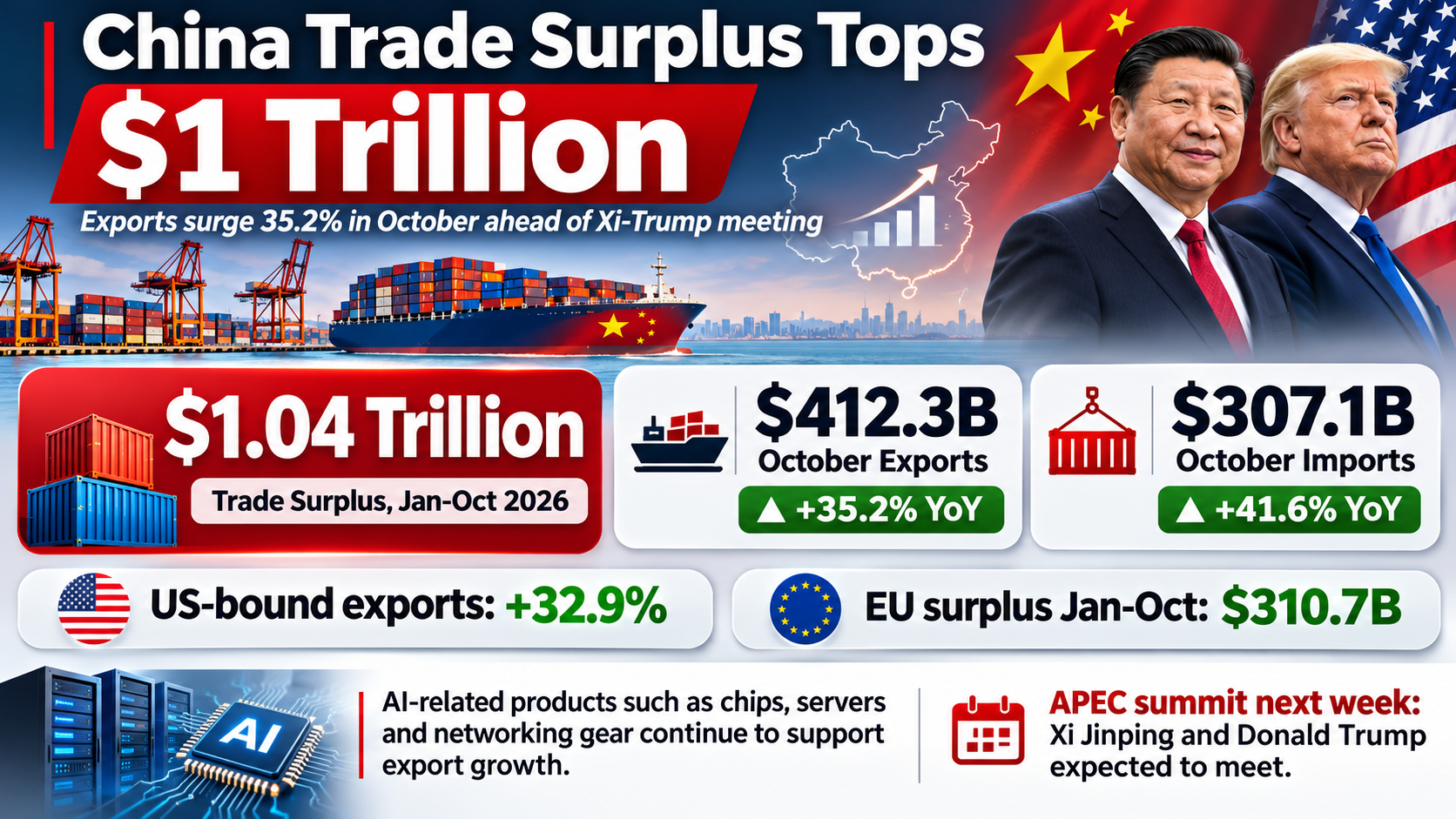
China’s export machine is gaining momentum, reaching another major milestone just days before a closely watched meeting between President Xi Jinping and US President Donald Trump. China’s trade surplus crossed $1 trillion during the first 10 months of 2026, highlighting the strength of its manufacturing and export industries despite persistent weakness in domestic consumption.
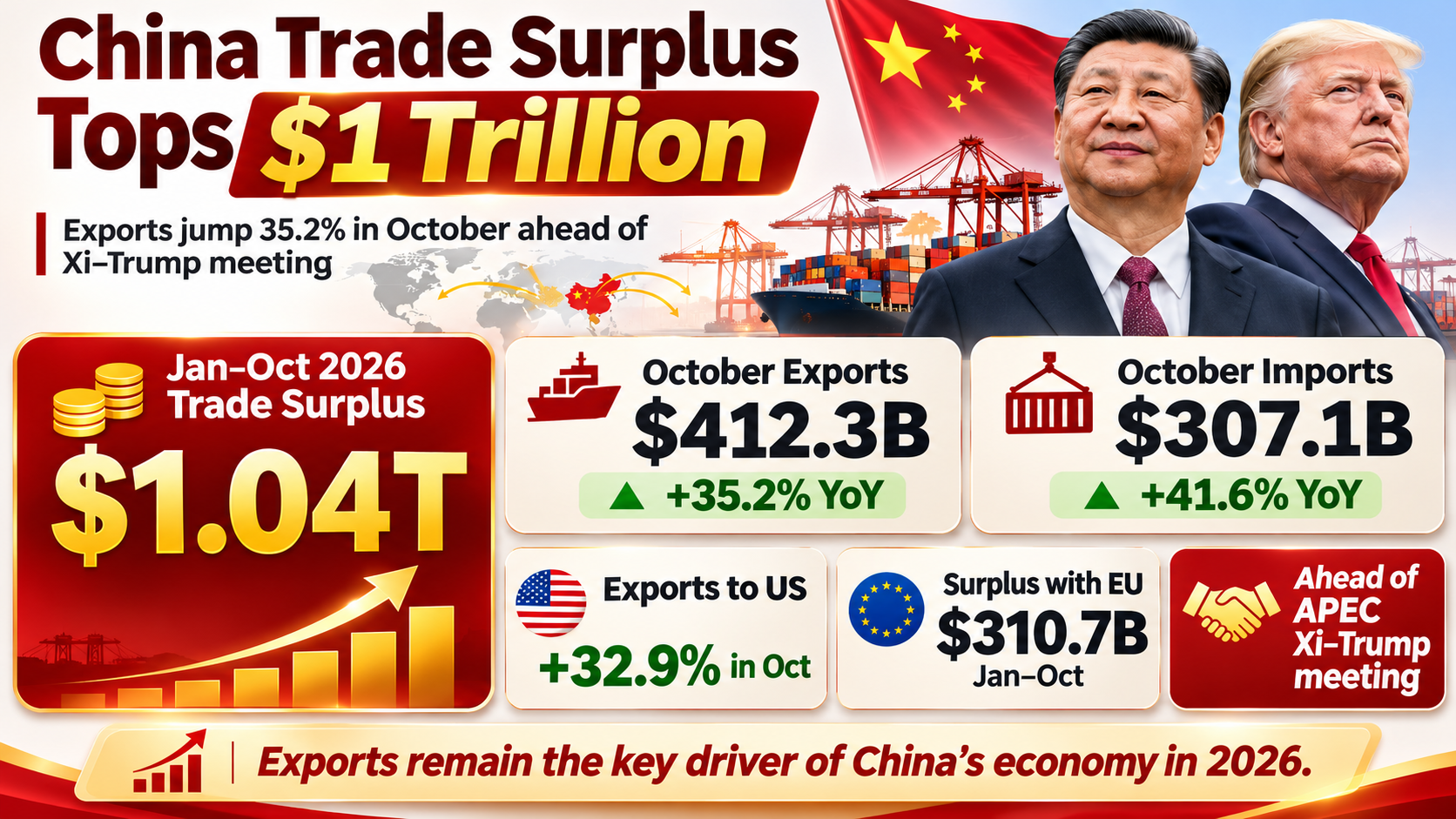
According to the General Administration of Customs (GAC), China’s trade surplus reached $1.04 trillion between January and October. The milestone was achieved earlier than last year, when the country crossed the $1 trillion mark in November.
The latest figures could have significant implications for global markets, semiconductor companies and international trade relations.
Track Live : GIFT Nifty Live – Today Price, Chart, Timings and Nifty Opening Signal
China’s Exports Up : AI Demand and Semiconductor Exports Strengthen China’s Economic Outlook
One of the biggest factors behind China’s export growth is increasing global demand for AI infrastructure.
Technology companies worldwide are investing heavily in data centres, computing infrastructure and networking equipment. This has created opportunities for manufacturers supplying semiconductor-related products and electronic components.
The export boom is providing support to China’s economy at a time when domestic activity remains under pressure from longstanding problems in the property sector.
China is targeting economic growth of 4.5% to 5% this year. However, sluggish domestic consumption and inflation remaining below the government’s approximately 2% target continue to present challenges.
China’s exports surge 35.2%, beating market expectations
October export growth was stronger than economists had anticipated.
| Indicator | October 2026 | September 2026 |
|---|---|---|
| Export growth | 35.2% | 36.3% |
| Import growth | 41.6% | 31.0% |
| Monthly trade surplus | $105.3 billion | $133.5 billion |
Economists surveyed by Reuters had expected exports to increase 33.5% and imports to rise 32%.
Both figures exceeded expectations.
However, imports expanded faster than exports, causing China’s monthly trade surplus to narrow from September’s $133.5 billion to approximately $105.3 billion in October.
Track Live : NSE Commodity Option Chain — Live MCX Options Data for Crude Oil, Gold, Silver & More
Xi-Trump Meeting Could Become the Next Major Global Market Trigger
The latest trade figures arrive ahead of the expected meeting between Xi Jinping and Donald Trump at the Asia-Pacific Economic Cooperation (APEC) summit in Shenzhen on November 18–19.
The two leaders have been navigating an uneasy truce following their prolonged trade conflict.
Exports to the United States surged 32.9% in October, according to Chinese customs data.
Investors will closely watch whether the upcoming meeting produces progress on tariffs, trade restrictions and technology-related disputes.
The possibility of further negotiations could improve global investor sentiment. However, renewed trade tensions could create volatility for companies dependent on international supply chains.
Could Vladimir Putin also participate?
Trump has indicated that he expects to meet Xi and Russian President Vladimir Putin during the APEC gathering.
A possible trilateral meeting could address broader geopolitical issues, including nuclear arms control and the Russia-Ukraine conflict.
However, this should be treated as a possibility rather than a confirmed formal trilateral summit.
Track Live : NSE Option Chain — Live | BSE Option Chain — Live Sensex & Bankex Options Data Today
China’s Growing Trade Surplus With Europe Raises Competition Concerns
China’s expanding trade surplus is also creating tensions with other major trading partners.
Its surplus with the European Union reached $310.7 billion during January-October, compared with $241.6 billion in the same period last year.
European policymakers are increasingly concerned that cheaper Chinese products could put pressure on domestic manufacturers.
Recent discussions between European and Chinese trade officials resulted in an agreement to limit exports of hybrid vehicles to Europe.
These developments indicate that China’s export strength could face increasing regulatory and trade-related challenges.
China is on track to exceed its $1.2 trillion annual trade surplus record
China recorded a trade surplus of approximately $1.19 trillion in 2025, crossing the $1 trillion milestone in November of that year.
In 2026, the country achieved the same milestone a month earlier.
| Period | Trade surplus |
|---|---|
| January–October 2025 | $964.8 billion |
| January–October 2026 | $1.04 trillion |
| Full-year 2025 | Approximately $1.19 trillion |
The latest figures represent an increase of approximately 7.8% compared with the corresponding 2025 period.
AI boom becomes a major driver of China’s export growth
One of the biggest factors behind China’s export expansion is the global race to build AI infrastructure.
Demand for AI-related products has increased purchases of Chinese-made:
-
Semiconductor chips and electronic components.
-
Data-centre servers.
-
Networking equipment.
-
Printed circuit boards.
-
Memory and computing hardware.
Reuters reported that China’s semiconductor exports increased 111.1% year-on-year during January–October 2026, while exports of high-tech products rose 47.9%.
These figures demonstrate how AI infrastructure investment is supporting China’s manufacturing and export industries.
The global expansion of data centres requires substantial quantities of computing equipment, networking hardware and electronic components. Chinese manufacturers are benefiting from this demand, particularly in products that do not require the most advanced semiconductor technology.
Read More : GIFT Nifty Gains High Hopes for Wednesday as Oil Cools Below $100 After Diwali Break
China’s trade surplus with the United States and European Union raises concerns
China’s expanding trade surplus is increasing pressure on its major trading partners.
US-China trade relations
China’s exports to the United States increased 32.9% in October, according to the supplied customs report.
However, China’s trade surplus with the US narrowed to $32.71 billion in October from $34.01 billion in September.
The broader imbalance remains a major source of disagreement between Washington and Beijing.
China-EU trade relations
China’s trade surplus with the European Union exceeded $310 billion during January–October 2026, compared with $241.6 billion during the corresponding period last year, according to the supplied report.
This growing imbalance has increased concerns among European manufacturers about competition from lower-cost Chinese products.
The EU has been considering stronger trade protections for domestic industries.
Hybrid vehicle export restrictions
An important development is the agreement reached during October discussions in Beijing between EU trade commissioner Maros Sefcovic and China’s commerce minister Wang Wentao.
The agreement seeks to limit Chinese hybrid vehicle exports to Europe over the coming years.
Because the measures have not yet taken effect, some Chinese manufacturers are expected to accelerate shipments before restrictions become operational.
| Important development | Additional |
|---|---|
| Semiconductor exports | Increased 111.1% in January–October |
| High-tech exports | Increased 47.9% |
| October crude oil imports | Highest level since March 2026 |
| Rare-earth exports | Increased 2.7% from September |
| Domestic vehicle sales | Declined for the 12th consecutive month |
| US-China trade surplus | $32.71 billion in October |
| EU-China trade surplus | More than $310 billion in January–October |
| US-China trade truce | Extended by two months on November 9 |
| 2026 GDP target | 4.5%–5.0% |
| APEC summit | November 18–19 in Shenzhen |
One particularly interesting development is the increase in China’s crude oil imports. Reuters reported that purchases reached their highest level since March as buyers adjusted to supply disruptions in the Middle East.
Rare-earth exports also edged higher, potentially indicating some easing in the contraction caused by export-control restrictions.
What China’s Export Boom Means for Indian Investors
China’s rising exports could create both opportunities and competitive challenges for Indian companies.
Strong global demand for AI infrastructure may support sentiment across semiconductor, electronics manufacturing and data centre-related stocks.
Indian companies such as Dixon Technologies, Kaynes Technology and CG Power could attract investor attention as global electronics and infrastructure spending expands. However, China’s export growth does not automatically translate into higher earnings for these companies.
On the other hand, aggressive Chinese pricing could increase competition for Indian manufacturers in electronics, engineering goods and other export-oriented industries.
Investors should monitor the Xi-Trump meeting, global semiconductor demand, trade restrictions and China’s domestic consumption trends.