
Defence Exports: Defence Ministry Seeks 20% Capex Increase as Defence Stocks Gain Attention
Could India’s defence sector be heading towards another major investment cycle? The Defence Ministry has sought a further 20% increase in capital expenditure for the coming year, raising expectations of fresh orders, manufacturing opportunities and long-term growth for domestic defence companies.
Defence Secretary Rajesh Kumar Singh announced the proposal at FICCI’s Annual Convention, expressing confidence that the ministry would secure the higher allocation.
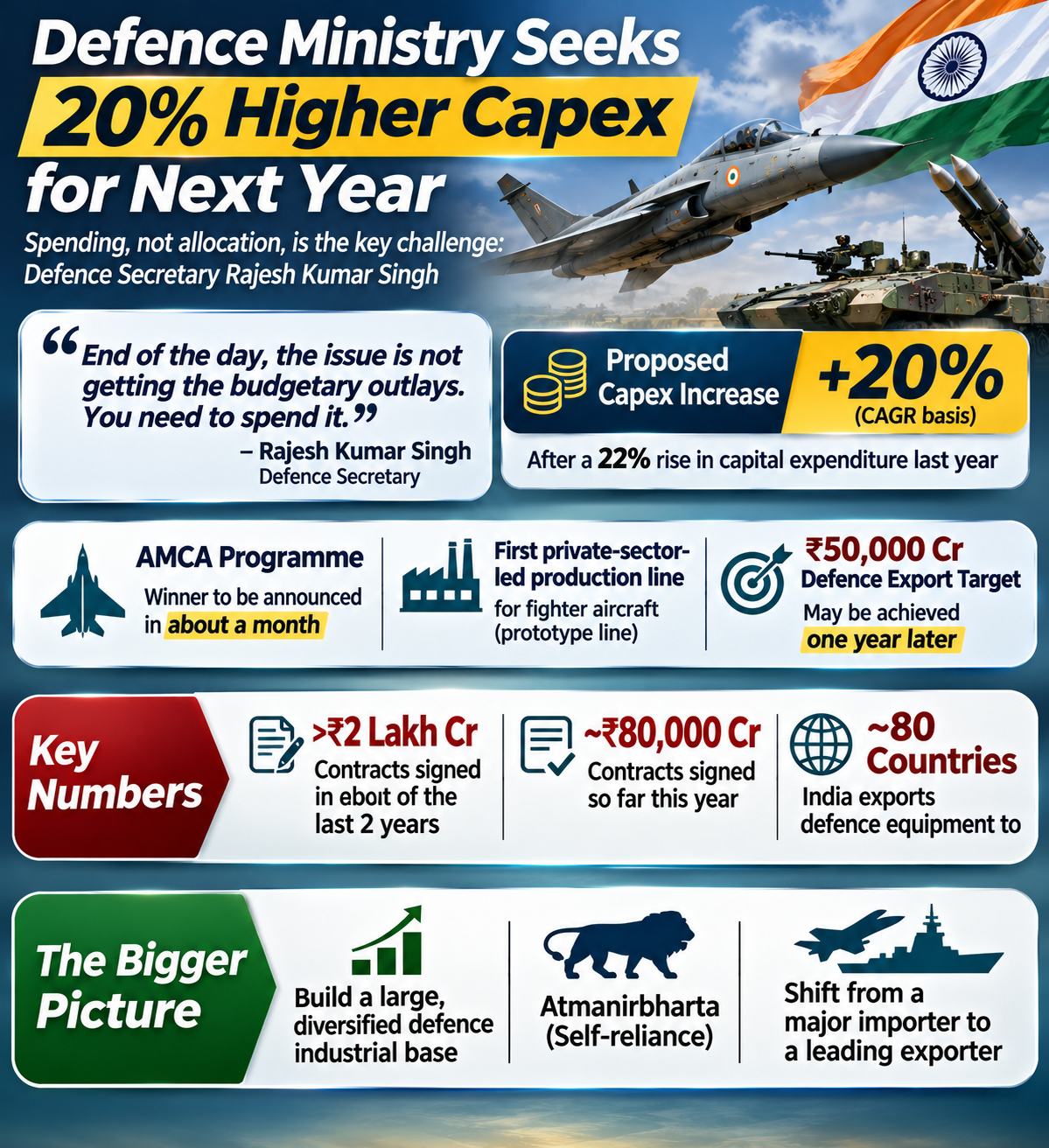
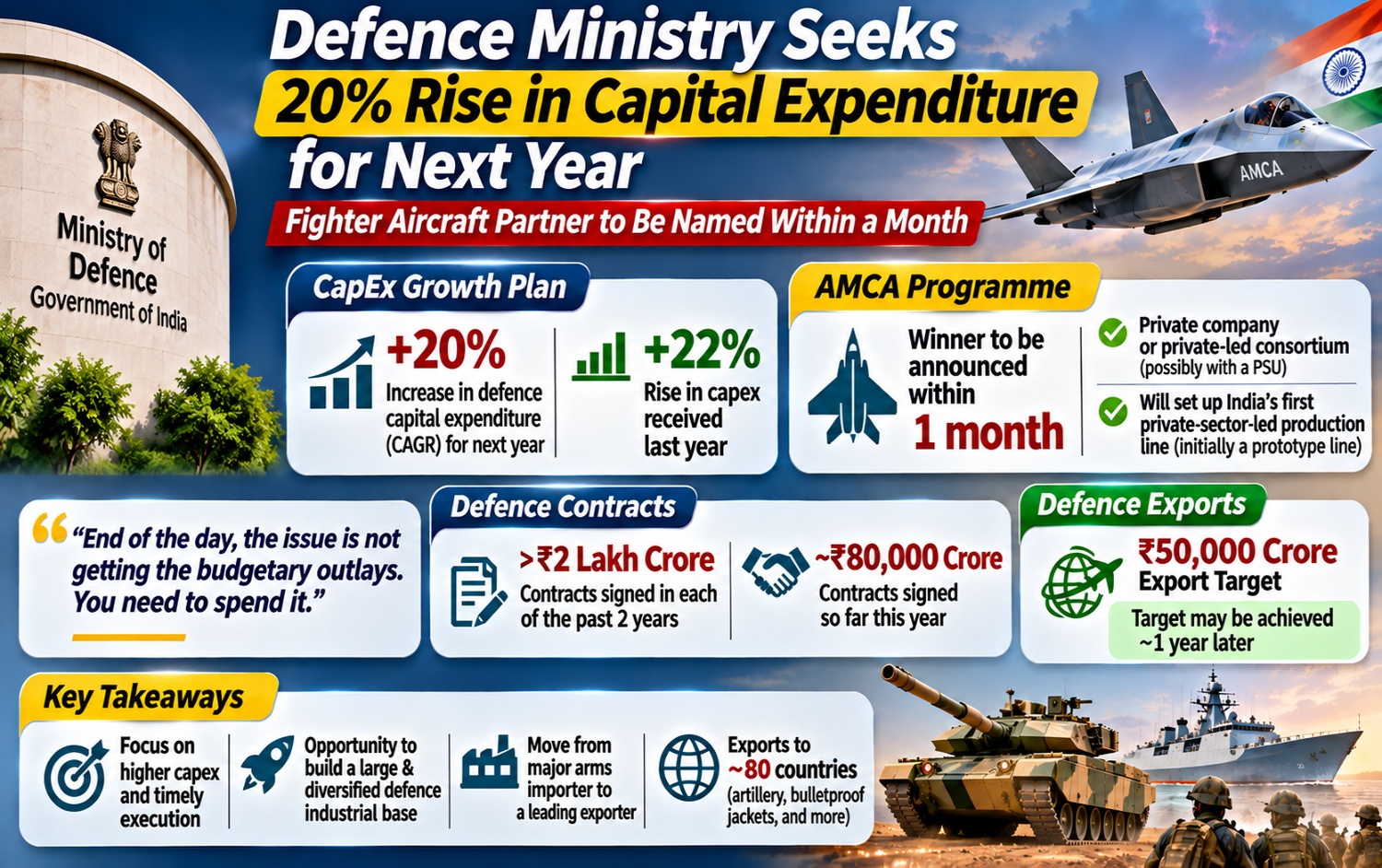
The proposed increase comes after a 22% rise in defence capital expenditure last year. For investors tracking defence stocks, the development could become an important trigger ahead of the Union Budget, particularly for companies involved in aircraft manufacturing, defence electronics, missiles and military equipment.
However, the government has highlighted an important challenge: ensuring that allocated funds are actually spent.
Track Live : NSE F&O Lot Size | FII DII Data Today
Defence Exports: Defence Secretary Says Spending Matters More Than Budget Allocation
Singh emphasised that higher budgetary allocations alone would not strengthen India’s defence manufacturing ecosystem unless the funds were utilised effectively.
“End of the day, the issue is not getting the budgetary outlays. You need to spend it,” he said.
He explained that the ministry must complete existing commitments, sign contracts and ensure their fulfilment before moving towards new procurement commitments.
The Defence Ministry has signed defence contracts worth more than Rs 2 lakh crore in each of the previous two years. So far in the current year, contracts worth approximately Rs 80,000 crore have been signed, including several major procurement agreements.
The ministry intends to set another record, indicating that defence procurement could remain a significant growth driver for domestic manufacturers.
Key details:
-
Current FY27 capital allocation: approximately ₹2.19 lakh crore.
-
Previous year’s increase: approximately 22%.
-
Additional increase sought: 20%.
-
Objective: Military modernisation, equipment procurement and domestic defence manufacturing.
The FY27 capital allocation of ₹2,19,306 crore represents a 21.84% increase over FY26’s budget estimate of ₹1.80 lakh crore.
Track Live : NSE Option Chain — Live | BSE Option Chain — Live Sensex & Bankex Options Data Today
Defence Exports: India May Miss the ₹50,000 Crore Target
India wants to become a major defence exporter rather than remain among the world’s largest arms importers.
However, Singh acknowledged that the ₹50,000 crore defence export target could be achieved approximately one year later than originally planned.
Important figures:
| Particulars | Details |
|---|---|
| Latest reported defence exports | Approximately ₹40,000 crore |
| Government export target | ₹50,000 crore |
| Target year stated by government | 2029 |
| Export destinations | Around 80 countries |
India exports a wide range of defence products, including artillery guns, ammunition, bulletproof jackets and other military equipment.
Defence Production Reaches ₹1.78 Lakh Crore
Another important development is the expansion of India’s domestic defence manufacturing industry.
According to the Defence Ministry:
-
Defence production reached a record ₹1.78 lakh crore in FY26.
-
Production stood at ₹46,429 crore in FY15.
-
The government targets ₹3 lakh crore in defence production by 2029.
-
The defence export target is ₹50,000 crore by 2029.
This demonstrates the scale of India’s defence manufacturing ambitions.
Why Spending Matters More Than Budget Allocation
Singh highlighted an important challenge facing the Defence Ministry: the ability to utilise allocated funds.
He explained that higher budgetary allocations alone would not strengthen defence capabilities unless procurement contracts were signed and fulfilled.
The ministry wants to:
-
Complete existing procurement commitments.
-
Accelerate contract execution.
-
Avoid accumulating unutilised allocations.
-
Provide clearer demand visibility to defence manufacturers.
-
Improve delivery timelines for military equipment.
India’s Defence Budget Reaches ₹7.85 Lakh Crore
The Union Budget 2026–27 allocated approximately ₹7.85 lakh crore to the Ministry of Defence.
Defence Budget 2026–27
₹7.85 lakh crore
| Allocation category | Amount |
|---|---|
| Total defence budget | ₹7.85 lakh crore |
| Capital expenditure | ₹2.19 lakh crore |
| Capital acquisition | ₹1.85 lakh crore |
| Domestic defence procurement earmark | ₹1.39 lakh crore |
| DRDO allocation | ₹29,100 crore |
AMCA Programme Winner Expected Within a Month
Another major development for the Indian defence industry is the upcoming selection of the winner of the Advanced Medium Combat Aircraft (AMCA) programme.
Singh said the government expects to announce the selected entity within approximately one month.
The winner will be a private-sector company or a private-sector-led consortium, potentially involving a public-sector company.
The selected entity will operate India’s first private-sector-led fighter aircraft production line, initially focusing on prototype manufacturing.
Singh described the initiative as a potential game changer for India’s military aviation industry.
The AMCA programme could create opportunities across aircraft manufacturing, engineering, defence components and advanced aviation technologies. It also represents an important step towards greater private-sector participation in India’s defence ecosystem.
| Bidder | Consortium details |
|---|---|
| Tata Advanced Systems | Independent bid |
| L&T-led consortium | L&T, BEL and Dynamatic Technologies |
| Bharat Forge-led consortium | Bharat Forge, BEML and Data Patterns |
Hindustan Aeronautics Limited (HAL) did not qualify in the technical evaluation.
Track Live : Nifty Levels Today | Sensex Levels Today
India Targets Defence Export Growth as Global Demand Rises
Singh said ongoing international conflicts have created new opportunities for Indian defence manufacturers, particularly in European markets.
He described 2026 as a difficult year because of geopolitical tensions but noted that increasing global military expenditure could support India’s ambition to develop a diversified defence industrial base.
India currently exports defence equipment to approximately 80 countries. Its export portfolio includes artillery guns, bulletproof jackets and other military equipment.
The Defence Secretary also acknowledged that India could miss its Rs 50,000 crore defence export target within the original deadline.
“We may hit that target perhaps one year later,” he said.
He stressed that India should move beyond being one of the world’s largest arms importers and focus on becoming a major defence exporter.
Read More : Reliance Shares Rally 17% in 11 Sessions: What’s Behind the Rs 2.74 Lakh Crore Gain?
Which Listed Defence Stocks Could Benefit?
The proposed 20% increase in defence capital expenditure could create opportunities for these six listed companies.
| Company | Defence business | Potential growth driver |
|---|---|---|
| HAL | Fighter aircraft, helicopters, aerospace | Tejas Mk1A and aircraft modernisation |
| BEL | Radars, defence electronics, communication | QRSAM, electronic warfare and radar orders |
| BDL | Missiles and guided weapons | Akash, Astra and air-defence systems |
| Mazagon Dock | Submarines and warships | Submarine and naval procurement |
| Cochin Shipyard | Warships and ship repairs | Naval modernisation and shipbuilding |
| Bharat Forge | Artillery and aerospace components | AMCA consortium and defence manufacturing |
Latest reported order books
Figures in ₹ crore; reporting periods differ.
| Company | Order book |
|---|---|
| HAL | 2,54,538 |
| BEL | 68,717 |
| BDL | 26,176 |
| Cochin Shipyard | 22,000 |
| Mazagon Dock | 18,218 |
| Bharat Forge | Not separately established |
Here’s What Happened Today and Why Traders Reacted
The proposed 20% defence capital expenditure increase and the upcoming AMCA selection have brought the domestic defence sector into focus.
For traders, higher defence spending signals the possibility of fresh procurement orders and stronger revenue visibility for companies supplying military equipment.
However, the actual benefit will depend on budget approval, contract awards, execution timelines and the ability of companies to convert government spending into earnings.
The distinction between announced allocations and actual expenditure will therefore remain important for market participants.
What Should Defence Stock Investors Watch Next?
Investors should closely monitor the upcoming Union Budget, defence procurement announcements and the selection of the AMCA programme winner.
Companies operating in aerospace, missiles, defence electronics, shipbuilding and military equipment could benefit from an expanding domestic procurement pipeline.
The government’s emphasis on private-sector participation and defence exports also creates opportunities beyond traditional public-sector defence manufacturers.
However, investors should not assume that higher capital expenditure will immediately translate into higher profits. Contract execution, margins, order-book quality and valuations will remain critical factors.