Nvidia Surged Up as CEO Comeback Sparks a Historic Rally but Raises Questions About Corporate Governance
Nvidia’s leadership crisis has taken an unexpected turn, but the company’s latest decision has created a bigger question for investors: who really controls one of the world’s most valuable technology companies?
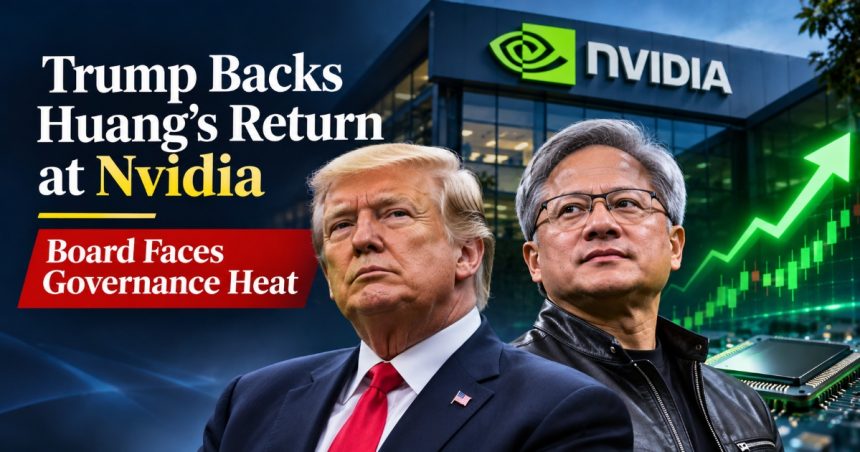
Nvidia Corp. has reinstated Jensen Huang as its President and Chief Executive Officer, just 11 days after his resignation. The decision followed intervention and public support from US President Donald Trump, who said his involvement was important in convincing the company’s board to bring Huang back.
The development triggered a powerful rally in Nvidia shares, offering relief to investors who had been concerned about the company’s leadership uncertainty. However, the sudden reversal has also intensified questions about corporate governance, board independence and the influence of political leadership over major American companies.
The controversy comes at a critical time for the artificial intelligence industry, which is already facing concerns over massive infrastructure spending, chip demand and geopolitical tensions.
Track Live : GIFT Nifty Live – Today Price, Chart, Timings and Nifty Opening Signa
Nvidia Surged Up: Donald Trump Played a Major Role in Jensen Huang’s Return
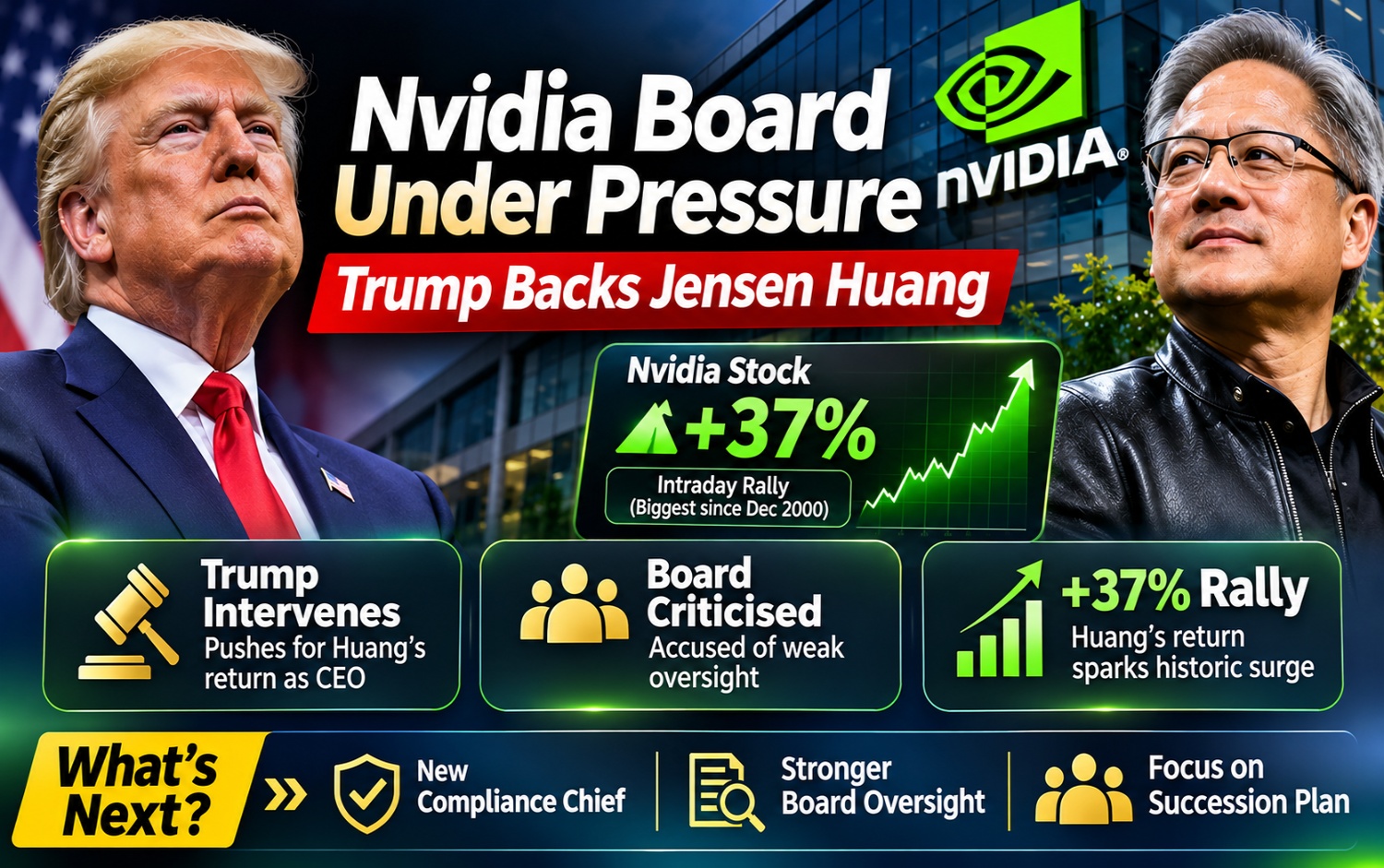
Trump publicly supported Huang’s return after the Nvidia board initially rejected his request to resume leadership.
Speaking to CNBC on Monday, Trump said, “I believe my intervention was very important.”
According to reports, Trump also contacted Nvidia directors and participated in discussions surrounding Huang’s reinstatement. He subsequently welcomed the board’s decision on Truth Social, describing it as the “correct and proper decision.”
Nvidia confirmed on November 23 that its board unanimously approved Huang’s return following discussions with him and input from senior levels of the US government.
The company said the board was satisfied with Huang’s candour and ability to lead Nvidia and believed his reinstatement posed no national security risk.
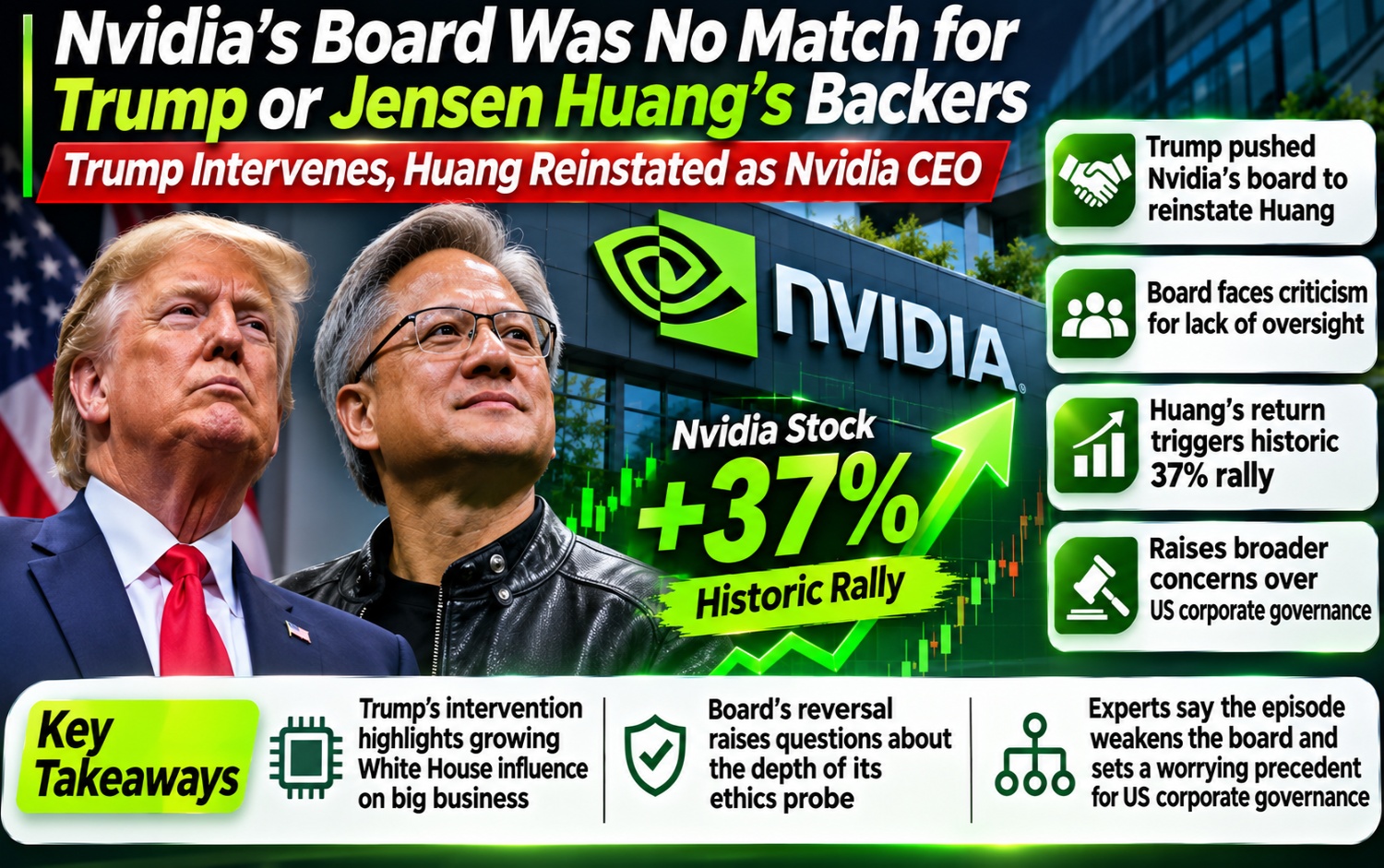
Nvidia Board Faces Questions Over Independence and Oversight
While Huang’s return has eased immediate leadership uncertainty, the decision has placed Nvidia’s board under considerable scrutiny.
The controversy began after revelations about Huang’s personal relationships, including an alleged relationship with a woman suspected of having links to Chinese intelligence. These allegations have not established that Huang knowingly participated in espionage or unlawful activity.
The board had initially resisted his return, but reversed its position within days.
Corporate governance experts have questioned whether the directors exercised sufficient independence when making the decision.
Columbia Law School professor John Coffee questioned the board’s independence, while Harvard Law School professor Lucian Bebchuk argued that pressure from the share price decline and presidential support influenced the decision.
The concerns extend beyond Huang’s reinstatement. Investors also want clarity about the company’s ongoing investigation and whether the board can independently oversee its chief executive.
What happened at Nvidia? Jensen Huang was reinstated just 11 days after resigning
Nvidia announced on November 23, 2026, that its board had unanimously reinstated Jensen Huang as President, Chief Executive Officer and a member of the board.
The decision reversed the board’s earlier position that it would not bring Huang back.
The company said its directors had held discussions and meetings with Huang and were satisfied with his candour and ability to lead Nvidia.
The board also confirmed that it had received input from senior levels of the US government before reaching its decision.
Important details:
| Particulars | Details |
|---|---|
| Company | Nvidia Corporation |
| CEO | Jensen Huang |
| Former interim CEO | Colette Kress |
| Board chairman | Harvey C. Jones |
| Resignation announced | November 12, 2026 |
| Reinstatement announced | November 23, 2026 |
| Time away from CEO position | 11 days |
| Reinstatement decision | Unanimous board vote |
| Government involvement | Input from senior US government officials |
| Investigation | Continues after reinstatement |
Nvidia said Huang’s reinstatement did not pose a national security risk, based on the input received from senior US government officials.
However, the company also confirmed that its independent investigation into a reported foreign intelligence effort targeting Huang would continue.
Track Live : NSE Option Chain — Live | BSE Option Chain — Live Sensex & Bankex Options Data Today
Why did Jensen Huang resign from Nvidia?
The controversy began after revelations about Huang’s personal relationships, including reported affairs involving a businesswoman and an Nvidia employee.
Huang acknowledged that he had made serious mistakes in his personal life and said he had not lived up to the standards expected of Nvidia employees.
One of the most sensitive aspects involved Alice Huang, a business executive associated with Singapore-based cloud-computing company Megaspeed.
US authorities have examined allegations concerning her possible links to Chinese intelligence and the potential diversion of restricted Nvidia chips to Chinese companies.
These developments raised questions about:
-
Huang’s personal conduct.
-
Potential conflicts of interest.
-
Compliance with Nvidia’s internal code of conduct.
-
National security implications.
-
The company’s relationship with businesses involved in advanced AI computing.
-
Whether Nvidia’s leadership had adequately disclosed relevant information.
Huang resigned on November 12, and the board accepted his resignation.
However, it is important not to confuse allegations with established findings.
The suspected Chinese intelligence connection has not been conclusively established in the cited reporting. China has also denied allegations that Alice Huang was a Chinese intelligence asset.
Why Jensen Huang’s Leadership Matters to Nvidia and the AI Industry
Huang, 63, transformed Nvidia from a graphics processing unit manufacturer into a global leader in AI computing and advanced semiconductors.
The company has become central to the development of AI infrastructure, with its processors powering data centres, cloud computing platforms and artificial intelligence applications.
His return is therefore significant for investors who view leadership continuity as an important factor in Nvidia’s long-term growth strategy.
However, the company’s challenges have not disappeared. Nvidia continues to face scrutiny over potential national security issues, export controls and allegations surrounding the movement of advanced chips to China.
The board has formed a separate committee to oversee national security and export control matters. It has also announced plans to appoint a new chief compliance officer.
What Nvidia’s Latest Development Means for Investors and AI Stocks
For investors, Jensen Huang’s reinstatement offers short-term relief by removing uncertainty surrounding Nvidia’s leadership.
However, the longer-term outlook will depend on the outcome of investigations, corporate governance reforms and the company’s ability to maintain its position in the global AI semiconductor market.
Investors should particularly monitor:
-
Nvidia shares: Whether the recent rally sustains or profit booking emerges.
-
AI stocks: Whether the positive sentiment spreads to semiconductor and technology companies.
-
Corporate governance: Whether Nvidia strengthens independent board oversight.
-
China exposure: How export restrictions and national security investigations affect future business.
-
AI spending: Whether demand for data centres and advanced processors supports earnings growth.
The development could also influence investor sentiment towards other AI-related companies, particularly those with significant exposure to Nvidia’s semiconductor ecosystem.
Here’s What Happened Today and Why Traders Reacted
Nvidia’s announcement became a major catalyst for global technology stocks on November 23.
Shares surged more than 30% in early trading, with Reuters reporting a gain of around 33%. Some market coverage reported an intraday rise approaching 37%. The rally followed a difficult period during which Nvidia had lost substantial market value amid leadership uncertainty.
The recovery also supported broader US equities. The Nasdaq gained around 6% in early trading, while the S&P 500 advanced approximately 4%, according to Reuters.
The market reaction reflected investors’ confidence in Huang’s importance to Nvidia’s AI business and the wider semiconductor industry.
What Should Traders Watch in the Coming Sessions?
Nvidia’s leadership comeback has restored confidence among some investors, but it has also created new questions about the independence of corporate boards and the relationship between government and major technology companies.
The company’s share price performance, ongoing investigations and upcoming regulatory developments will remain important market triggers.