HDFC Bank Rebound extend recovery as buying interest strengthens
HDFC Bank shares attracted fresh buying interest on Thursday, November 26, rising nearly 2.5% after the private sector lender announced an important board-level decision. The stock’s recovery has gained momentum since its late-October lows, bringing it back into focus among banking sector investors.
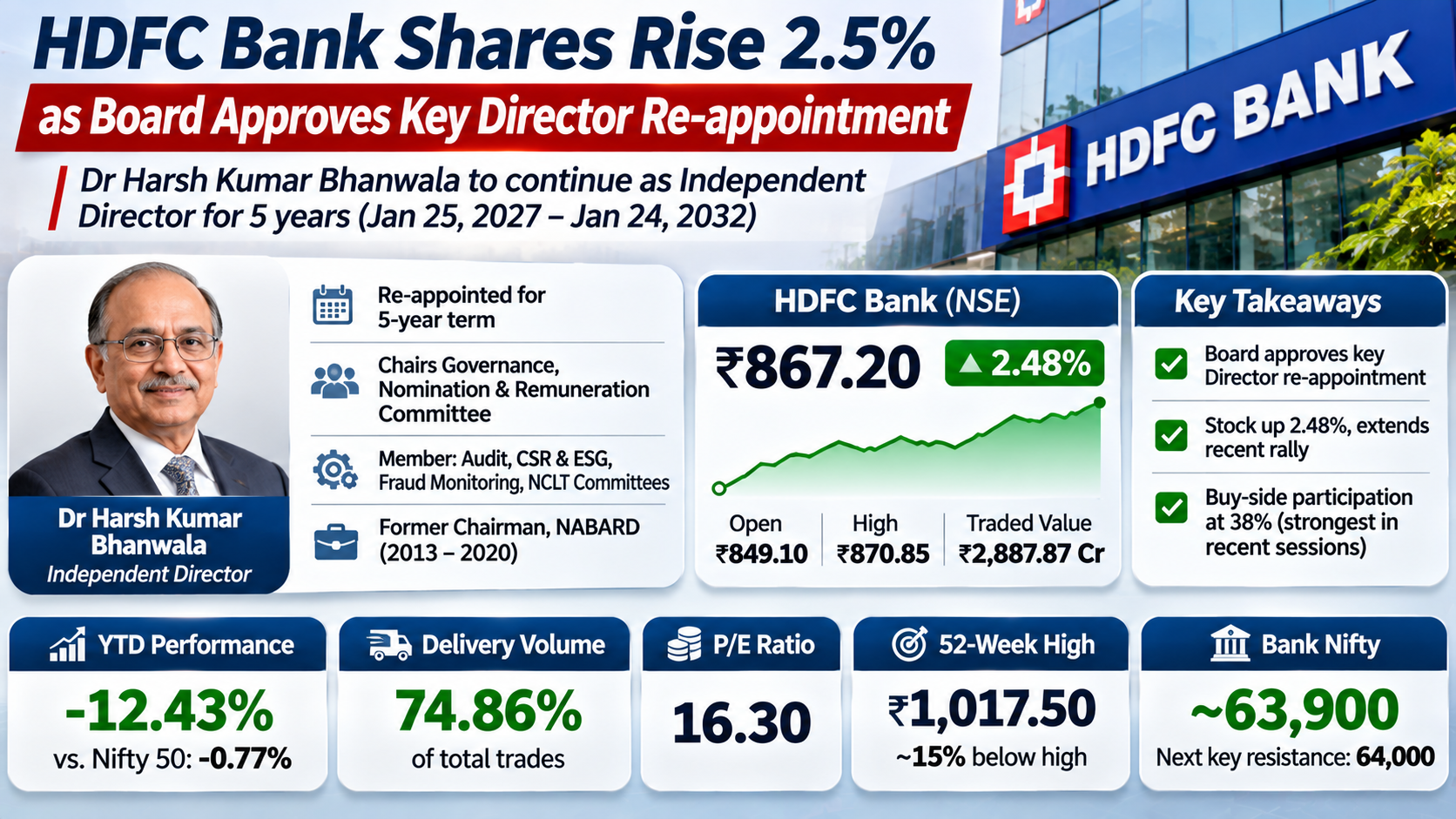
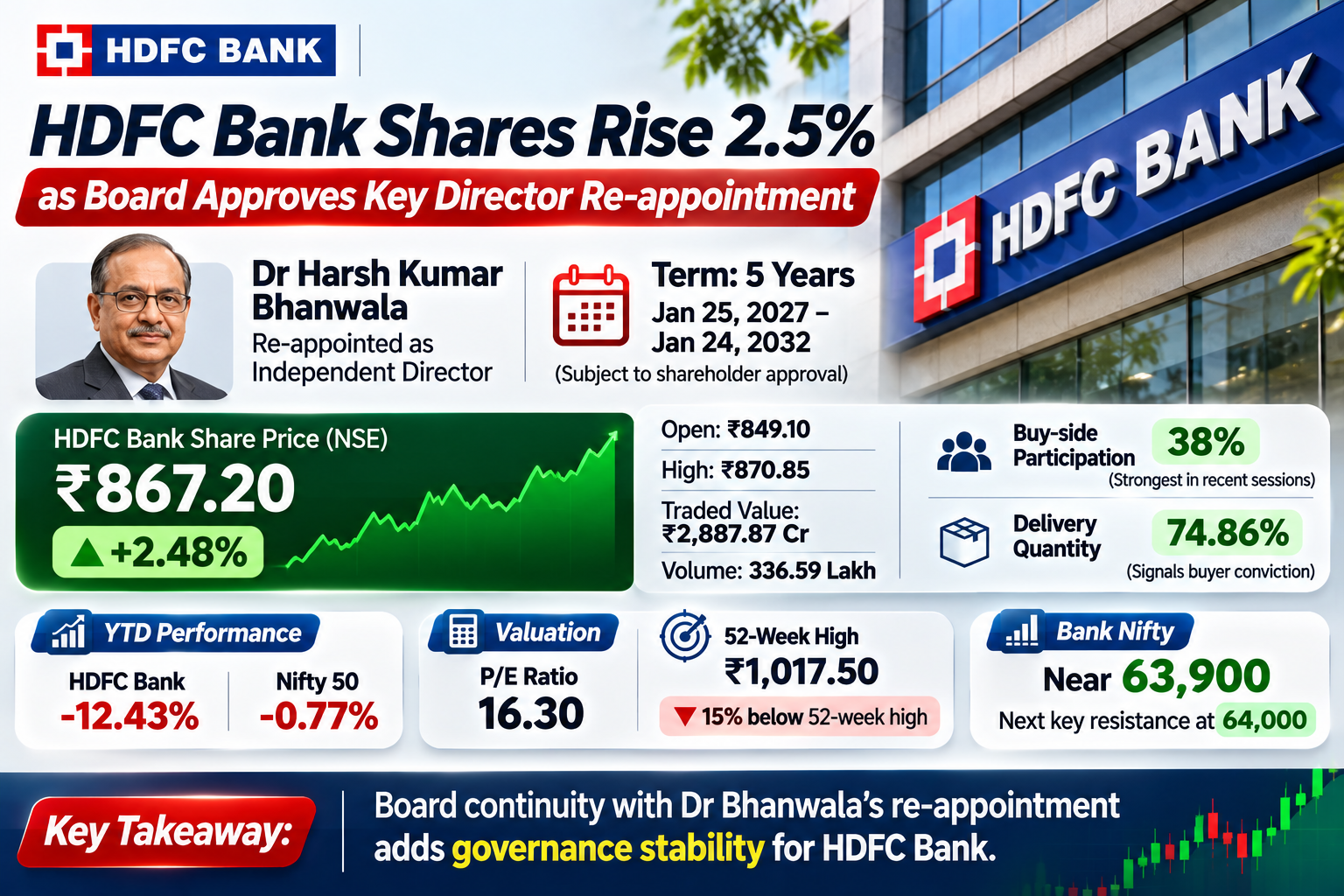
HDFC Bank shares advanced 2.48% to Rs 867.20 on the NSE during morning trade. The rally followed the bank’s disclosure that its board had approved the re-appointment of Dr Harsh Kumar Bhanwala as an Independent Director for another five-year term.
The development comes at a time when the stock continues to underperform the broader market on a year-to-date basis, making its recent recovery particularly important for investors.
Track Live : NSE Option Chain — Live | BSE Option Chain — Live Sensex & Bankex Options Data Today
HDFC Bank Rebound price movement signals stronger buying participation
The stock opened at Rs 849.10 and touched an intraday high of Rs 870.85 before trading at Rs 867.20.
Market participation also improved during the session. Buy-side participation reached 38%, its strongest reading in recent sessions.
HDFC Bank recorded a traded value of Rs 2,887.87 crore, with 336.59 lakh shares changing hands. More importantly, delivery volume accounted for 74.86% of the traded quantity.
The relatively high delivery percentage indicates that a significant proportion of shares traded during the session resulted in delivery rather than being squared off within the trading day.
The stock has gained nearly 30% from its late-October lows, highlighting a substantial recovery in recent weeks.
The board approved the proposal following a recommendation from its Governance, Nomination and Remuneration Committee.
| Appointment details | Information |
|---|---|
| Bank | HDFC Bank |
| Director | Dr Harsh Kumar Bhanwala |
| Designation | Independent Director |
| Board approval date | November 25, 2026 |
| New tenure begins | January 25, 2027 |
| New tenure ends | January 24, 2032 |
| Duration | Five years |
| Approval pending | Shareholder approval |
| DIN | 06417704 |
Track Live : NSE F&O Lot Size | FII DII Data Today
HDFC Bank continues to underperform the Nifty 50 in 2026
Despite the recent rally, HDFC Bank’s broader performance remains under pressure.
Its year-to-date loss narrowed to 12.43%, compared with a decline of just 0.77% in the Nifty 50.
The stock currently trades at a price-to-earnings (P/E) ratio of 16.30 and remains approximately 15% below its 52-week high of Rs 1,017.50.
For investors, this performance gap highlights why the recent recovery needs to be assessed alongside the bank’s longer-term earnings and valuation outlook.
How does HDFC Bank compare with the Nifty 50?
According to the supplied report, HDFC Bank’s year-to-date loss narrowed to 12.43%, compared with a 0.77% decline in the Nifty 50.
| Performance indicator | Reported YTD return |
|---|---|
| HDFC Bank | -12.43% |
| Nifty 50 | -0.77% |
This highlights that HDFC Bank has continued to underperform the broader benchmark despite its recent recovery.
HDFC Bank shares rise 2.48%
HDFC Bank shares gained 2.48% to ₹867.20 on the NSE during Thursday morning trading, according to the supplied market report.
The stock opened at ₹849.10 and touched an intraday high of ₹870.85.
Trading activity also increased, with reported traded value of ₹2,887.87 crore and volume of 336.59 lakh shares.
HDFC Bank share-price performance
| Stock-market indicator | Reported figure |
|---|---|
| Previous closing price | Approximately ₹846.20 |
| Opening price | ₹849.10 |
| Intraday high | ₹870.85 |
| Reported trading price | ₹867.20 |
| Intraday gain | 2.48% |
| Traded volume | 336.59 lakh shares |
| Traded value | ₹2,887.87 crore |
| Delivery percentage | 74.86% |
| P/E ratio | 16.30 |
| 52-week high | ₹1,017.50 |
The previous closing price of ₹846.20 is also consistent with the November 25 market-data snapshot.
Track Live : Nifty Levels Today | Sensex Levels Today | Bank Nifty Levels Today
Bank Nifty resistance at 64,000 remains important for traders
The banking sector benchmark, Bank Nifty, held near the 63,900 level, with market participants monitoring 64,000 as the next important resistance.
A sustained move above this level could improve sentiment towards banking stocks, while failure to cross it may encourage profit-booking.
HDFC Bank’s recent recovery and stronger trading participation could keep the stock on traders’ radar.
HDFC Bank’s Q2 FY27 results provide an important fundamental backdrop
Beyond the board announcement and share-price movement, investors should also examine the bank’s latest financial performance.
HDFC Bank reported a 4.7% year-on-year increase in standalone net profit to ₹19,510 crore in Q2 FY27.
Net interest income (NII), which represents the difference between interest earned and interest paid, increased 9.7% to ₹34,620 crore.
The bank’s loan growth and deposit mobilisation remained strong, although lower treasury gains and higher expenses restricted overall profit growth.
HDFC Bank Q2 FY27 financial performance
| Financial indicator | Q2 FY27 | Year-on-year growth |
|---|---|---|
| Standalone net profit | ₹19,510 crore | 4.7% |
| Net interest income | ₹34,620 crore | 9.7% |
| Gross advances | ₹32.20 lakh crore | 16.3% |
| Total deposits | ₹33.27 lakh crore | 18.8% |
| Other income | ₹13,830 crore | -3.6% |
| Provisions and contingencies | ₹3,570 crore | — |
| Net interest margin (NIM) | 3.16% of total assets | — |
| Cost-to-income ratio | 39.1% | — |
Track Live : NSE Commodity Option Chain — Live MCX Options Data for Crude Oil, Gold, Silver & More
HDFC Bank shares have recovered nearly 30% from late-October lows
The latest gain comes after a substantial recovery in HDFC Bank shares from their late-October levels.
The stock had fallen to approximately ₹669.20 on October 30, 2026, before recovering sharply in November.
By November 11, the shares had already gained around 22% in ten trading sessions, according to an Economic Times report.
The recovery was supported by improving investor sentiment, easing governance concerns and expectations of better operating performance.
HDFC Bank’s asset quality remains relatively strong
Asset quality is another important factor for investors evaluating the bank’s financial position.
HDFC Bank’s gross non-performing asset (GNPA) ratio improved to 1.11% in September 2026, compared with 1.17% in June 2026 and 1.24% in September 2025.
Its net NPA ratio stood at 0.37%.
| Asset-quality indicator | Q2 FY27 | Q1 FY27 |
|---|---|---|
| Gross NPA ratio | 1.11% | 1.17% |
| Net NPA ratio | 0.37% | Not specified here |
| GNPA excluding agricultural NPAs | 0.87% | 0.91% |
| Credit cost ratio | 0.44% | — |
HDFC Bank valuation: Is the stock still trading below its historical peak?
According to the supplied market snapshot, HDFC Bank was trading at a price-to-earnings (P/E) ratio of approximately 16.30.
The stock remained around 15% below its 52-week high of ₹1,017.50.
A lower share price relative to its previous peak does not automatically mean that a stock is undervalued. Investors should also examine earnings growth, return on assets, return on equity and future margin expectations.
Valuation indicators
| Valuation indicator | Reported figure |
|---|---|
| Share price | ₹867.20 |
| P/E ratio | 16.30 |
| 52-week high | ₹1,017.50 |
| Distance from 52-week high | Approximately 14.8% |
| Q2 FY27 standalone EPS | Approximately ₹13.70 |
The EPS figure is calculated from reported quarterly standalone profit and the approximate weighted share count, rather than being a forward earnings estimate.
HDFC Bank: Additional information for investors
| Particulars | Details |
|---|---|
| Official board filing date | November 25, 2026 |
| Regulatory disclosure | SEBI Regulation 30 |
| Director’s name | Dr Harsh Kumar Bhanwala |
| Director Identification Number (DIN) | 06417704 |
| Designation | Independent Director |
| Reappointment period | January 25, 2027 – January 24, 2032 |
| Tenure | Five years |
| Approval status | Board approved; shareholder approval pending |
| Professional experience | Approximately 40 years |
| NABARD chairmanship | December 18, 2013 – May 27, 2020 |
| Educational qualification | B.Sc. in Dairy Technology, NDRI |
| Management qualification | Postgraduate in Management, IIM Ahmedabad |
| Doctoral qualification | PhD in Management |
| Previous position at IIFCL | Executive Director and Chairman-cum-Managing Director |
| Other leadership position | Former Managing Director, Delhi State Cooperative Bank |
| Other board-level experience | Chairman, NABARD Consultancy Services |
| HDFC Bank committee | Chairman, Governance, Nomination and Remuneration Committee |
| Other committee memberships | Audit, CSR & ESG, Fraud Monitoring and NCLT Matters |
HDFC Bank Q2 FY27 financial performance
| Financial indicator | Q2 FY27 | Year-on-year growth |
|---|---|---|
| Standalone net profit | ₹19,510 crore | 4.7% |
| Net interest income (NII) | ₹34,620 crore | 9.7% |
| Gross advances | ₹32.20 lakh crore | 16.3% |
| Total deposits | ₹33.27 lakh crore | 18.8% |
| Gross NPA ratio | 1.11% | Improved from 1.24% |
| Net NPA ratio | 0.37% | — |
| Net interest margin | 3.16% | — |
| Cost-to-income ratio | 39.1% | — |
HDFC Bank leadership update
| Particulars | Details |
|---|---|
| New MD and CEO | Anup Bagchi |
| Appointment effective date | October 27, 2026 |
| Previous position | MD and CEO, ICICI Prudential Life Insurance |
| Previous banking role | Executive Director, ICICI Bank |
| Professional experience | More than three decades |
| Management qualification | IIM Bangalore |
| Engineering qualification | IIT Kanpur |
| Appointment tenure | Three years |
Who is Dr Harsh Kumar Bhanwala? His 40 years of experience explained
Dr Harsh Kumar Bhanwala brings approximately 40 years of professional experience across banking, financial services, rural development, institutional governance and agricultural finance.
His experience is particularly relevant for a large banking institution such as HDFC Bank because it includes overseeing development finance institutions, cooperative banking systems and financial-sector organisations.
According to HDFC Bank’s official disclosure, his professional background includes:
Independent Director, HDFC Bank 40 years
Professional experience
-
Banking and finance
-
Rural development
-
Board governance
-
Sustainable agriculture
-
Development finance
His educational qualifications
Bhanwala has a strong academic background in management and agriculture-related education.
| Qualification | Institution |
|---|---|
| BSc in Dairy Technology | National Dairy Research Institute, Karnal |
| Postgraduate in Management | Indian Institute of Management Ahmedabad |
| PhD in Management | Management research |
| Honorary doctorate in Science | Tamil Nadu Agricultural University and ICAR institutions |
His experience as NABARD chairman is particularly important
One of Bhanwala’s most significant professional assignments was serving as chairman of NABARD.
He headed the institution from December 18, 2013, to May 27, 2020.
NABARD is India’s apex development financial institution for agriculture and rural development. Its activities include supporting rural infrastructure, agricultural credit and cooperative banking institutions.
During his tenure, Bhanwala was involved in institutional leadership and oversight of rural financial development.
His other important leadership positions
| Institution | Position |
|---|---|
| NABARD | Chairman |
| IIFCL | Executive Director and later Chairman-cum-Managing Director |
| Delhi State Cooperative Bank | Managing Director |
| Capital India Finance | Executive Chairman |
| Bankers Institute of Rural Development | Chairman |
| NABARD Consultancy Services | Chairman |
Read More : Will the RBI Raise Rates on Dec 4? Most Economists Expect a Quarter-Point Hike as Inflation Tops 6%
What should HDFC Bank investors watch next?
Investors should monitor whether HDFC Bank can sustain its recovery and whether buying interest continues over the coming sessions.
The re-appointment of an experienced Independent Director provides continuity at the board level, but the stock’s longer-term performance will depend on earnings growth, asset quality, loan growth and profitability.