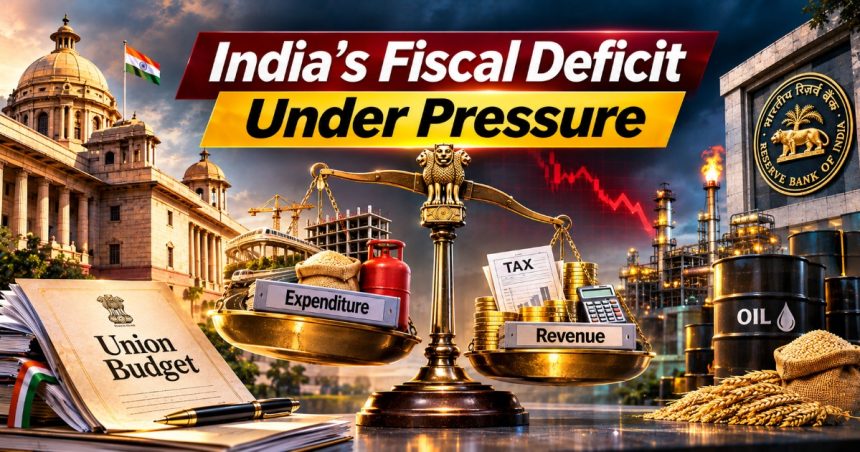
8th Pay Commission : India’s FY28 fiscal deficit target faces fresh pressure from rising expenditure
India’s efforts to reduce its fiscal deficit could face fresh challenges in FY28 as rising government expenditure, higher oil prices and the implementation of the 8th Pay Commission put pressure on public finances.
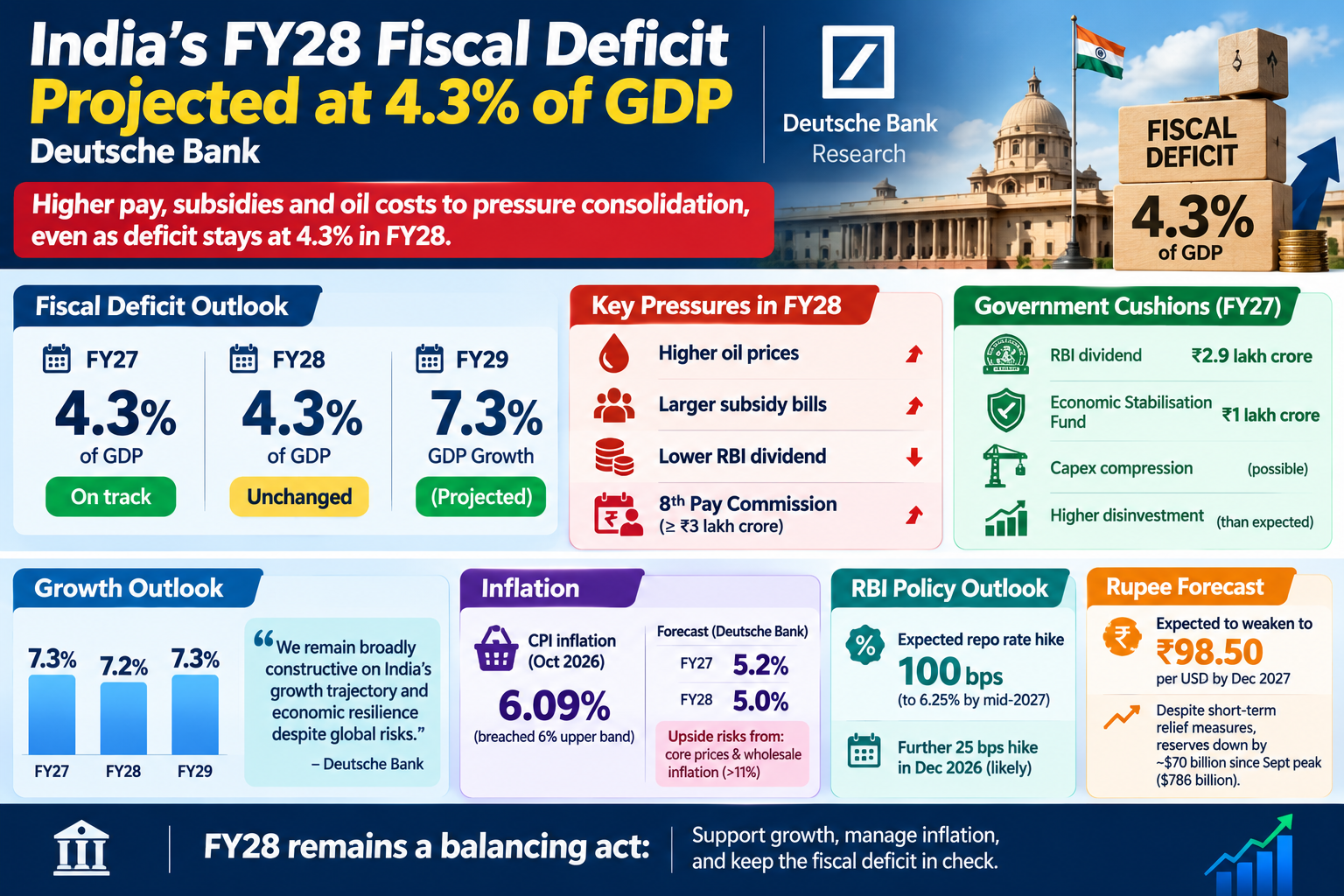
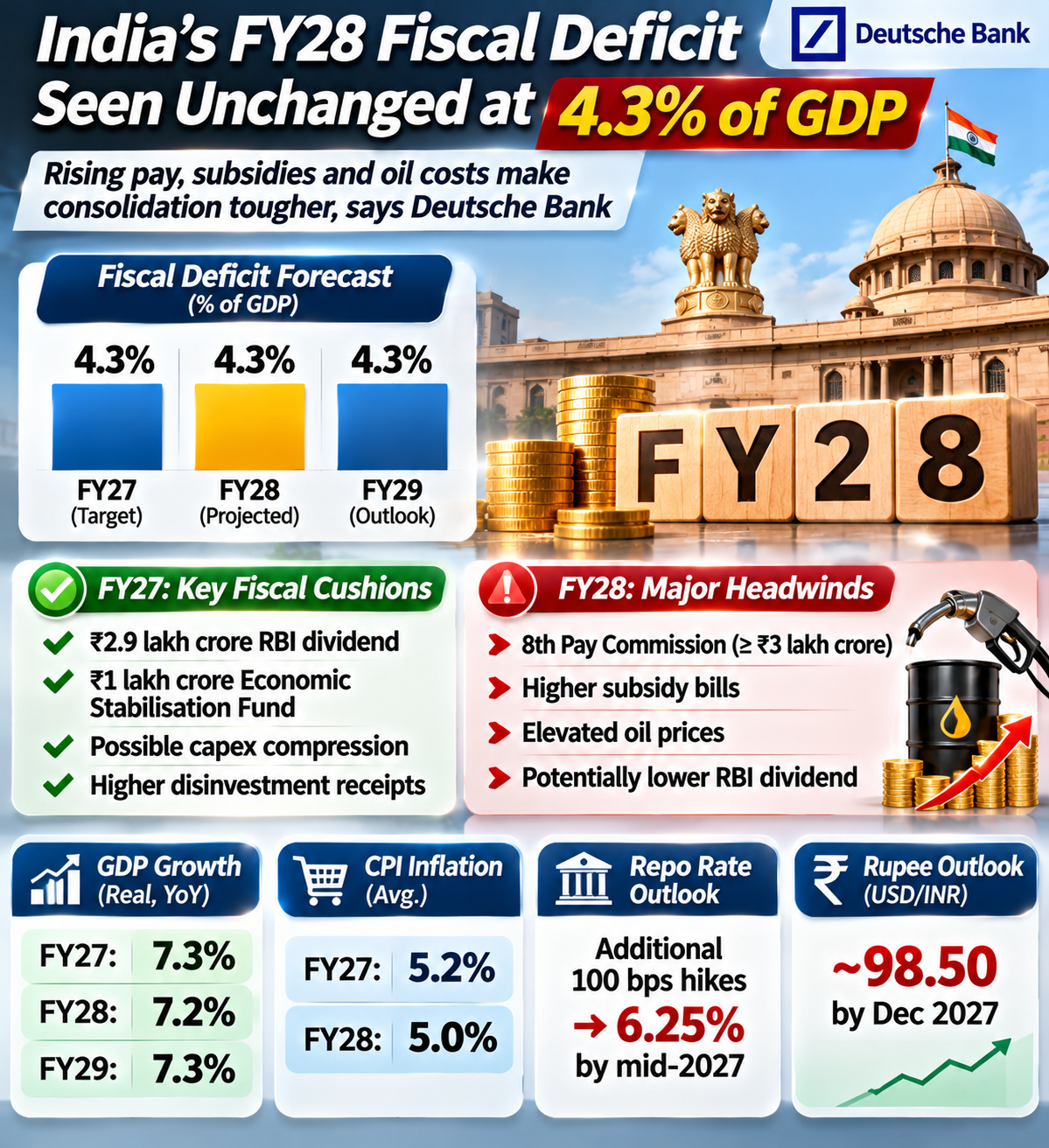
Deutsche Bank Research expects India’s fiscal deficit to remain unchanged at 4.3% of GDP in FY28, indicating that the government may find it difficult to achieve further fiscal consolidation despite improving economic growth.
The projection comes even as the central government remains on track to meet its FY27 fiscal deficit target of 4.3% of GDP.
For investors, the forecast raises important questions about government borrowing, bond yields, interest rates and the broader economic outlook.
Track Live : Nifty Levels Today | Sensex Levels Today | Bank Nifty Levels Today
8th Pay Commission could add Rs 3 lakh crore to government expenditure
One of the biggest expenditure risks identified by Deutsche Bank is the implementation of the 8th Pay Commission.
According to the report, the proposed pay revision could increase government expenditure by at least Rs 3 lakh crore.
Delaying the implementation until 2028 could provide temporary relief to government finances. However, such a move could result in a larger accumulation of salary and pension arrears.
Higher government expenditure could limit the government’s ability to accelerate fiscal consolidation while maintaining capital investment and welfare spending.
Track Live : NSE Option Chain — Live | BSE Option Chain — Live Sensex & Bankex Options Data Today
Estimated financial impact of the 8th Pay Commission
| Particulars | Details |
|---|---|
| Commission | 8th Central Pay Commission |
| Estimated additional expenditure | At least ₹3 lakh crore |
| Potential implementation period | FY28 |
| Main expenditure areas | Salaries, pensions and employee benefits |
| Potential postponement | 2028 |
| Risk from delay | Accumulation of salary and pension arrears |
| Fiscal impact | Higher revenue expenditure and borrowing pressure |
India’s fiscal deficit likely to remain at 4.3% in FY28
Deutsche Bank expects India’s fiscal deficit to remain unchanged at 4.3% of GDP in FY28, indicating that the government’s fiscal consolidation process could temporarily lose momentum.
The central government is expected to meet its FY27 target of 4.3%, but the expenditure outlook for the following financial year is more challenging.
A fiscal deficit occurs when government expenditure exceeds its total receipts, excluding borrowings. The difference is financed through borrowing.
India’s fiscal deficit outlook
| Financial year | Fiscal deficit | Status |
|---|---|---|
| FY25 | 4.8% of GDP | Actual |
| FY26 | 4.4% of GDP | Revised estimate |
| FY27 | 4.3% of GDP | Budget target |
| FY28 | 4.3% of GDP | Deutsche Bank forecast |
The FY28 figure is Deutsche Bank’s projection, not an officially announced government target.
Four factors supporting India’s FY27 fiscal deficit target
According to Deutsche Bank, the government has several financial cushions that could help it achieve the FY27 fiscal deficit target.
These include a substantial RBI dividend, an Economic Stabilisation Fund provision, potential capital expenditure compression and stronger-than-expected disinvestment receipts.
| Fiscal support measure | Amount / details | Potential benefit |
|---|---|---|
| RBI dividend transfer | ₹2.9 lakh crore | Boosts non-tax revenue |
| Economic Stabilisation Fund provision | ₹1 lakh crore | Provides budgetary flexibility |
| Capital expenditure compression | No specific amount disclosed | Can reduce near-term expenditure |
| Disinvestment receipts | Higher-than-expected receipts anticipated | Supports government revenue |
Deutsche Bank expects India’s GDP growth to remain above 7%
Despite fiscal pressures and external economic risks, Deutsche Bank remains relatively optimistic about India’s growth outlook.
The bank projects real GDP growth at:
- FY27: 7.3%
- FY28: 7.2%
- FY29: 7.3%
However, growth could moderate during the second half of FY27 because of a sub-normal monsoon, higher crude oil prices and unfavourable base effects following last year’s GST rate cuts.
The implementation of 8th Pay Commission awards could subsequently support household consumption and domestic demand.
Deutsche Bank said it remained “broadly constructive on India’s growth trajectory and general resilience of the economy”.
| Particulars | Details |
|---|---|
| Current repo rate | 5.50% |
| October 2026 rate hike | 25 basis points |
| Deutsche Bank’s expected December hike | 25 basis points |
| Expected policy rate | 6.25% |
| Expected timeline | By mid-2027 or earlier |
| Inflation concern | CPI above 6% in October |
RBI dividend could decline in FY28, reducing government revenue support
The ₹2.9 lakh crore RBI dividend has provided an important cushion for the government’s FY27 fiscal position.
However, Deutsche Bank expects the central bank’s dividend contribution to potentially decline in the subsequent financial year.
This creates an additional challenge because the government could face higher expenditure at the same time as one of its major non-tax revenue sources weakens.
| Particulars | FY27 | FY28 outlook |
|---|---|---|
| RBI dividend | ₹2.9 lakh crore | Potentially lower |
| Government expenditure | Supported by existing cushions | Higher pressure |
| Subsidy requirements | Relatively manageable in current estimates | Potential increase |
| Fiscal consolidation | Target of 4.3% | More challenging |
The Tribune+1
A lower RBI dividend does not automatically mean the government will miss its deficit target. However, it could require adjustments in spending, revenue mobilisation or borrowing.
Track Live : NSE F&O Lot Size | FII DII Data Today
Inflation above 6% raises expectations of further RBI rate hikes
Inflation remains another important concern for the Indian economy.
Retail inflation reached 6.09% in October, moving above the RBI’s upper tolerance limit of 6%, mainly because of rising cereal and pulse prices.
Deutsche Bank has maintained its CPI inflation forecasts at 5.2% for FY27 and 5% for FY28, although it highlighted risks from broader core inflation pressures and wholesale inflation remaining above 11%.
The bank expects the RBI to continue tightening monetary policy, forecasting 100 basis points of repo rate hikes in the current cycle.
It expects a 25-basis-point increase in December 2026, potentially taking the repo rate to 6.25% by mid-2027 or earlier.
India’s inflation outlook
| Particulars | Inflation |
|---|---|
| October 2026 retail CPI inflation | 6.09% |
| RBI upper tolerance limit | 6.00% |
| October food inflation | 8.94% |
| Deutsche Bank FY27 CPI forecast | 5.2% |
| Deutsche Bank FY28 CPI forecast | 5.0% |
| Wholesale inflation | Above 11%, according to the report |
Rupee could weaken to 98.50 against the US dollar by December 2027
India’s external financial position is also facing pressure from reduced capital inflows and declining foreign exchange reserves.
According to Deutsche Bank, India’s forex reserves have fallen by nearly $70 billion from their early-September peak of $786 billion.
Although recent RBI measures have provided temporary support to the rupee, the bank expects gradual depreciation to 98.50 against the US dollar by December 2027.
It expects the RBI to rebuild its foreign exchange reserve buffer over time.
Deutsche Bank expects the rupee to gradually depreciate to ₹98.50 against the US dollar by the end of December 2027.
Rupee and foreign exchange outlook
| Particulars | Details |
|---|---|
| Early-September forex reserve peak | $786 billion |
| Decline in reserves | Nearly $70 billion |
| Implied level after decline | Approximately $716 billion |
| Deutsche Bank’s rupee forecast | ₹98.50 per US dollar |
| Forecast period | December 2027 |
| Main concerns | Lower capital inflows and reserve rebuilding |
Read More : Gold Falls, RBI Holdings Don’t: Why India’s Reserve Share of Gold Dropped From 19% to Under 14%
Why the FY28 fiscal deficit forecast matters for government bonds
The expectation that India’s fiscal deficit will remain at 4.3% of GDP in FY28 is also important for the government securities market.
A fiscal deficit determines how much the government needs to borrow to finance its expenditure.
If the deficit remains unchanged, the government may continue to require substantial market borrowing.
At the same time, higher inflation and expectations of RBI rate hikes could increase pressure on bond yields.
What does the FY28 fiscal deficit forecast mean for investors?
The combination of higher government expenditure, elevated inflation and expected RBI rate hikes could influence several financial market segments.
For bond investors, a fiscal deficit stuck at 4.3% could mean continued government borrowing requirements, while higher interest rates may keep bond yields under pressure.
For equity investors, stronger GDP growth and consumption could support sectors such as banking, automobiles and consumer goods. However, higher borrowing costs and expensive crude oil could pressure companies with significant debt or energy exposure.
Currency investors will also need to monitor foreign capital flows and RBI intervention as the rupee faces external pressure.