IndiGo Q1: Revenue Up 20% But Net Profit Turns Negative Amid Rising Jet Fuel Prices
India’s largest airline delivered a mixed quarterly performance that is raising fresh questions for investors. IndiGo Q1 results showed strong revenue growth and resilient passenger demand, but soaring fuel costs, rupee depreciation and Middle East disruptions pushed the airline into a quarterly loss.
While the airline continued to expand its business and improve yields, sharply higher operating expenses outweighed the gains. Investors are now watching whether easing fuel prices and improving aircraft utilisation can help IndiGo return to profitability in the coming quarters.
IndiGo Q1 results show ₹382 crore loss despite 20% revenue growth
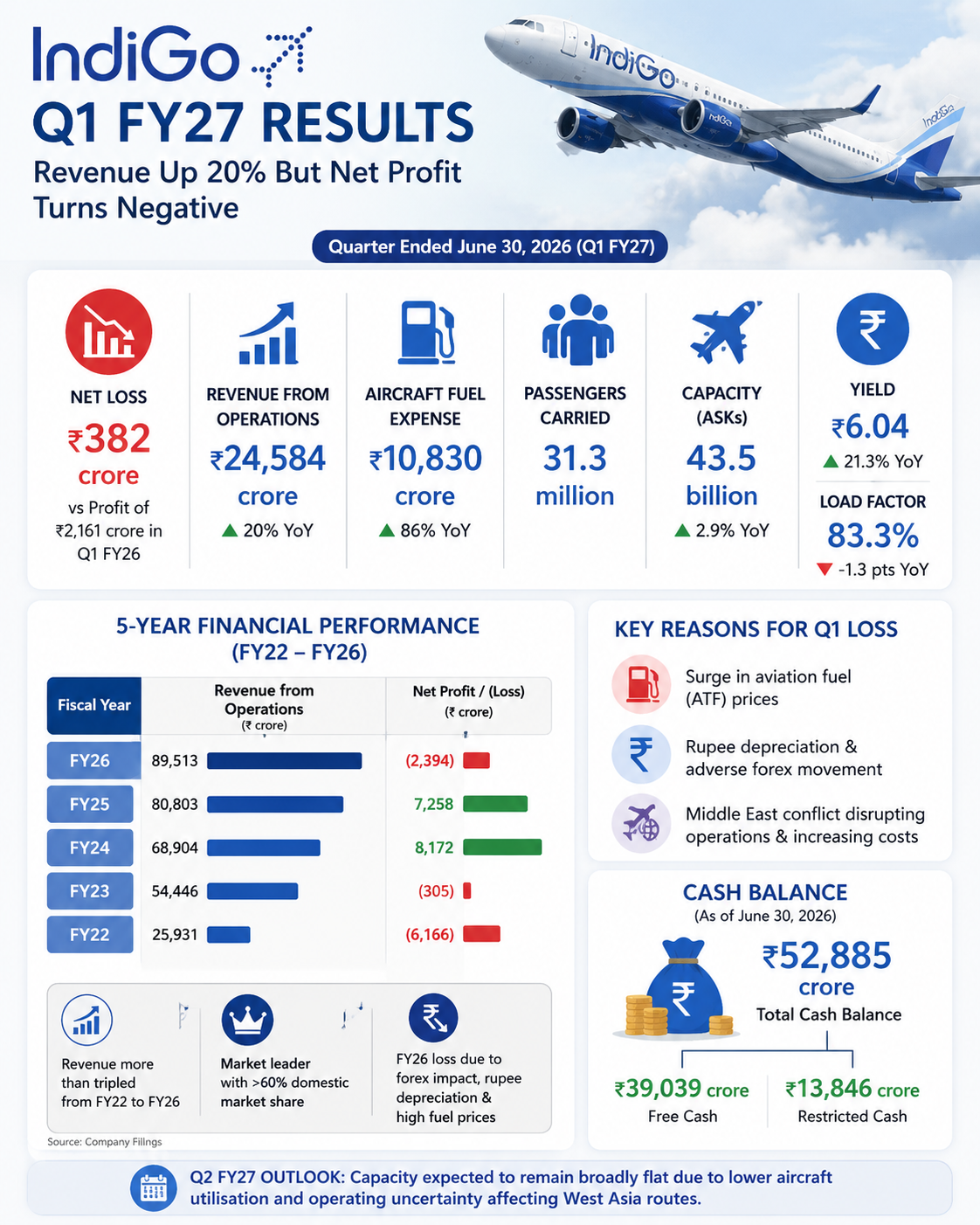
InterGlobe Aviation, the parent company of IndiGo, reported a net loss of ₹382 crore for the quarter ended June 30, 2026 (Q1 FY27). The company had posted a net profit of ₹2,161 crore in the same quarter last year.
Despite the loss, IndiGo Q1 results showed healthy business momentum. Revenue from operations increased 20% year-on-year to ₹24,584 crore, compared with ₹20,496 crore in Q1 FY26.
However, the strong revenue growth was overshadowed by a much sharper rise in costs. Total expenses surged 35.1%, primarily due to an 86% jump in aircraft fuel expenses to ₹10,830 crore.
Track Live : NSE Option Chain — Live
Key highlights from the results include:
- Net result: Reported a quarterly loss (figures vary across reports: ₹238 crore vs ₹382 crore).
- Revenue from operations: ₹24,584 crore, up 20% YoY.
- Aircraft fuel expense: Jumped nearly 86% to ₹10,830 crore.
- Major reasons for the loss:
- Surge in aviation turbine fuel (ATF) prices
- Rupee depreciation and adverse foreign exchange movement
- Middle East conflict disrupting operations and increasing costs
- Passengers carried: 31.3 million
- Capacity (ASKs): Increased 2.9% to 43.5 billion
- Yield: Rose 21.3% to ₹6.04
- Load factor: Declined 1.3 percentage points to 83.3%
- Cash balance (June 30, 2026): ₹52,885 crore, including ₹39,039 crore of free cash and ₹13,846 crore of restricted cash.
Management said elevated fuel prices, network constraints in the Middle East, and currency weakness weighed on earnings, although passenger demand remained healthy. The airline expects capacity in Q2 FY27 to remain broadly flat because of lower aircraft utilisation and operational uncertainty affecting West Asia routes.
Read More : SEBI Cash Margin Rules May Shift From Flat 20% to Risk-Based Framework
IndiGo Financial Performance Over the Last 5 Years (FY22–FY26)
InterGlobe Aviation Ltd. (IndiGo) has undergone a remarkable financial cycle over the past five fiscal years—recovering from the pandemic, posting record profits in FY24 and FY25, and slipping back into a loss in FY26 due to higher fuel costs and a sharp foreign exchange impact despite reporting its highest-ever annual revenue.
| Fiscal Year | Revenue from Operations | Net Profit / (Loss) | Key Highlights |
|---|---|---|---|
| FY26 | ₹89,513 crore | ₹(2,394) crore | Record revenue, but forex losses and higher fuel costs led to an annual loss. |
| FY25 | ₹80,803 crore | ₹7,258 crore | Strong domestic demand, international expansion and healthy yields supported robust profitability. |
| FY24 | ₹68,904 crore | ₹8,172 crore | Best-ever annual profit driven by record passenger traffic and improved operating efficiency. |
| FY23 | ₹54,446 crore | ₹(305) crore | Business recovered sharply after COVID restrictions, though profitability remained marginally negative. |
| FY22 | ₹25,931 crore | ₹(6,166) crore | Pandemic-related travel restrictions and weak passenger demand resulted in heavy losses. |
Key Performance Drivers
- Pandemic Recovery: Revenue more than tripled between FY22 and FY26 as air travel demand rebounded strongly.
- Record Operations: IndiGo strengthened its leadership in Indian aviation with a domestic market share exceeding 60%, expanding its fleet and passenger base.
- FY26 Pressure: Despite achieving its highest-ever annual revenue, steep rupee depreciation, significant foreign exchange adjustments and elevated aviation fuel prices pushed the airline into a net loss.
Fuel prices, rupee weakness and Middle East conflict weighed on earnings
IndiGo attributed the weak quarterly performance to several external factors that significantly increased operating costs.
In its exchange filing, the airline said:
“A combination of fuel price escalation, adverse foreign exchange movement and the Middle East conflict impacted profitability during the quarter.”
Jet fuel prices remained elevated during the quarter after geopolitical tensions involving Iran pushed global crude oil prices above $100 per barrel. Since IndiGo does not hedge its fuel requirements, the airline absorbed the full impact of higher aviation fuel prices.
The depreciation of the Indian rupee also increased lease and foreign currency-related expenses, adding further pressure on margins.
Read More : SEBI Cash Margin Rules May Shift From Flat 20% to Risk-Based Framework
Passenger demand remained healthy even as margins weakened
Although profitability came under pressure, IndiGo continued to witness healthy travel demand.
During the quarter:
- Capacity increased 2.9% to 43.5 billion ASKs
- Passenger traffic rose to 31.3 million
- Yield improved 21.3% to ₹6.04
- Load factor slipped 1.3 percentage points to 83.3%
Managing Director Rahul Bhatia said demand remained strong despite a challenging operating environment.
“The first quarter was shaped by a volatile operating environment, with elevated fuel costs and network-related constraints in the Middle East impacting profitability. At the same time, demand remained healthy and our revenue performance improved year-on-year, supported by improved yields and continued customer preference for IndiGo as we proudly served more than 31 million passengers.”
He added that the airline remains focused on disciplined capacity management, cost control and long-term network expansion.
“While near-term uncertainties remain, we continue to stay committed to our long-term priorities of strengthening the network, enhancing customer choice, and creating sustainable value for all stakeholders.”
Strong cash position provides financial cushion
Despite reporting a quarterly loss, IndiGo continues to maintain a strong balance sheet.
As of June 30, 2026, the airline reported a total cash balance of ₹52,885 crore, including:
- ₹39,039 crore of free cash
- ₹13,846 crore of restricted cash
The sizeable cash reserves are expected to provide financial flexibility while the airline navigates volatile fuel prices and geopolitical uncertainties.
What Can Move IndiGo Stock Next?
Despite reporting a quarterly loss, IndiGo’s long-term outlook will largely depend on how macroeconomic conditions and operational trends evolve over the coming quarters. Investors are expected to closely track the following catalysts:
- Brent crude oil prices: Aviation turbine fuel (ATF) is IndiGo’s biggest operating cost. Any decline in Brent crude prices could significantly improve margins, while sustained elevated oil prices may continue to pressure profitability.
- Rupee–US dollar movement: A weaker rupee increases dollar-denominated expenses such as aircraft lease rentals, maintenance contracts and spare parts. Currency stability would help reduce forex-related losses.
- Domestic passenger demand: IndiGo continues to dominate India’s aviation market, and healthy passenger traffic during the festive season could support higher revenues and better capacity utilization despite cost pressures.
- International route recovery: A normalization of flight operations to West Asia and the reopening of affected airspace could improve international capacity, reduce flight diversions and support higher-yield routes.
- Middle East geopolitical developments: Any easing of geopolitical tensions would likely lower fuel costs and operational disruptions, improving earnings visibility for airlines.
- Aircraft deliveries and fleet utilization: Timely Airbus deliveries and higher aircraft utilization will be crucial for capacity expansion and future revenue growth after management guided for broadly flat capacity in Q2 FY27.
- Q2 FY27 earnings: The next quarterly results will be a key trigger, with investors looking for signs of margin recovery, sustained yield growth, easing fuel costs and improved profitability.
Here’s what happened today and why traders reacted
The market reacted cautiously after IndiGo Q1 results reflected a sharp reversal from last year’s profit.
Although revenue growth remained robust, investors focused on the steep rise in fuel costs and operating expenses that pushed the airline into losses. The continued impact of crude oil prices, rupee depreciation and Middle East disruptions also raised concerns about near-term profitability.
Following the earnings announcement, IndiGo shares closed 1.7% lower at ₹5,030 on the BSE.
What could be the impact on traders and investors?
The quarterly numbers suggest that IndiGo’s underlying demand remains strong, but profitability will continue to depend largely on fuel prices and foreign exchange movements.
For investors, the key positives include:
- Healthy 20% revenue growth
- Strong passenger demand
- Improved ticket yields
- Robust cash balance exceeding ₹52,000 crore
However, concerns remain over:
- Elevated aviation turbine fuel prices
- Rupee depreciation
- Geopolitical risks affecting international routes
- Margin pressure due to rising operating costs
Short-term market sentiment may remain cautious until cost pressures begin to ease.
What should investors watch next?
Looking ahead, IndiGo expects capacity during the second quarter of FY27 to remain broadly flat compared with the corresponding period last year. The airline cited seasonally weaker travel demand and operational uncertainty on India-West Asia routes as reasons for lower aircraft utilisation.
Investors should closely monitor:
- Global crude oil and jet fuel prices
- Rupee movement against the US dollar
- Passenger demand during the festive season
- Recovery in aircraft utilisation
- Margin improvement in the coming quarters
While IndiGo Q1 results disappointed on profitability, the airline’s strong revenue growth, market leadership and healthy cash reserves indicate that its long-term growth story remains intact. The pace of earnings recovery will largely depend on how quickly fuel costs and geopolitical pressures begin to ease.