
US Treasury Doubles Bond Buybacks as Debt, AI Spending and War Risks Rattle Markets
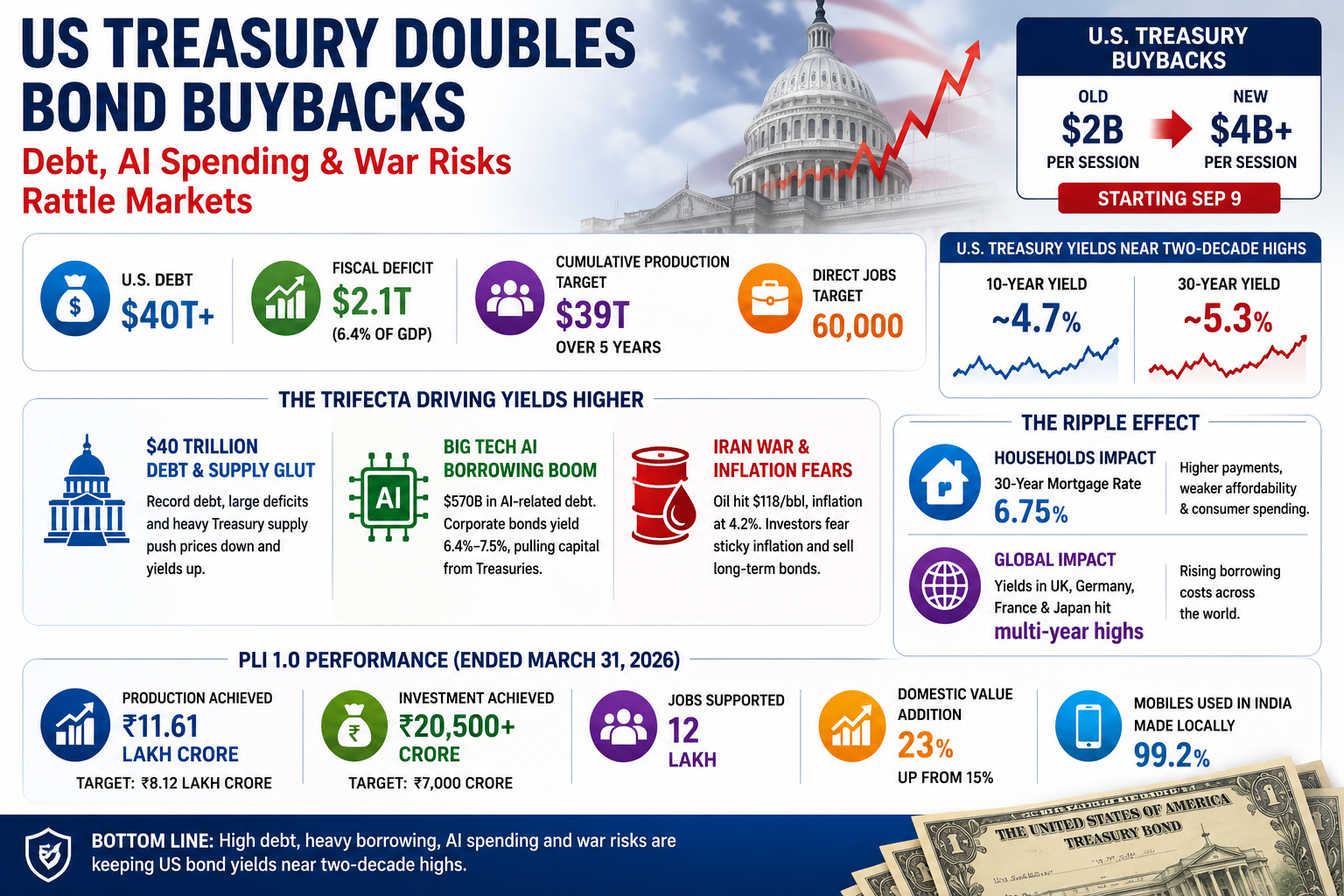
The world’s biggest bond market is sending a warning that investors cannot afford to ignore. US Treasury yields are climbing sharply, even after the government stepped in with larger bond buybacks to calm markets.
The concern goes beyond a single inflation report or Federal Reserve decision. A combination of more than $40 trillion of US debt, heavy government borrowing, AI-related corporate financing and Iran-driven energy inflation is putting pressure on long-term bonds.
The result is a difficult question for investors: is this simply a necessary adjustment, or is the US bond market heading towards a deeper shock?
Track Live : NSE Option Chain — Live
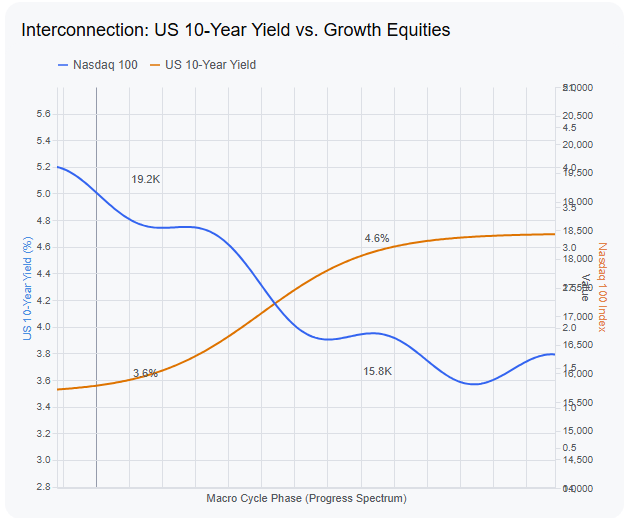
- US 10-Year Treasury Yield: The ultimate global benchmark for risk-free capital. When it rises, equity valuations (especially tech) come under pressure, and global capital pulls back to the US.
- US 30-Year Treasury Yield: Reflects long-term global growth, structural inflation expectations, and the market’s confidence in the sustainability of the $40+ trillion US national debt.
- US Treasury Auction Demand (Bid-to-Cover Ratio): Measures institutional appetite for new US debt supply. Low demand forces yields higher, signaling market strain and potential debt saturation.
- US Corporate Bond Issuance: Tracks private market credit demand. High-yield AI infrastructure bonds (offering 6.4%–7.5%) act as a capital drain, pulling institutional liquidity away from sovereign bonds.
Treasury doubles bond buybacks as long-term yields remain elevated
US Treasury Secretary Scott Bessent announced on August 19 that the Treasury would double its long-end bond buybacks to at least $4 billion per operation, beginning September 9.
The programme is focused on older, less-liquid Treasuries in the 10-to-20-year and 20-to-30-year maturity segments. The aim is to improve market liquidity and support smoother functioning rather than directly control interest rates.
The move initially provided some relief. But that relief proved temporary as investors continued to focus on the bigger problems facing the bond market. Reuters reported that the 30-year Treasury yield reached around 5.34%, its highest level since 2007.
The Macro Forces Driving Yields Higher
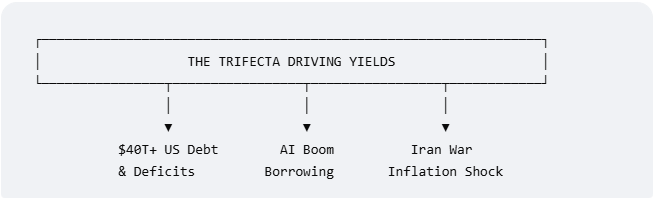
- The $40 Trillion Debt Burden & Supply Glut
The US national debt has crossed $40 trillion, fueled by a massive projected annual fiscal deficit of $2.1 trillion (6.4% of GDP). To fund this, the government is flooding the market with an unprecedented supply of new Treasuries. This oversupply pushes bond prices down and yields up, forcing the US to spend more on interest payments than on national defense. - The Big Tech AI Borrowing Boom
Corporate borrowing for AI infrastructure has reached historic highs, with global AI-related debt issuance hitting $570 billion—including a massive $500 billion Nvidia-backed financing consortium for data centers and power grids. Big Tech’s active corporate bonds offer highly attractive yields of 6.4% to 7.5%, draining institutional capital away from safer Treasuries and adding roughly 0.3 percentage points to the 10-year Treasury yield. - The Iran War & Sticky Inflation Fears
Geopolitical conflict involving Iran pushed Brent crude to a wartime peak of $118 per barrel, dragging US gasoline past $4 a gallon and driving inflation up to 4.2%. Fearing that inflation will erode the real value of fixed-income assets, investors have aggressively sold off long-term bonds. This anxiety was compounded by a perceived dovish stance from Fed Chair Kevin Warsh, sparking fears of unanchored long-term inflation.
Why are US Treasury yields rising so quickly?
The basic mechanics are straightforward.
When investors sell bonds, bond prices fall and yields rise. The current pressure is concentrated at the longer end of the Treasury curve, where investors demand greater compensation for inflation, economic and fiscal risks.
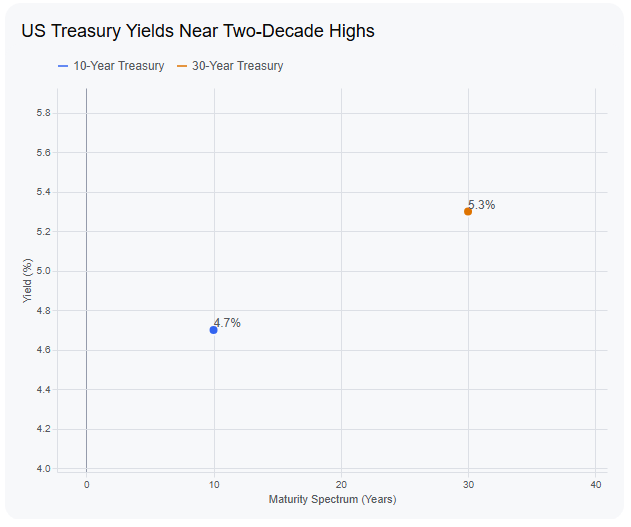
The 10-year Treasury yield has been hovering around the 4.7% region, while the 30-year yield has moved above 5.3%. Recent market moves have pushed long-term borrowing costs to levels not seen for many years.
The bigger concern is that several forces are hitting the bond market simultaneously.
Inflation, Policy & Sentiment Drivers
- US CPI / Core Inflation: The primary metric dictating central bank paths. Sticky inflation or a print above the 4.2% threshold prevents interest rate cuts and triggers immediate fixed-income sell-offs.
- Brent Crude Oil: The world’s primary commodity bellwether. Geopolitical shocks that push crude toward $118 per barrel export energy inflation globally, driving up domestic retail fuel and corporate input costs.
- Fed Rate Expectations (Fed Funds Futures): Dictates global monetary trajectory. Shifting terminal rate expectations instantly reprice global currencies, short-term yields, and growth stocks.
- Nasdaq 100 Performance: The global proxy for risk-on retail sentiment and tech growth equity valuation. It is highly sensitive to long-term discount rates and the heavy borrowing costs of the AI infrastructure boom.
The $40 trillion US debt burden is becoming harder to ignore
US government debt has now crossed the $40 trillion mark.
At the same time, Washington continues to run large fiscal deficits. That means the government needs to issue substantial amounts of Treasury securities to finance spending.
For investors, more bond supply can mean that the government must offer higher yields to attract buyers.
That creates another problem. Higher yields mean higher interest costs for the government, potentially adding further pressure to future deficits and borrowing needs. The Treasury’s own Debt to the Penny data tracks the US government’s outstanding debt on a daily basis.
The Ripple Effect: Domestic & Global Fallout
- Household Squeeze: Higher Treasury yields serve as the benchmark for consumer credit. The average 30-year US mortgage rate has jumped to 6.75%, freezing the housing market by severely compromising affordability and denting overall consumer spending power.
- Global Contagion: Because US Treasuries are the risk-free anchor of global finance, rising US yields have triggered a worldwide chain reaction. Sovereign bond yields in the UK, Germany, France, and Japan have concurrently spiked to multi-year highs, raising borrowing costs for governments and corporations globally.
AI borrowing is adding another layer of pressure
The artificial intelligence boom is also changing the corporate bond market.
Technology companies and data-centre operators are committing enormous amounts of capital to AI infrastructure, including computing capacity, data centres and power networks.
This borrowing competes for investor capital that could otherwise flow into Treasuries. The result is particularly important when corporate debt offers attractive yields and investors are already demanding higher returns across fixed-income markets.
For investors, the AI boom therefore has a second-order impact: it is not only an equity-market story, but increasingly a bond-market financing story.
Read More : Govt’s New Mobile Manufacturing Scheme Offers Up to 6.5% Incentives, Eyes Indian Brands
Iran tensions are making the inflation problem worse
Geopolitical tensions are adding another complication.
The Iran conflict has pushed oil prices sharply higher and increased concerns about energy-driven inflation. Reuters reported that crude prices have risen as the conflict and uncertainty around the Strait of Hormuz continue to affect energy markets.
Higher oil prices can feed into fuel, transportation and other consumer costs.
That matters for Treasury investors because persistent inflation reduces the attractiveness of locking money into long-term bonds at today’s yields. If inflation stays elevated, investors may demand even higher yields.
Track Live : BSE Option Chain — Live Sensex & Bankex Options Data Today
What does the US bond sell-off mean for households?
The US bond sell-off does not stop at Wall Street.
Treasury yields influence borrowing costs throughout the economy, including mortgages and corporate loans.
The US 30-year mortgage rate recently moved close to 6.76%, showing how rising benchmark yields can translate into higher household financing costs.
Higher mortgage rates can reduce housing affordability, weaken demand and put pressure on consumer spending.
What could the US bond sell-off mean for investors?
The impact could spread across almost every major asset class.
Higher US Treasury yields can make bonds more attractive relative to equities, particularly when the yield on safe government debt rises. That can put pressure on expensive growth and technology stocks whose valuations depend heavily on future earnings.
The effect is also global. US Treasuries are a benchmark for international borrowing costs, meaning higher US yields can push government and corporate borrowing costs higher elsewhere.
For investors, the key question is whether yields stabilise or continue climbing.
If inflation cools and fiscal concerns ease, the bond market could regain stability. But if debt issuance, energy prices and long-term inflation expectations remain elevated, the US bond sell-off could continue to shape global markets in the months ahead.
As LPL Financial’s Lawrence Gillum described the move, the key debate is whether it represents a “necessary normalisation, not a crisis”—or the beginning of something more serious.