
Sensex Erases 700-Point Rally Before Close — Metal Selloff and Profit Booking Drag Nifty Lower
| Index | Close | Change | % Change |
|---|---|---|---|
| Nifty 50 | 24,056.00 | +34.35 | +0.14% |
| Sensex | 77,100.47 | +109.25 | +0.14% |
| Nifty Bank | 58,177.05 | +26.70 | +0.05% |
| Nifty Fin Service | 26,770.55 | +34.55 | +0.13% |
| BSE Bankex | 65,599.62 | +19.09 | +0.03% |
| BSE Focused IT | 33,554.76 | -162.61 | -0.48% |
For most of Thursday, it looked like the stock market was ready to extend its powerful rally. The Sensex was comfortably higher, the Nifty was inching towards another breakout, and investors were betting that easing crude oil prices could fuel the next leg of the market’s rise.
Then something changed.
A wave of selling hit metal and energy stocks, profit booking intensified, and within hours the Sensex had erased nearly 700 points from its intraday high. The dramatic turnaround left investors wondering whether this was just a pause in the rally—or an early warning sign.
Sensex Erases Gain: Here’s What Happened Today and Why Traders Reacted
After gaining nearly 1,700 points over the previous two sessions, the Sensex and Nifty entered Thursday with strong momentum.
But as the day progressed, investors began locking in profits at higher levels.
The result was a sharp pullback from intraday highs.
The Sensex eventually closed at 77,100.47, up just 109 points, while the Nifty ended near 24,056, gaining only 34 points despite a much stronger start.
The market may have finished in the green, but the real story was the selling pressure that emerged during the second half of trading.
Read More : EPFO Announces 72-Hour Shutdown From June 26; Millions of PF Subscribers to Be Affected
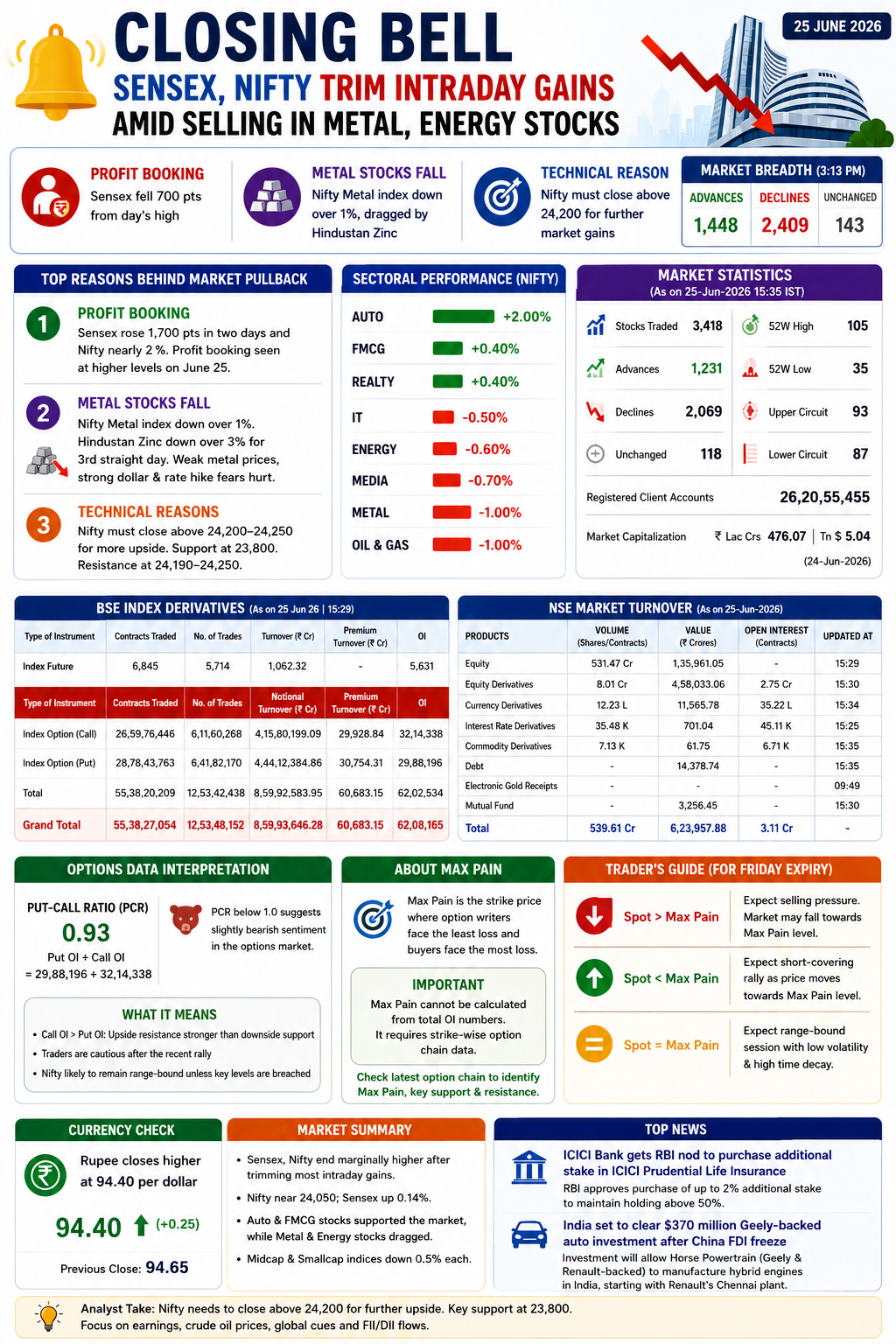
Why Did Sensex and Nifty Give Up Most of Their Gains Today?
After rallying sharply over the previous two sessions, Indian equity benchmarks lost most of their intraday gains on June 25 as investors booked profits and selling intensified in metal and energy stocks. Despite the late-session weakness, both indices managed to close marginally in the green.
- Widespread Profit Booking: Traders liquidated positions at historic highs, triggering a 700-point slide in the Sensex.
- Metal Sector Drag: The Nifty Metal index fell over 1% on its third straight day of losses, heavily weighed down by Hindustan Zinc and Hindalco.
- Energy Drag: Major energy and oil PSU stocks faced severe selling pressure late in the session.
- Negative Market Breadth: Decliners heavily outnumbered advancers, with 2,409 shares dropping against 1,448 advancing shares.
One Sector Became the Market’s Biggest Problem
If there was one sector responsible for dragging the market lower, it was metals.
The Nifty Metal index fell more than 1%, making it the worst-performing sector of the day.
Hindustan Zinc dropped over 3% and extended its three-day decline to nearly 9%.
Vedanta and National Aluminium Company also slipped around 3%.
The selloff followed weakness in global metal prices as aluminium and silver corrected amid easing supply concerns and a stronger US dollar.
Concerns over future US interest-rate decisions also weighed on commodity-linked stocks.
Top Gainers of the Day
| Stock | Close (₹) | Gain (%) |
|---|---|---|
| Indigo | 5,462.00 | +4.89% |
| M&M | 3,185.30 | +3.94% |
| Maruti Suzuki | 13,753.00 | +3.81% |
| Max Healthcare | 1,122.90 | +3.81% |
| Tata Consumer | 1,131.50 | +3.04% |
Top Losers of the Day
| Stock | Close (₹) | Loss (%) |
|---|---|---|
| ONGC | 233.15 | -2.85% |
| Hindalco | 952.00 | -2.52% |
| Power Grid | 284.50 | -2.20% |
| Tech Mahindra | 1,439.70 | -1.50% |
| Bharti Airtel | 1,849.90 | -1.46% |
Energy, metals and IT stocks witnessed profit-booking, with ONGC emerging as the biggest laggard among Nifty constituents.
Track Live : Stock Market Today
Derivatives Activity Signals Strong Participation
Index options trading remained exceptionally robust:
- Total Index Call Options traded: 26.59 crore contracts
- Total Index Put Options traded: 28.78 crore contracts
- Combined options turnover: ₹8.60 lakh crore
- Total Open Interest: 6.21 million contracts
The higher Put contract volume suggests traders remained cautious despite the benchmark indices ending in positive territory.
Market Turnover Highlights
| Segment | Turnover (₹ Crore) |
|---|---|
| Equity | 1,35,961 |
| Equity Derivatives | 4,58,033 |
| Currency Derivatives | 11,566 |
| Debt Market | 14,379 |
| Mutual Funds | 3,256 |
| Total Market Turnover | 6,23,958 |
Falling Crude Prices Helped Auto Stocks but Hurt Energy Giants
One of the biggest market themes this week has been the sharp fall in crude oil prices.
Brent crude slipped towards $73 per barrel, returning close to levels seen before the Middle East conflict escalated.
Lower crude prices are usually positive for auto companies because they reduce input costs and ease inflation concerns.
That is why investors aggressively bought automobile stocks.
However, the same trend hurt energy producers.
ONGC emerged as the biggest loser in the Nifty 50, falling nearly 3%.
Oil India, Coal India and Power Grid also witnessed selling pressure.
The weakness in these heavyweight stocks prevented the broader market from holding onto its early gains.
Auto Stocks Suddenly Became Investor Favourites
While metals and energy stocks struggled, auto stocks enjoyed one of their best sessions in weeks.
The Nifty Auto index surged more than 2%, becoming the top-performing sectoral index.
Mahindra & Mahindra jumped nearly 4%.
Maruti Suzuki gained close to 4%.
Uno Minda rose more than 4%, making it one of the biggest gainers in the sector.
Investors believe lower crude oil prices could improve profit margins and support demand for vehicles in the coming quarters.
That optimism triggered strong buying across the automobile and auto ancillary space.
The Market Breadth Revealed a Hidden Weakness
The benchmark indices may have ended with gains, but market breadth painted a different picture.
More than 2,000 stocks declined during the session compared with around 1,200 advancing stocks.
Both the Nifty Midcap and Nifty Smallcap indices ended lower by around 0.5%.
This suggests that selling pressure was broader than what the benchmark indices reflected.
In other words, many investors felt the pain even on a day when the market closed higher.
Despite benchmark gains, the broader market remained under pressure.
- Stocks traded: 3,418
- Advances: 1,231
- Declines: 2,069
- Unchanged: 118
- 52-week highs: 105 stocks
- 52-week lows: 35 stocks
- Upper circuits: 93 stocks
- Lower circuits: 87 stocks
The advance-decline ratio indicates that selling pressure persisted across broader segments even as frontline indices managed to stay in positive territory.
Technical Resistance Near 24,200
Market experts believe 24,200–24,250 remains a crucial resistance zone for the Nifty.
According to Axis Securities, a decisive close above 24,200 is needed to confirm the next leg of the market rally. Meanwhile, 23,800 is expected to act as an important support level.
Options Data Decoded: What Does PCR of 0.93 Indicate for Traders?
The derivatives data suggests that option traders remained slightly cautious despite Nifty ending above 24,000. Based on total open interest, the Put-Call Ratio (PCR) works out to approximately 0.93 (29,88,196 Put OI ÷ 32,14,338 Call OI).
A PCR below 1.0 generally indicates that call open interest is higher than put open interest, reflecting a mildly bearish to neutral sentiment. However, PCR should always be read alongside price action and the option chain, rather than in isolation.
What Does PCR 0.93 Mean?
| Indicator | Interpretation |
|---|---|
| PCR: 0.93 | Neutral to mildly bearish bias |
| Call OI > Put OI | Upside resistance remains stronger than downside support |
| Options positioning | Traders are cautious after the recent rally |
| Near-term view | Nifty may remain range-bound unless resistance is decisively broken |
Track : Nifty PCR Today – Live Put Call Ratio Chart
What About Max Pain?
Max Pain cannot be calculated from the aggregate derivatives numbers provided in the article. It requires strike-wise option chain open interest data (Call and Put OI across every strike price), not just the total market open interest. The published derivatives statistics are therefore insufficient to identify the actual Max Pain level.
If the strike-wise option chain shows Max Pain close to the spot price, Nifty often gravitates toward that level as expiry approaches. However, without the detailed option chain, any specific Max Pain level would be speculative.
Trader Takeaway
- PCR of 0.93 suggests a balanced but slightly cautious options market.
- 24,200–24,250 remains the immediate resistance zone for Nifty.
- A decisive close above 24,200 could trigger fresh buying, while failure to cross this level may keep the index range-bound.
- Traders should monitor the latest strike-wise option chain before Friday’s session to identify the actual Max Pain, strongest Call writing (resistance), and strongest Put writing (support).