MCX Crude Oil Climbs Over 4% as Middle East Conflict Raises Supply Disruption Risks
Global crude oil prices today surged sharply on Wednesday after the United States and Saudi Arabia launched coordinated military strikes against Iran-backed militant targets in Iraq, escalating geopolitical tensions in the Middle East. The renewed conflict has revived fears of supply disruptions, sending Brent and WTI crude futures sharply higher and putting energy markets back under the spotlight.
The latest spike in oil prices comes at a time when investors were expecting geopolitical tensions in the region to ease. Instead, fresh military action and reports of attacks on Saudi energy infrastructure have raised concerns that global oil supplies could remain under pressure in the coming weeks.
For Indian investors, rising crude prices could once again influence inflation expectations, fuel costs, and the performance of several oil-sensitive sectors.
Track Live : Nifty Levels Today
: MULTI COMMODITY EXCHANGE OF INDIA
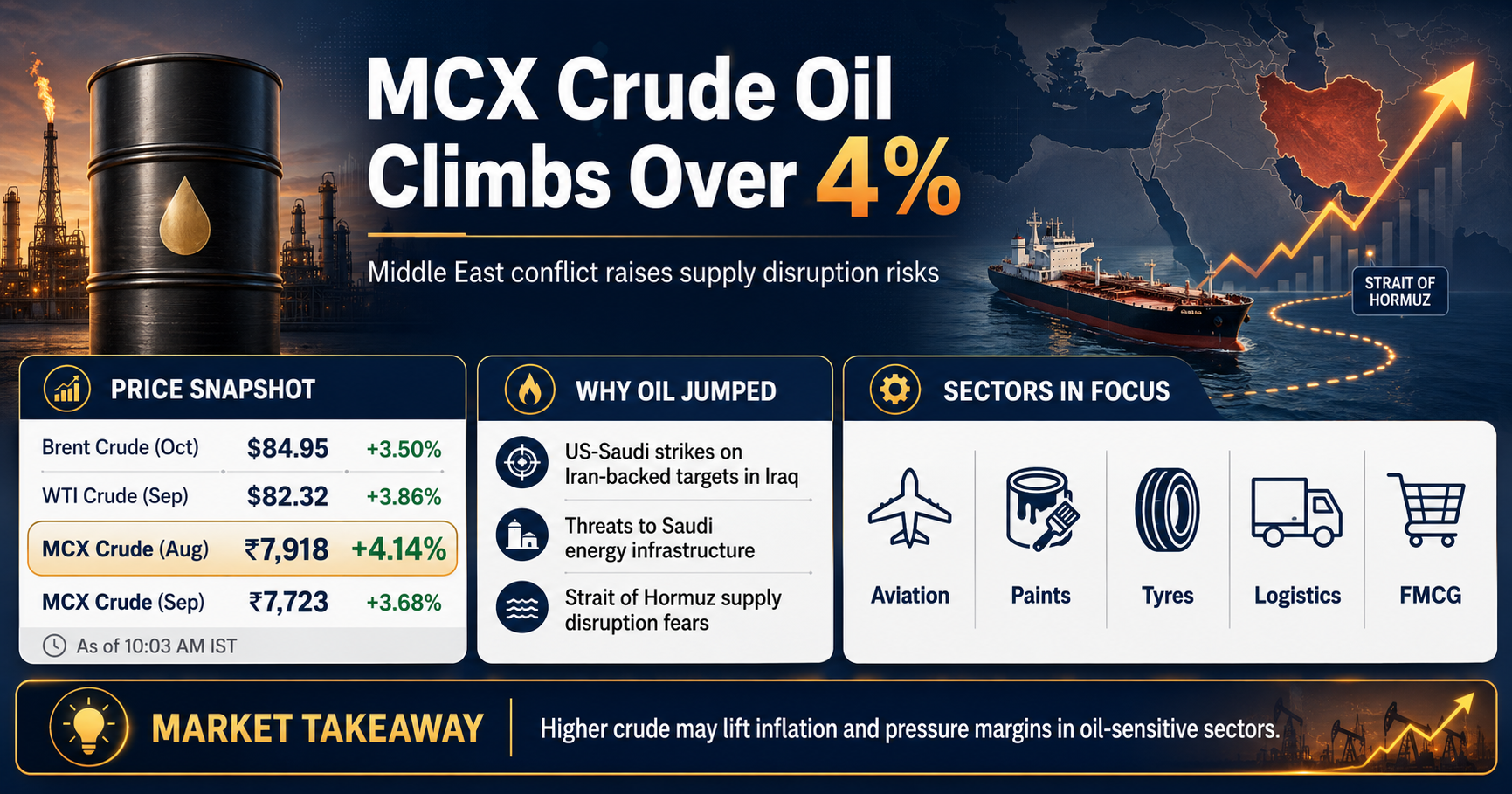
MCX Crude oil climbs as Middle East tensions escalate
Oil futures climbed across global and domestic markets during early Wednesday trade.
At 10:03 am, October Brent crude futures were trading at $84.95 per barrel, up 3.50%, while September WTI crude futures gained 3.86% to $82.32 per barrel.
On the Multi Commodity Exchange (MCX), August crude oil futures jumped 4.14% to ₹7,918, compared with the previous close of ₹7,603. Meanwhile, September crude futures rose 3.68% to ₹7,723.
The sharp rally reflects growing concerns that geopolitical instability could disrupt oil production and transportation across one of the world’s most important energy-producing regions.
Brent, WTI and MCX Crude Prices Rise As of 10:03 AM IST:
| Contract | Price | Change |
|---|---|---|
| Brent Crude (October) | $84.95/barrel | ▲ 3.50% |
| WTI Crude (September) | $82.32/barrel | ▲ 3.86% |
| MCX Crude (August) | ₹7,918 | ▲ 4.14% |
| MCX Crude (September) | ₹7,723 | ▲ 3.68% |
The rebound erased part of the heavy selloff witnessed over the previous three trading sessions as traders priced in renewed geopolitical risk.
US and Saudi Arabia target Iran-backed groups in Iraq
The rally followed an announcement by the US Central Command, which said American and Saudi Arabian armed forces carried out precision strikes in Iraq on July 28 against Iran-aligned militant groups allegedly directed by the Islamic Revolutionary Guard Corps (IRGC).
According to the statement, the operation targeted logistics hubs and weapons facilities after more than 30 drone attacks against US forces and Saudi energy infrastructure over the past 72 hours.
The military said the attacks on US personnel were unsuccessful, but the latest developments have significantly reduced expectations of a quick de-escalation in the region.
Read More : Adani Enterprises Q1 FY27 Results Today, July 29, 2026; Conference Call Scheduled for 5:00 PM IST
Saudi oil infrastructure concerns add to supply fears
Analysts believe the biggest concern for oil markets is the increasing threat to Saudi Arabia’s energy infrastructure.
Commodity analysts Warren Patterson, Head of Commodities Strategy at ING Think, and Ewa Manthey, Commodities Strategist, said oil prices rebounded after a three-day sell-off as fresh geopolitical developments changed market sentiment.
They noted, “Saudi Arabia intercepted drones from Iranian-backed groups in Iraq targeting Saudi energy infrastructure. These developments throw cold water on the idea of a swift de-escalation in the Persian Gulf.”
The analysts added that reports suggesting the shutdown of Saudi Arabia’s 400,000 barrels-per-day Jazan refinery following Houthi attacks, if confirmed, would further tighten global refined fuel supplies.
Strait of Hormuz remains a major risk for global oil supply
Another key concern for energy markets is the Strait of Hormuz, through which roughly one-fifth of global oil trade normally passes.
Reports indicate tanker traffic remains severely disrupted as negotiations between Iran and Oman over shipping arrangements have yet to produce a breakthrough, keeping traders on alert for further supply bottlenecks.
Any prolonged disruption through the Strait of Hormuz could have a significant impact on global crude exports, further supporting higher oil prices.
Other Commodity Prices
- MCX Natural Gas (August): ₹259.50 (▼ 0.57%)
- NCDEX Turmeric (August): ₹20,504 (▲ 0.73%)
- NCDEX Mumbai Rainfall Futures (August): ₹2,433 (▼ 1.10%)
Which Stocks Could Face Pressure if Crude Oil Prices Stay Elevated?
Higher crude oil prices increase fuel, freight, packaging, petrochemical, and raw material costs, which can squeeze operating margins if companies are unable to pass on the higher costs to customers through price hikes. Sectors with significant exposure to crude-linked inputs are therefore likely to remain under pressure if oil prices continue rising.
| Sector | Key Risk | Stocks to Watch |
|---|---|---|
| Aviation | Aviation Turbine Fuel (ATF) accounts for a large share of operating costs | InterGlobe Aviation (IndiGo), SpiceJet |
| Paints | Crude-derived chemicals and solvents increase raw material costs | Asian Paints, Berger Paints, Kansai Nerolac |
| Tyres | Synthetic rubber, carbon black and nylon are petrochemical derivatives | MRF, Apollo Tyres, CEAT, JK Tyre |
| Cement | Higher fuel, petcoke, logistics and kiln operating costs | UltraTech Cement, ACC, Ambuja Cements |
| FMCG | Costlier plastic packaging, transportation and petrochemical inputs | Dabur, Marico, Godrej Consumer Products, Hindustan Unilever |
| Logistics | Diesel price increases raise fleet operating and freight costs | Blue Dart Express, Delhivery |
Why these sectors are vulnerable
- Aviation: Jet fuel is typically one of the largest operating expenses for airlines, so sustained increases in crude prices can significantly affect profitability.
- Paint companies: Around 40–50% of paint manufacturing inputs are linked to crude oil derivatives, making margins highly sensitive to oil price movements.
- Tyre manufacturers: Key inputs such as synthetic rubber and carbon black are petroleum-based, increasing production costs when crude rises.
- Cement producers: Higher energy, petcoke, diesel and transportation costs raise manufacturing expenses across the sector.
- FMCG companies: Plastic packaging, detergents, soaps and logistics all become more expensive, putting pressure on margins if price hikes cannot fully offset costs.
- Logistics firms: Rising diesel prices directly increase transportation and delivery expenses, affecting profitability across courier and supply-chain businesses.
Here’s what happened today and why traders reacted
Oil markets reacted sharply after military action by the US and Saudi Arabia reignited concerns over Middle East supply disruptions.
Investors shifted their focus from recent demand concerns to geopolitical risks, triggering fresh buying in crude oil futures. Reports of attacks on Saudi energy facilities, possible refinery disruptions, and continued uncertainty around the Strait of Hormuz added to bullish sentiment.
As a result, energy prices climbed more than 3% across international markets, while Indian crude futures also posted strong gains.
What rising crude oil prices mean for Indian markets and investors
Higher crude oil prices today could have a mixed impact on Indian equities.
Oil exploration and production companies may benefit from stronger crude prices, while sectors heavily dependent on petroleum products—including aviation, paints, chemicals, tyres, logistics, and oil marketing companies—could face margin pressure if elevated prices persist.
Investors will also monitor inflation expectations, as sustained increases in crude oil often translate into higher transportation and input costs across the economy.
For traders, volatility in energy-related stocks is likely to remain elevated as geopolitical developments continue to influence commodity markets. Any further escalation in the Middle East or confirmed disruption to Saudi oil production could push crude prices higher, while signs of diplomatic progress may help ease supply concerns and stabilize global markets.