
Sebi Backs Closing Auction Session: Why Nifty Jumped 200+ Points in Closing Minutes
The final 15 minutes of trading have suddenly become one of the most closely watched periods in the Indian stock market. As the Closing Auction Session (CAS) begins reshaping how benchmark indices settle, traders are witnessing sharp moves in the Nifty while regulators insist the new system is designed to improve market integrity—not create volatility.
The early days of the Closing Auction Session (CAS) have sparked intense discussions among traders, particularly those active in index derivatives. While some market participants have reported unexpected swings in option settlements, the Securities and Exchange Board of India (Sebi) maintains that the long-term goal is to deliver a more transparent and reliable closing price.
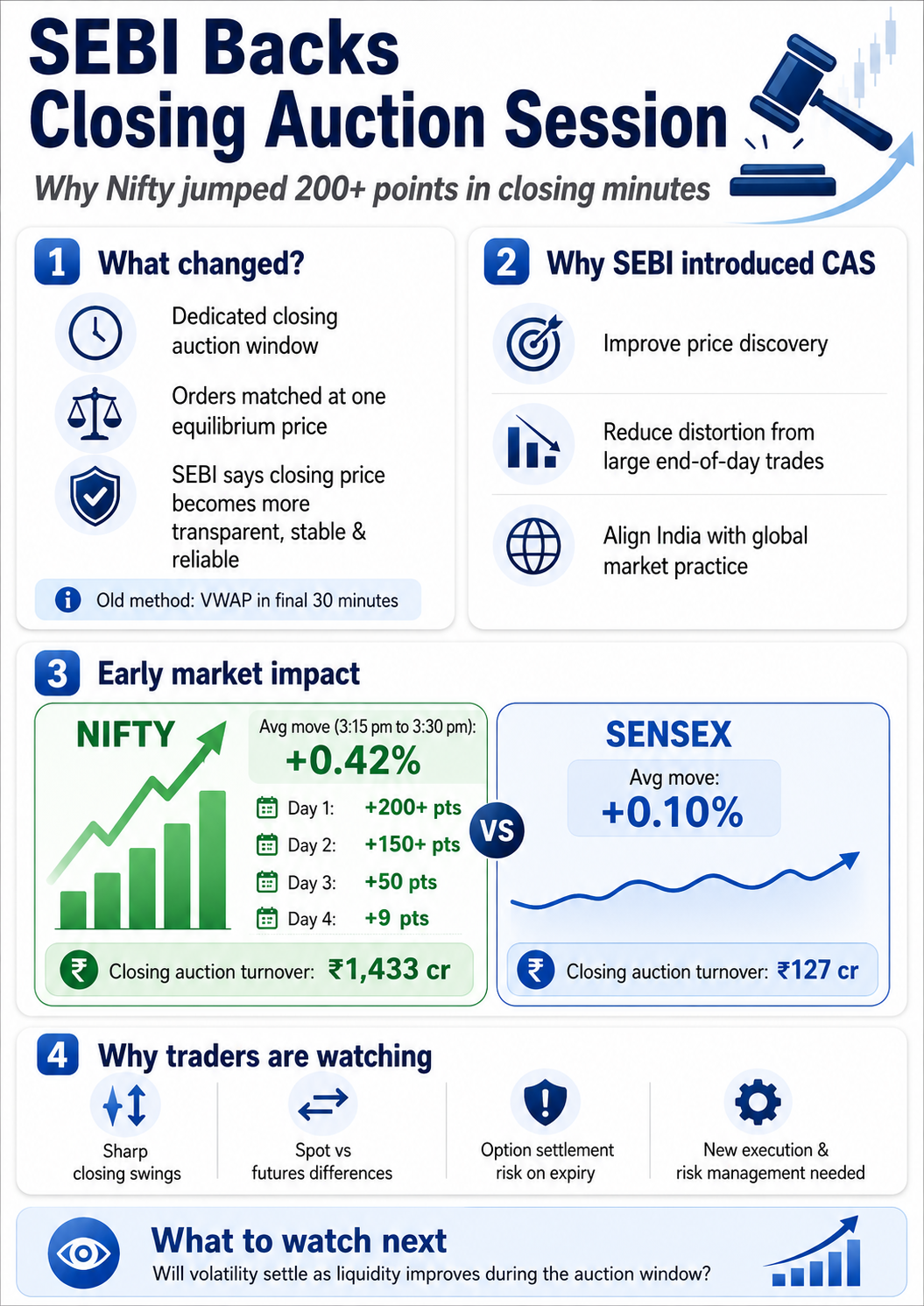
Sebi Backs Closing Auction Session strengthens India’s price discovery
In its latest annual report, Sebi described the Closing Auction Session (CAS) as a “significant step in enhancing the robustness of India’s price discovery mechanism.”
The market regulator said the auction-based framework is expected to produce a closing price that is “more transparent, stable and reliable.” According to Sebi, the mechanism aligns India’s equity markets with established global practices, where closing auctions have long been used to improve market efficiency.
Rather than relying solely on trades executed during the final moments of regular trading, Closing Auction Session (CAS) allows market participants to place buy and sell orders during a dedicated auction window. Sebi believes this leads to better price discovery and reduces the possibility of distortions in the official closing price.
Track Live : Nifty Levels Today
Why traders are closely watching the new closing mechanism
Although Sebi’s objective is focused on improving price discovery, the first few trading sessions under the new system have generated mixed reactions.
Several traders have pointed to sharp price movements during the closing auction window. Many derivatives participants have also raised concerns after noticing differences between spot index movements and futures pricing, especially on expiry days.
Since index option contracts settle based on the official closing value, even relatively small movements during the Closing Auction Session (CAS) can significantly change option payouts for positions near important strike prices.
As a result, traders who previously built strategies around the old closing methodology are now reassessing their risk management and execution plans.
Why SEBI Introduced CAS
According to SEBI’s latest annual report, the previous system relied on the Volume Weighted Average Price (VWAP) during the final 30 minutes of regular trading. The regulator believes this approach could be influenced by large institutional orders, especially during index rebalancing.
Under CAS:
- A dedicated auction window collects buy and sell orders.
- Orders are matched at a single equilibrium price.
- The resulting price becomes the official closing price.
- The framework aims to improve fairness, transparency, and execution certainty.
Traders Raise Concerns After CAS Rollout
Although SEBI has defended the mechanism, the first few trading sessions have generated debate among traders.
Key concerns include:
- Sharp price swings during the closing auction.
- Differences between Nifty’s closing value and futures prices.
- Unexpected gains or losses for options traders near expiry.
- Lower visibility during the auction window, requiring changes in trading strategies.
Nifty records larger moves than Sensex after CAS rollout
Early market data suggests the impact of Closing Auction Session (CAS) has been more pronounced in the Nifty than in the Sensex.
Over the first four trading sessions, the average difference between the Nifty’s level at 3:30 pm and 3:15 pm stood at approximately 0.42%.
The most dramatic move came on the first day of implementation, when the Nifty surged by more than 200 points during the closing auction. The index gained over 150 points on the second day, around 50 points on the third day and roughly 9 points on the fourth session.
On Thursday, Nifty’s closing auction turnover reached approximately ₹1,433 crore, highlighting strong participation during the auction window.
The Sensex, however, experienced much smaller movements over the same period.
Its average difference between 3:15 pm and 3:30 pm stood at nearly 0.10%, while turnover during the closing auction was around ₹127 crore, even on its weekly expiry day.
The contrasting performance has prompted market participants to examine whether differences in liquidity, derivatives activity and index composition are contributing to the varying impact across benchmark indices.
Track Live : Results Calendar — NSE & BSE
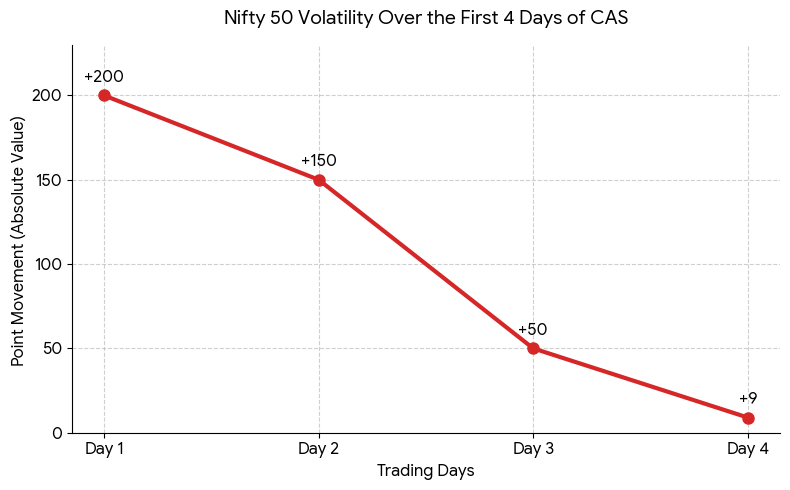
Early Market Data
The first four trading sessions showed noticeable differences between the two benchmark indices:
- Nifty
- Average movement between 3:15 PM and 3:30 PM: approximately +0.42%
- Jumped over 200 points on the first day of CAS.
- Rose more than 150 points on the second day.
- Closing auction turnover on Thursday was about ₹1,433 crore.
- Sensex
- Average movement during the same period: around +0.10%
- Weekly expiry saw comparatively smaller moves.
- Closing auction turnover was approximately ₹127 crore.
Here’s what happened today and why traders reacted
The market’s attention remained firmly on the Closing Auction Session (CAS) as Sebi defended the framework in its annual report.
While traders continued to discuss the sharp closing swings witnessed in the Nifty, Sebi reiterated that the objective of CAS is not to manage short-term price movements but to improve the quality of the official closing price.
The regulator emphasized that a transparent auction-based process should ultimately deliver a more accurate benchmark for investors, fund managers and institutions that rely on closing prices for portfolio valuation and settlement.
What impact could Closing Auction Session have on investors?
For long-term investors, the introduction of Closing Auction Session (CAS) is unlikely to change investment decisions directly. However, a more reliable closing price can improve portfolio valuation, index fund tracking and institutional execution over time.
Passive funds, exchange-traded funds (ETFs) and mutual funds that transact near the market close may benefit from more efficient price discovery if the system performs as intended.
For short-term traders, however, the adjustment is more immediate.
Options traders, expiry-day participants and algorithmic traders may need to recalibrate execution strategies as closing auction dynamics become a larger driver of settlement prices. Increased volatility during the auction window could create both trading opportunities and additional risks.
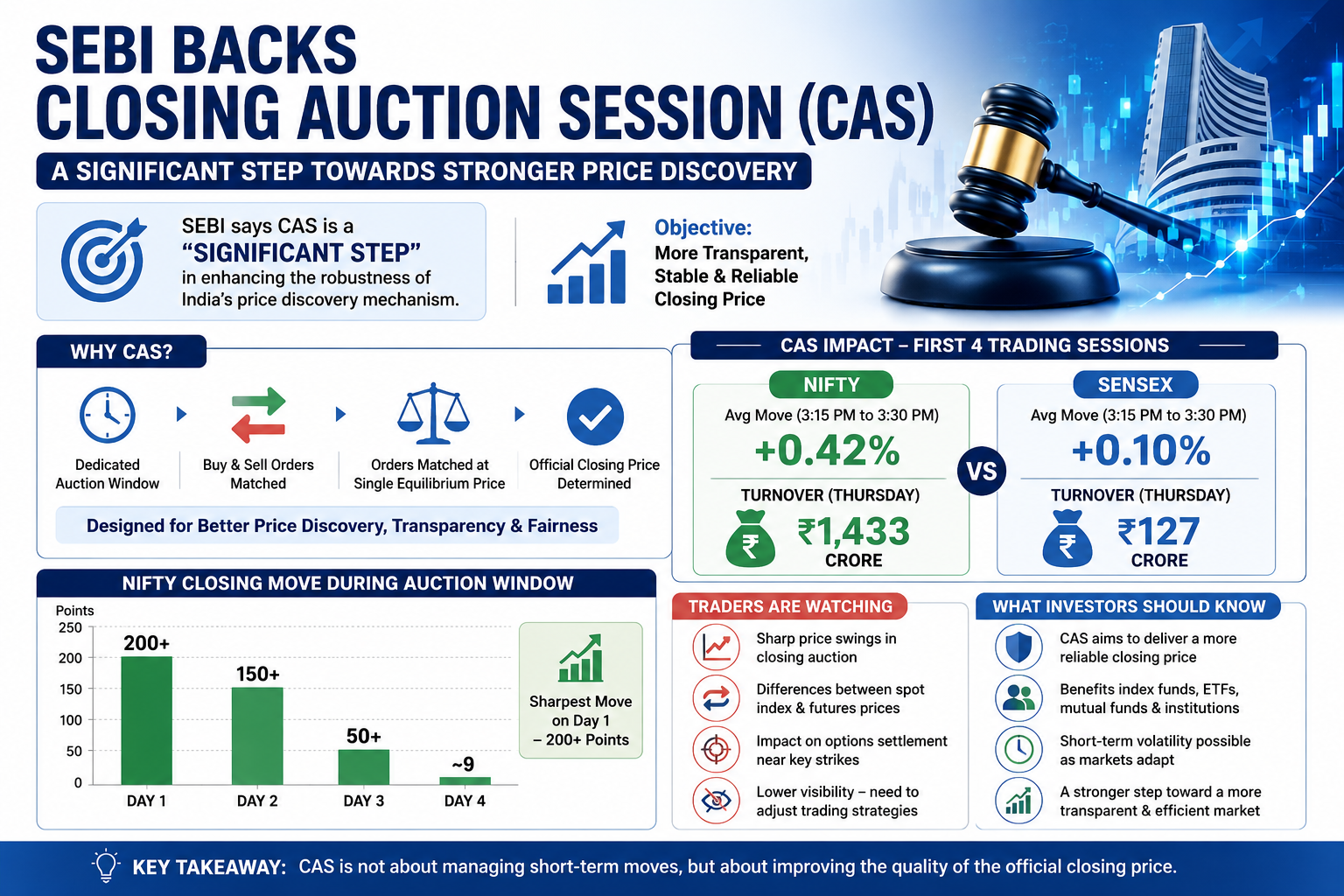
What investors should watch next
The coming weeks will determine whether the initial volatility surrounding the Closing Auction Session (CAS) gradually stabilizes as traders adapt to the new framework.
Investors will also monitor whether liquidity improves during the auction period and whether the gap between spot and derivatives markets narrows over time.
If the mechanism succeeds in delivering more efficient closing prices without sustained volatility, Closing Auction Session (CAS) could become one of the most significant structural changes to India’s equity market in recent years, reinforcing Sebi’s broader objective of making the market more transparent, efficient and globally competitive.