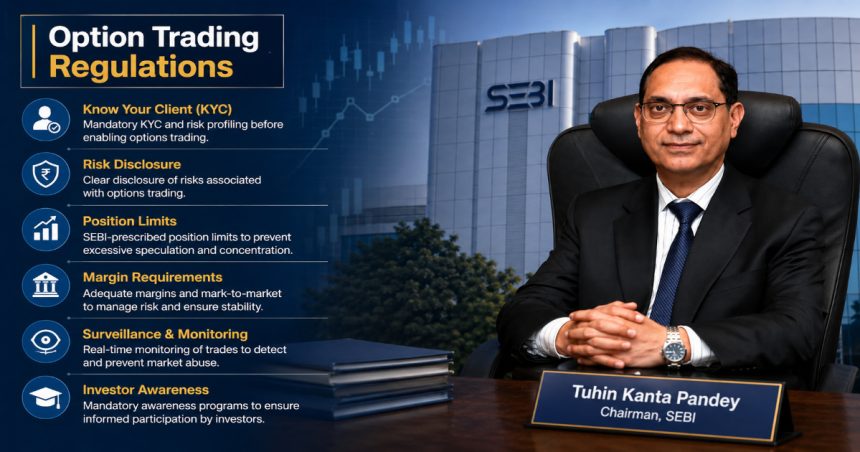
SEBI Signals Options Trading Won’t Dictate Policy as SLBM Revamp Nears
India’s capital markets could be heading for another regulatory shift, and traders may soon feel the impact. SEBI Chairman Tuhin Kanta Pandey has made it clear that options trading alone will not determine market policy, while the regulator is moving with urgency to overhaul the Securities Lending and Borrowing Mechanism (SLBM).
The proposed SLBM revamp could become particularly important for traders as SEBI looks to deepen securities lending and increase participation in the Closing Auction Session (CAS). At the same time, the regulator has confirmed that CAS is here to stay.
Track Live : NSE Option Chain — Live
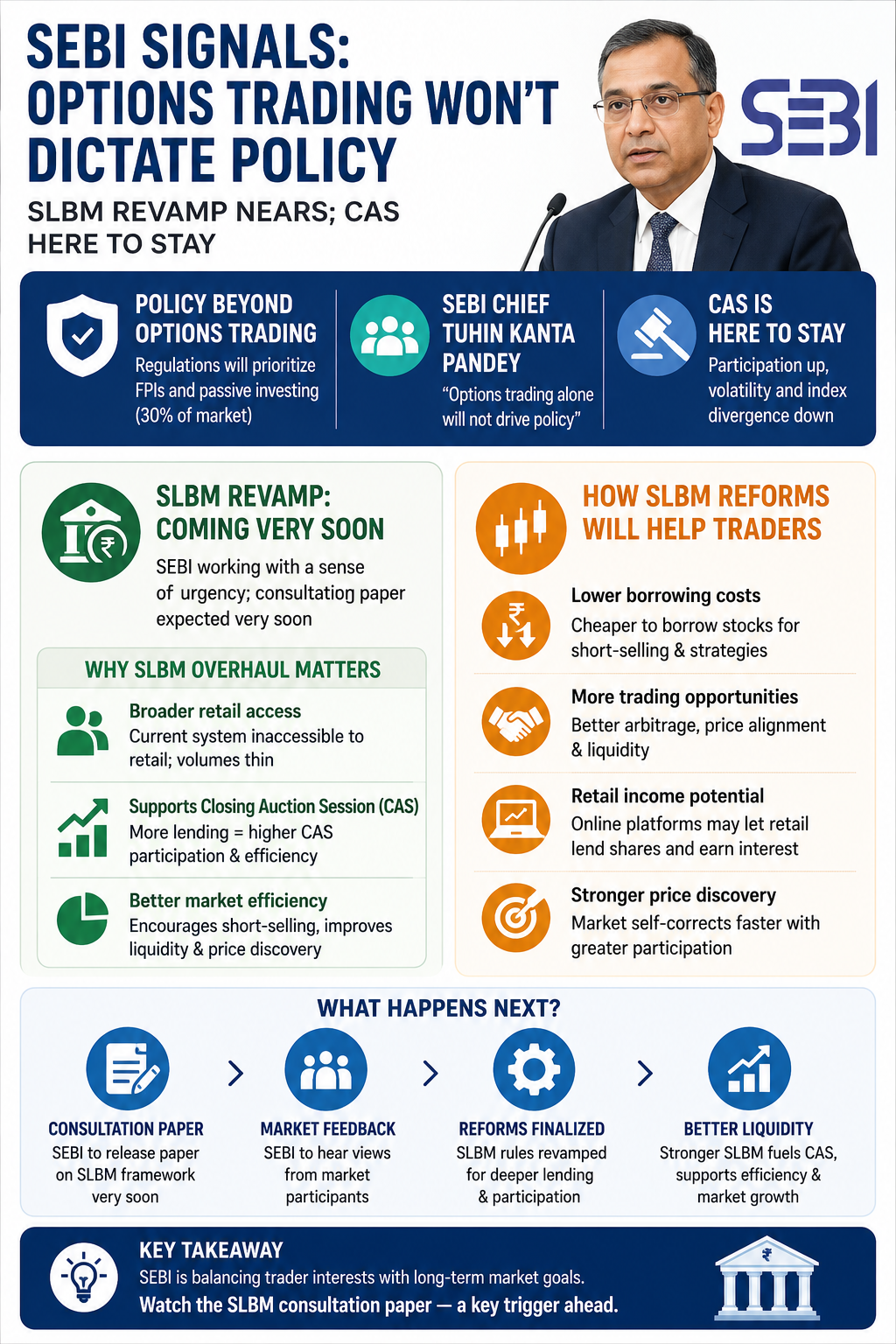
SEBI Signals options trading cannot drive market policy
Speaking on the sidelines of a cyber defence event at the NISM campus in Patalganga on Monday, Pandey said market regulations must consider the broader structure of India’s capital markets rather than focusing only on options trading.
“It really depends on our success in terms of attracting FPIs, allowing the passive investing, which is already 30 percent of your market,” Pandey said.
He added that regulators cannot change policy simply because some participants want to trade options in a particular way.
The comments are important for traders because they suggest that SEBI’s regulatory approach will increasingly balance derivatives activity with the interests of foreign portfolio investors (FPIs), passive funds and long-term market participants.
Options Trading Will Not Dictate Market Policy
- Prioritizing Capital Inflows: SEBI’s policy focus remains anchored on attracting long-term Foreign Portfolio Investors (FPIs).
- Guarding Passive Assets: With passive investing (ETFs and index funds) now making up a massive 30% of the Indian market, regulatory frameworks must protect stable long-term assets over speculative retail option volumes
SLBM revamp could come very soon
While options trading remains under regulatory scrutiny, the bigger near-term development could be SEBI’s planned overhaul of SLBM.
Pandey said SEBI is working with a “sense of urgency” and that a consultation paper on the proposed SLBM framework is expected “very soon”.
“We must get to the reformed SLBM very soon,” Pandey said.
A working group is already examining possible changes. Before the consultation paper is released, SEBI also plans to hear views from market participants.
The proposed reforms could address some of the longstanding problems that have limited participation in India’s securities lending market.
Read More : FM Sitharaman: Banking Panel Likely This Month; PSBs Post Record Rs.1.98 Lakh Crore Profit
Why SEBI is Overhauling the SLBM
- Broadening Retail Access: The current SLBM framework suffers from thin volume and high institutional borrowing costs because it remains largely inaccessible to retail investors.
- Fueling the Closing Auction Session (CAS): A deeper lending market directly fuels the CAS by giving traders the shares needed to settle large, end-of-day institutional block trades.
- Enhancing Short-Selling & Price Discovery: Overhauling this mechanism makes short-selling more viable, allowing the market to self-correct and discover realistic stock valuations faster.
Why the SLBM overhaul matters for traders
The Securities Lending and Borrowing Mechanism allows investors to lend securities to other market participants. A more efficient system can make securities borrowing easier and potentially support greater short-selling activity.
Historically, however, India’s SLBM market has faced limited participation and relatively high borrowing costs.
SEBI has previously identified accessibility as a key issue, particularly for the widely dispersed retail investor segment. Earlier proposals included transparent online platforms and alternative business models to make securities lending more accessible.
A successful SLBM revamp could therefore improve liquidity, reduce friction and encourage more participants to enter the market.
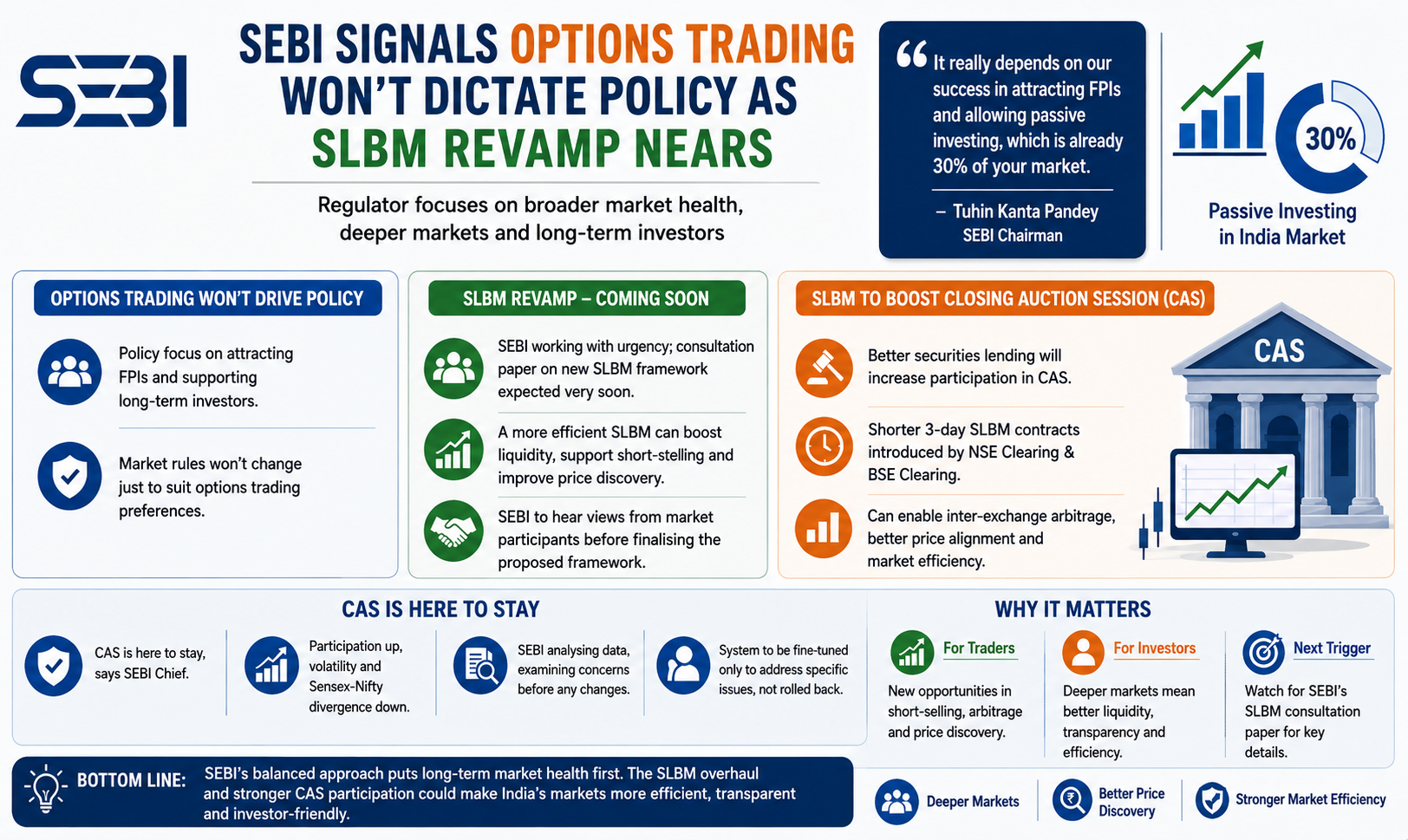
SLBM could give the Closing Auction Session a boost
The timing of the proposed SLBM reforms is particularly significant because SEBI also wants to strengthen participation in the Closing Auction Session.
Pandey directly linked the two developments.
“It will definitely help in CAS because the CAS would mean more participation, SLBM improves CAS participation,” he said.
Clearing corporations NSE Clearing and BSE Clearing have already announced shorter three-day SLBM contracts aimed at increasing participation around the closing auction.
The shorter-tenor contracts could make securities lending more practical around CAS and potentially support inter-exchange arbitrage, better price alignment and overall market efficiency.
What Changes are Coming Soon?
- Immediate Consultation Paper: SEBI’s dedicated working group is rapidly drafting a public consultation paper to be released with a “sense of urgency”.
- 3-Day Shorter SLBM Contracts: Clearing corporations (NSE Clearing and BSE Clearing) have already introduced short-tenor, three-day contracts to facilitate rapid, end-of-day inter-exchange arbitrage.
- Permanent CAS Status: Despite social media pushback and trader complaints, SEBI confirmed the Closing Auction Session is here to stay, as internal data shows it has successfully curbed extreme index volatility and reduced divergences between the Nifty and Sensex.
Here’s what happened today and why traders reacted
For traders, the key takeaway is that SEBI is not backing away from market reforms despite concerns from some market participants.
The regulator’s decision to retain CAS means traders should continue adapting to the closing auction framework rather than expecting its reversal.
At the same time, a more efficient SLBM system could create new opportunities around short-selling, arbitrage and price discovery.
SEBI has also said that participation in CAS has increased since its introduction, while volatility and divergences between the Sensex and Nifty have declined.
The regulator is still studying unusual trading activity, particularly around expiry days, before deciding whether additional changes are necessary.
CAS is here to stay, SEBI chief confirms
Pandey was clear about the regulator’s position on CAS.
“CAS is here to stay,” he said.
SEBI is analysing concerns raised by market participants and suggestions circulating on social media. However, any future changes are expected to target specific problems identified through market data rather than scrap the system altogether.
This means traders should focus on understanding how CAS affects execution, liquidity and closing prices instead of expecting a rollback.
Why investors should watch SEBI’s next move
SEBI’s latest comments send two clear signals: options trading will not be the sole driver of market policy, and CAS is not going away.
The proposed SLBM overhaul could be the more important development for market structure. If the reforms successfully reduce borrowing costs and widen participation, securities lending could become a more meaningful part of India’s capital markets.
For traders, that could mean new opportunities. For long-term investors, a deeper and more efficient market could ultimately improve liquidity, transparency and price discovery.
The next major trigger will be the SLBM consultation paper, which could provide the first detailed indication of how SEBI plans to reshape the market.
- For Short Sellers & Arbitrageurs: Borrowing specific stocks to bet against overvalued companies will become significantly cheaper and more transparent.
- For Retail Investors: Upcoming online lending platforms could soon allow retail investors to safely lend out their long-term stock portfolios to institutions in exchange for steady interest income.
- For Institutional Traders: The permanent nature of CAS ensures a structured, low-volatility window at the end of the trading day to execute massive portfolio rebalancing acts.