Yes Bank Dollar Bond Issue: First Since 2020 AT1 Crisis, Taps Global Investors
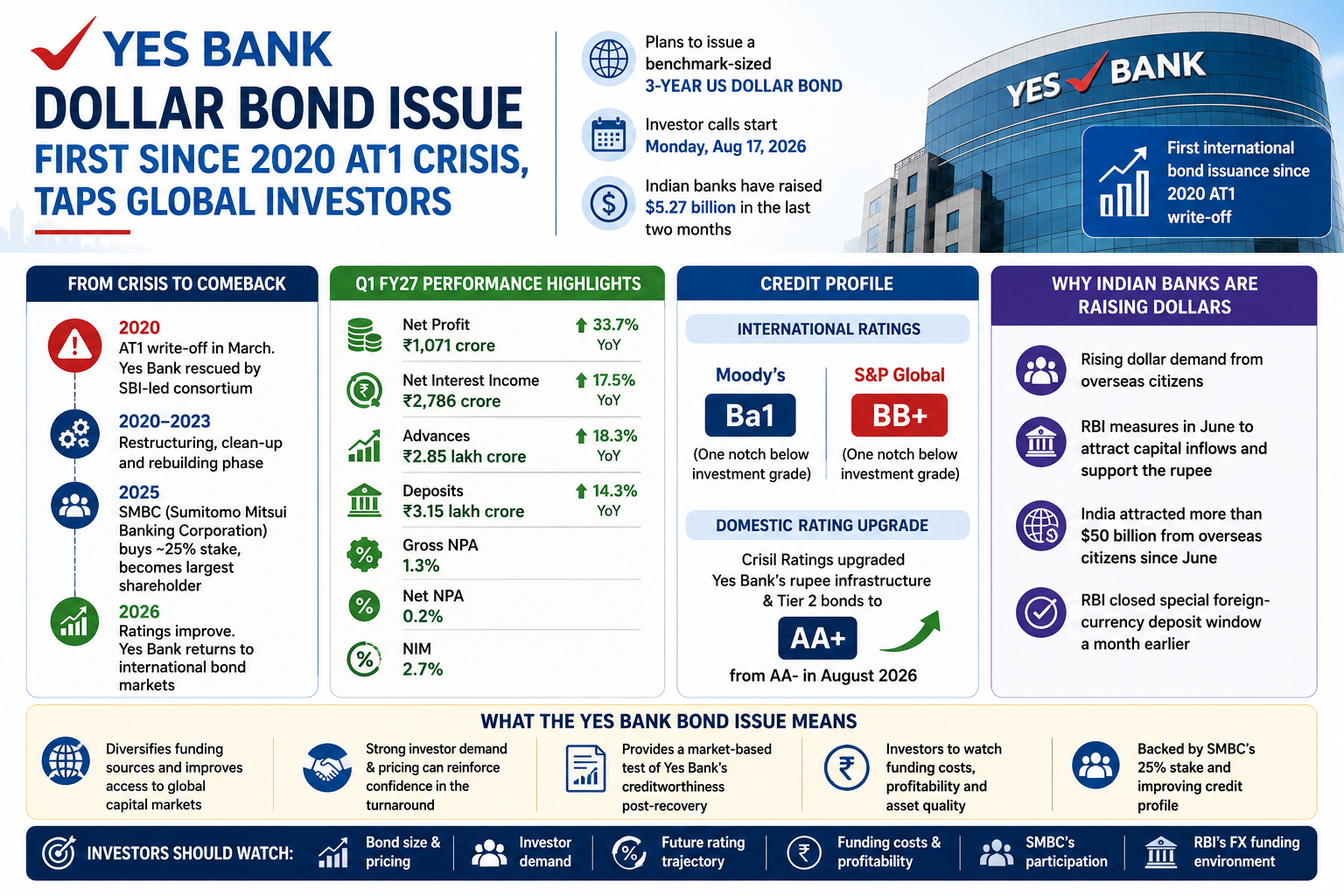
Yes Bank is preparing to make a notable return to the international bond market, years after its controversial Additional Tier 1 (AT1) debt write-off shook investor confidence. The private lender plans to issue a benchmark-sized three-year US dollar bond, marking its first such issuance since 2020.
The move comes as Indian banks are increasingly turning to overseas debt markets to raise funds. For investors, Yes Bank’s return is more than a routine fundraising exercise—it offers a fresh test of how far the lender’s turnaround has progressed since its 2020 crisis.
Track Live : NSE Option Chain — Live
Why Yes Bank is returning to the dollar bond market now
Yes Bank has appointed arrangers for the proposed dollar bond issue and is scheduled to hold calls with fixed-income investors starting Monday, according to people familiar with the matter.
The lender plans to issue a benchmark-sized three-year US dollar note. The exact size and pricing will depend on investor demand and market conditions.
The proposed transaction comes at a time when Indian lenders have raised about $5.27 billion over the past two months. Demand for foreign currency funding has increased following measures announced by the Reserve Bank of India in June to encourage capital inflows and support the rupee.
Yes Bank did not immediately respond to a request for comment.
Market Entry Details
- Instrument: Three-year US currency (USD) senior notes.
- Size: Benchmark-sized (typically means a minimum of $300 million to $500 million).
- Timing: Investor calls commence on Monday (August 17, 2026).
- Catalyst: Driven by recent Reserve Bank of India (RBI) measures designed to boost capital inflows and support the rupee. [1]
Yes Bank’s Latest Financial Performance
- Net profit: ₹1,071 crore, up 33.7% YoY
- Net interest income: ₹2,786 crore, up 17.5% YoY
- Advances: Up 18.3% YoY
- Deposits: ₹3.15 lakh crore, up 14.3% YoY
- Gross NPA: Improved to 1.3%
- Net NPA: 0.2%
- NIM: Improved to 2.7%
- SMBC: Became Yes Bank’s largest shareholder with a 24.9% stake
- Credit profile: Domestic and international ratings have improved
- Bond-market return: Planned 3-year dollar bond marks Yes Bank’s first international bond issuance since the 2020 AT1 write-off
The 2020 AT1 write-off remains an important part of Yes Bank’s history
The latest bond plan is significant because Yes Bank has not returned to this segment since the dramatic events of 2020.
In March that year, the bank permanently wrote off its Additional Tier 1 debt. AT1 securities qualify as bank capital but are hybrid instruments that can be written off when specified regulatory triggers are breached.
The move came after Indian authorities stepped in to take control of Yes Bank. The lender was subsequently rescued through a consortium led by State Bank of India, helping prevent a deeper financial crisis.
That episode severely affected investor confidence in the bank’s debt instruments and became a major event for India’s AT1 bond market.
Credit Ratings Profile
- Moody’s Ratings: Ba1
- S&P Global Ratings: BB+
- Domestic Context: Crisil Ratings recently upgraded Yes Bank’s rupee infrastructure and Tier-2 bonds to AA+ (up from AA-), pointing to sustained earnings growth.
Yes Bank’s turnaround has changed its credit story
Since the crisis, Yes Bank has undergone a steady turnaround.
A major development came in 2025 when the banking unit of Sumitomo Mitsui Financial Group acquired roughly a 25% stake in Yes Bank, becoming its largest shareholder.
The lender has also benefited from several rating upgrades on its domestic-currency debt.
Most recently, Crisil Ratings raised Yes Bank’s rupee infrastructure bonds and Basel III-compliant Tier 2 debt to AA+ from AA- in August. Crisil cited a sustained improvement in the bank’s earnings profile.
The same bonds had carried an A- rating at the beginning of 2023, highlighting the improvement in Yes Bank’s credit profile over the period.
Historical Context & Turnaround Timeline
-
- March 2020: Yes Bank collapsed and was rescued by a State Bank of India (SBI)-led consortium. The bank permanently wrote off its risky Additional Tier 1 (AT1) local bonds, triggering prolonged legal battles with retail and institutional investors.
- 2023–2025: The bank initiated an aggressive bad-loan cleanup and restructuring phase.
- 2025: Japan’s Sumitomo Mitsui Financial Group Inc. (SMFG) acquired a 25% stake, becoming the largest shareholder and anchoring international investor confidence.
- August 2026: The current USD bond issuance marks the official return of the lender to international capital markets.
Read More : SEBI Signals Options Trading Won’t Dictate Policy as SLBM Revamp Nears
Yes Bank’s dollar bond remains just below investment grade
Despite the improvement in its domestic debt ratings, Yes Bank’s proposed international borrowing still carries a below-investment-grade profile.
The bank’s dollar bond is rated Ba1 by Moody’s Ratings and BB+ by S&P Global Ratings.
Both ratings are only one notch below investment grade.
That makes investor demand for the proposed three-year dollar bond particularly important. Strong demand and competitive pricing could reinforce the market’s growing confidence in Yes Bank’s financial recovery.
Why Indian banks are rushing to raise dollars
Yes Bank’s bond comeback is happening against a broader increase in foreign-currency fundraising by Indian lenders.
India’s bond and loan markets have gained momentum as banks seek to tap rising dollar demand and increase leverage against foreign-currency deposits offered to overseas citizens.
The trend follows the Reserve Bank of India’s efforts to attract capital from the Indian diaspora and strengthen the country’s foreign-exchange reserves.
India has reportedly attracted more than $50 billion from overseas citizens since June, leading the RBI to close its special foreign-currency deposit window a month earlier than initially expected.
This environment has created a favourable backdrop for Indian banks looking to access international debt investors.
What the Yes Bank bond issue means for investors
The proposed dollar bond could have several implications for Yes Bank.
A successful issue could diversify the bank’s funding sources and improve its access to international capital markets. It may also provide a market-based indication of how investors currently assess the lender’s creditworthiness.
Equity investors could view strong demand positively if the transaction reinforces the broader turnaround narrative. However, investors should also monitor the bank’s funding costs, asset quality, profitability and future rating actions.
Investors should watch:
- Final size and pricing of the three-year dollar bond.
- Demand from international fixed-income investors.
- Yes Bank’s future credit-rating trajectory.
- Funding costs and profitability.
- Further participation by strategic shareholder SMFG.
- Changes in the RBI’s foreign-currency funding environment.
Why this bond comeback matters for Yes Bank
Yes Bank’s planned return to the dollar bond market marks an important chapter in its post-2020 recovery.
The bank is moving back into international debt markets at a time when Indian lenders are benefiting from strong demand for dollar funding. With its international ratings still just below investment grade, the transaction will provide an important real-time test of investor confidence.
If the issue receives strong demand and favourable pricing, it could strengthen the perception that Yes Bank has moved well beyond its 2020 crisis. For investors, the bond sale therefore deserves attention not only as a fundraising exercise but also as another indicator of the bank’s financial turnaround.
Strategic Implications for Investors
- Pricing Premium: Because the bonds are rated just below investment grade (junk/high-yield territory), Yes Bank will likely have to offer a yield premium to attract global fixed-income investors.
- Litigation Shadow: While the bank’s financial fundamentals have vastly improved, some international investors may remain cautious due to the precedent set by the total erasure of the 2020 AT1 bonds.
- Institutional Backing: The 25% ownership by SMFG acts as a structural safety net, significantly reducing default risk compared to the pre-2020 era.