Key Takeaways
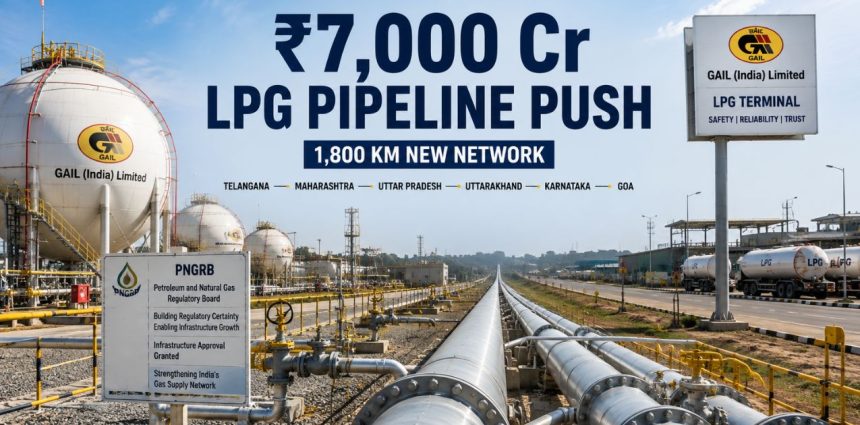
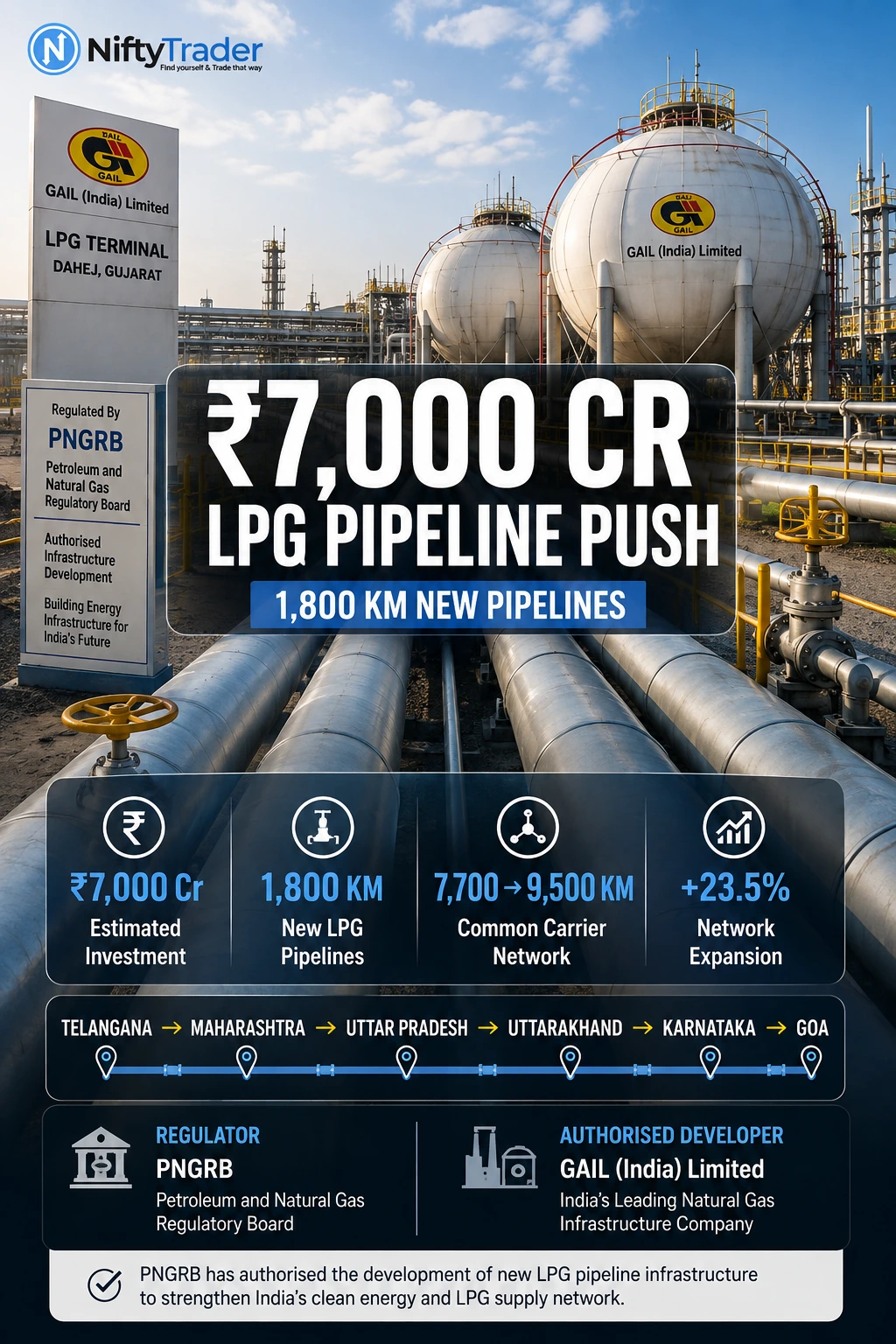
- PNGRB has authorised GAIL (India) Ltd to build nearly 1,800 km of new common-carrier LPG pipelines across six states at an estimated cost of ₹7,000 crore.
- Three routes are involved, Cherlapally-Nagpur (556 km), Jhansi-Sitarganj (611 km), and Shikrapur-Goa & Hubli (633 km), lifting India’s authorised LPG pipeline network from 7,700 km to about 9,500 km, a 23.5% jump.
- The authorisation traces back to mid-July, when GAIL first disclosed it to investors on its Q1 FY27 earnings call, at a lower cited figure of ₹6,700 crore.
- The routes are three of four corridors from a broader PNGRB tender launched in April 2026, worth roughly ₹12,500 crore; a fourth link, Paradip-Raipur, is still pending.
- The push is aimed at cutting India’s reliance on road tankers to move LPG, which the regulator has flagged as a safety and logistics risk.
- GAIL shares ended Friday near ₹172, within its 52-week range of ₹134.36-₹186.87.
What PNGRB Has Cleared
New Delhi: State-run gas utility GAIL (India) Ltd has received formal authorisation from the Petroleum and Natural Gas Regulatory Board (PNGRB) to build nearly 1,800 km of new common-carrier LPG pipelines across six states, at an estimated investment of ₹7,000 crore, the regulator said in a statement.
Common-carrier status means the pipelines will be open-access infrastructure, available to other fuel marketers beyond GAIL once operational.
The authorisation covers three separate routes. The Cherlapally (Telangana) to Nagpur (Maharashtra) line will run 556 km. The Jhansi (Uttar Pradesh) to Sitarganj (Uttarakhand) pipeline covers 611 km. The Shikrapur (Maharashtra) to Goa and Hubli (Karnataka) corridor spans 633 km.
Together, they will pass through Telangana, Maharashtra, Uttar Pradesh, Uttarakhand, Karnataka and Goa.
PNGRB said the projects build on the earlier authorisation of the 2,757-km Kandla-Gorakhpur LPG pipeline, currently the country’s longest single LPG line, and will take the authorised network from 7,700 km to close to 9,500 km, an increase of nearly 23.5%.
Check Live: GAIL (INDIA) Options Chart
Why Pipelines Over Road Tankers
India imports the bulk of its LPG requirement, with cargoes landing at coastal terminals before being moved inland, currently through a mix of pipelines and a large fleet of road tankers.
PNGRB has argued that pipeline transport is safer and more economical than trucking LPG over long distances, and pointed to a history of serious tanker accidents as part of the rationale for the shift.
A bigger pipeline network also functions as a buffer: gas held within the system, known as line-pack storage, can help maintain supply during short-term disruptions or demand spikes.
Fewer tankers on the road means lower accident risk, reduced logistics costs and less traffic congestion along key corridors, the regulator said.
Part of a Larger ₹12,500-Crore LPG Grid
These three pipelines are not a standalone initiative. PNGRB opened bidding in April 2026 for four LPG corridors spanning roughly 2,500 km, with a combined tentative investment of ₹12,500 crore, as part of nine LPG pipeline projects it has identified nationwide to phase out bulk road transportation of LPG by 2030.
Three of those four bid corridors, Cherlapally-Nagpur, Jhansi-Sitarganj and Shikrapur-Hubli-Goa, have now been authorised to GAIL. The fourth, a Paradip-Raipur link, remains outstanding and is worth tracking for a follow-up authorisation.
Also Check: GAIL Option Chain (GAIL) — Live OI, IV, Greeks & PCR
A Number Investors Already Had
The authorisation itself isn’t breaking news in the strictest sense. GAIL disclosed it to investors in late July, during its Q1 FY27 earnings call, when the company said PNGRB had cleared the same three pipelines, then cited at a combined investment of ₹6,700 crore, with the order received on July 14.
PNGRB’s latest statement adds route-wise and state-wise detail and puts the combined investment at ₹7,000 crore; the ₹300-crore gap between the regulator’s figure and the company’s own disclosure remains unreconciled. What is new is the level of official detail now available on the routes, states and network math.
Also Read: GAIL Q1 FY27 Results: Gas Marketing Growth Drives Profit
GAIL’s Wider LPG Push
The new pipelines sit alongside a separate, already-approved expansion of GAIL’s Jamnagar-Loni LPG line, where the company is doubling capacity to 6.5 MMTPA from 3.25 MMTPA at an estimated cost of around ₹5,000 crore.
Between the two projects, GAIL’s LPG pipeline capital commitments now run into several thousand crores over the next three years. On the stock, GAIL shares ended Friday’s session near ₹172 on the NSE, within its 52-week range of ₹134.36 to ₹186.87, valuing the state-run gas major at close to ₹1.13 lakh crore.
Bottom Line
The PNGRB authorisation formalises a build-out GAIL had already flagged to investors, a meaningful, multi-year expansion of India’s LPG pipeline backbone, executed entirely by the state-run gas utility.
For readers tracking this story, the number worth watching may not be ₹7,000 crore or ₹6,700 crore, but the 23.5% jump in network length once the three lines are commissioned, and whether the pending Paradip-Raipur corridor gets its own authorisation next.
Read Next: More Ways to Buy Bonds, Fewer Ways to Oversell Them: Inside SEBI’s Twin Bond Proposals
This article is for informational purposes only and does not constitute investment advice. NiftyTrader is not a SEBI-registered investment advisor. Readers should consult a qualified financial advisor before making investment decisions.