Cipla Pharma Licence Cancellation Order Withdrawn After Bombay HC Rebuke
A regulatory setback for Cipla Pharma & Life Sciences has taken an unexpected turn. The Maharashtra FDA has withdrawn its order cancelling the drug sale licence of the company’s Pune carrying and forwarding unit after the Bombay High Court criticised the regulator’s procedure and said it had gone “overboard.”
The development could draw attention from Cipla investors and traders, as the licence cancellation had raised concerns around regulatory compliance and the potential impact on the company’s operations.
Track Live : NSE Option Chain — Live
Bombay High Court says FDA went “overboard”
A bench comprising Acting Chief Justice Ravindra Ghuge and Justice Gautam Ankhad said the FDA had acted against the principles of natural justice.
The court also criticised the regulator for allegedly following the wrong procedure and described its approach as “high-handed.”
“You are going overboard,” the bench told the FDA while acknowledging the regulator’s work.
The court further questioned the decision to call Cipla for a hearing on August 26, which was a public holiday declared by the Maharashtra government.
What the Bombay High Court Said
- “Going Overboard”: The court told the FDA, “You are doing a laudable and appreciative job, but now you are going overboard. This is not the first time this is happening. You have wronged, and now you have to resolve the issue.”
- High-Handed Behavior: The bench observed that the regulator behaved in a “high-handed” manner, followed an entirely wrong procedure, and bypasses the fundamental principles of natural justice by failing to give the company a fair chance to present its case.
- Lack of Transparency: The court questioned whether it was “fair and transparent” to send an email, demand a same-day holiday appearance, and immediately cancel the license when the company requested a standard adjournment.
Why Cipla challenged the FDA licence cancellation
Cipla Pharma & Life Sciences had challenged the FDA’s action in the Bombay High Court.
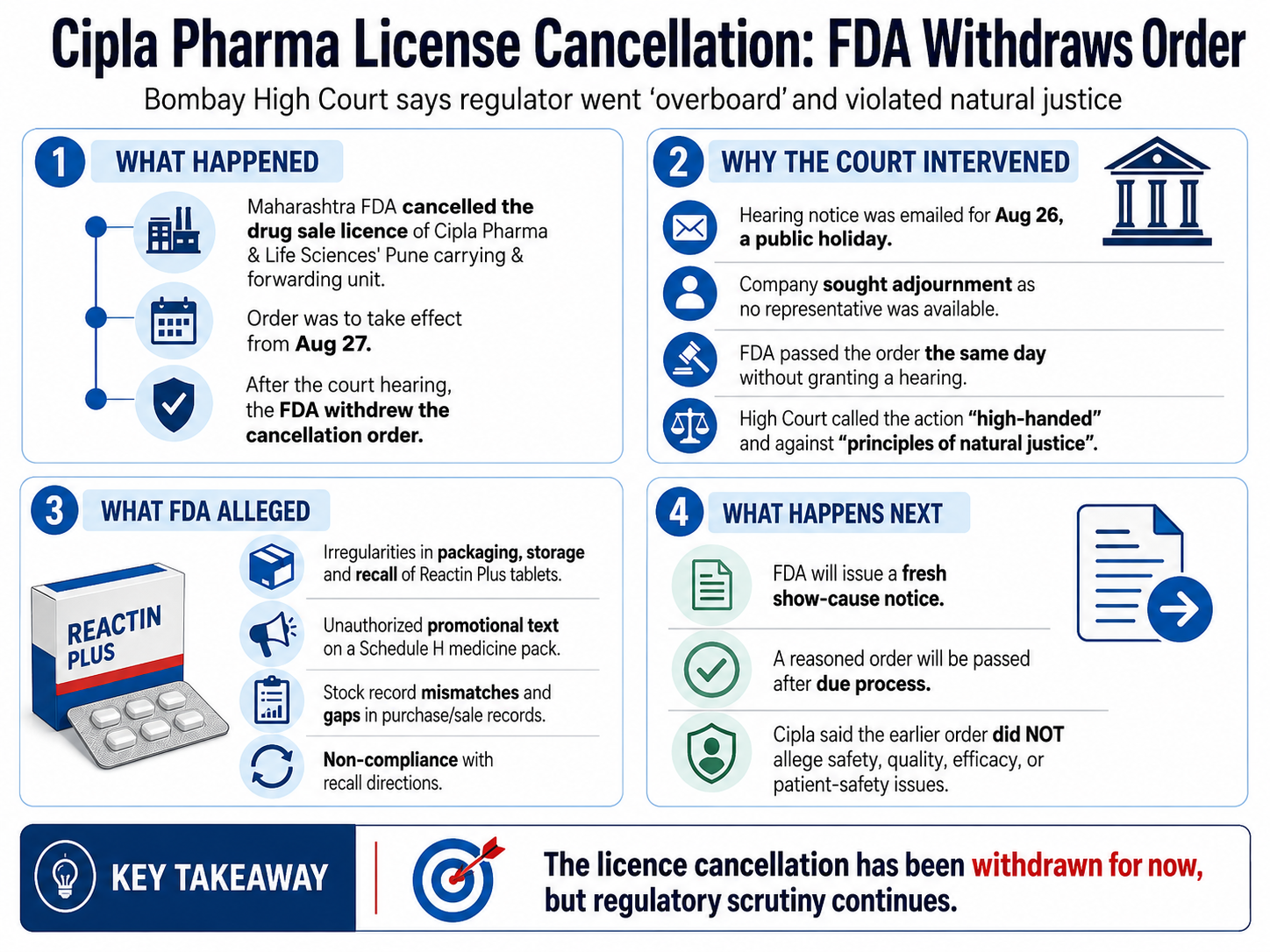
Senior counsel Aabad Ponda, appearing for Cipla, told the court that the company received an email asking it to appear for a hearing on August 26.
Since the date was a public holiday, Cipla had no representative available and requested an adjournment. According to the company’s submission, the FDA nevertheless passed the licence cancellation order on the same day without providing the requested hearing.
The FDA argued that the law did not give the company a right to a hearing. The court, however, questioned why the regulator had called the company for a hearing in the first place if it was not prepared to provide an opportunity to respond.
Will the Pune FDA issue materially affect Cipla’s earnings?
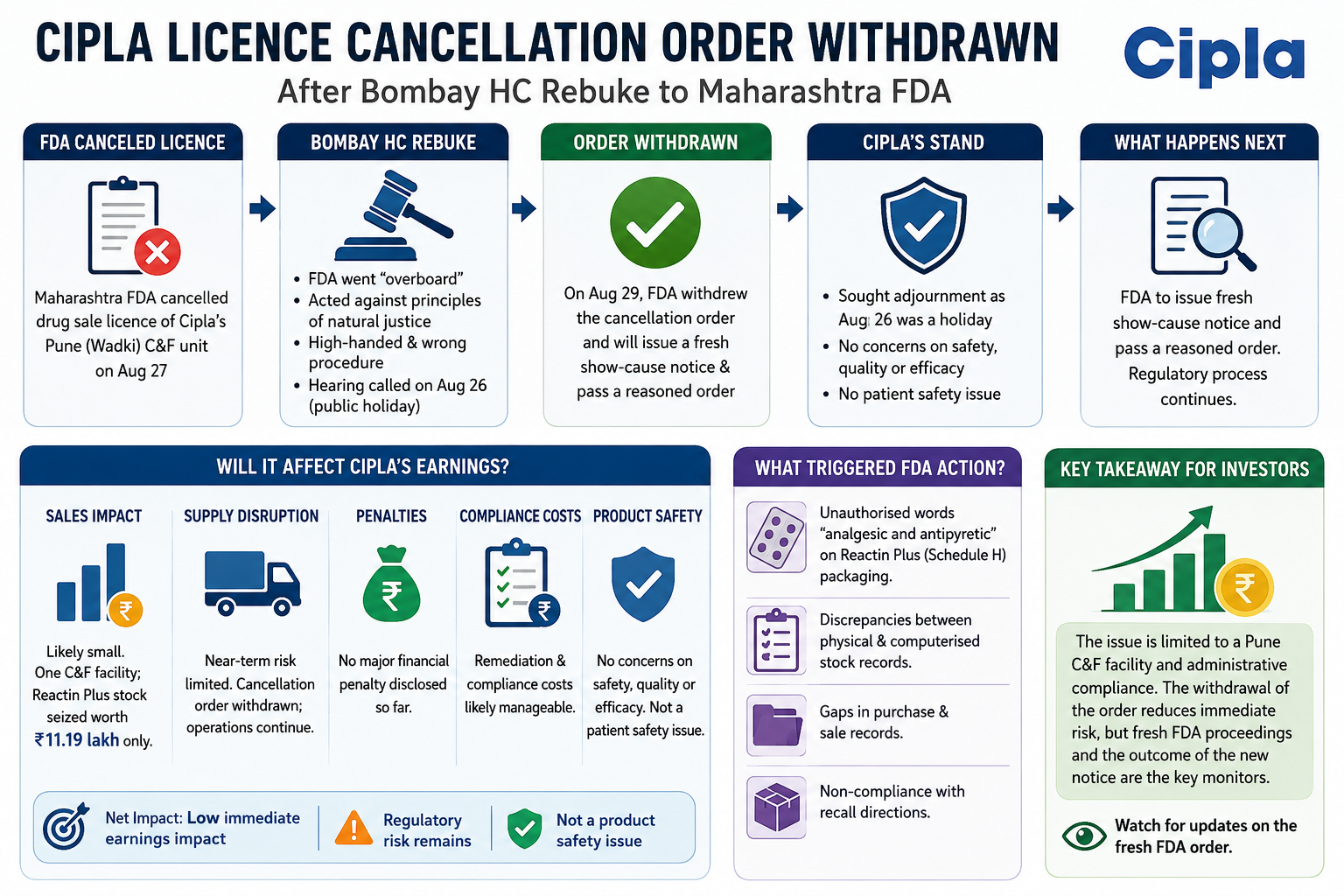
At this stage, a material impact on Cipla’s consolidated earnings appears unlikely — but it is too early to say there will be no impact. The important distinction is that the action concerns a single C&F/distribution facility in Wadki, Pune, rather than a company-wide manufacturing licence or Cipla’s entire product portfolio. The Bombay High Court has also led the Maharashtra FDA to withdraw the cancellation order and issue a fresh show-cause notice, reducing the risk of an immediate prolonged shutdown.
Here is the investor-focused breakdown:
Track Live : BSE Option Chain — Live Sensex & Bankex Options Data Today
1. How significant is the affected Pune facility?
Likely small at the consolidated level.
Cipla reported consolidated gross revenue of ₹28,162.59 crore in FY26 and profit after tax attributable to shareholders of ₹3,879.23 crore.
The FDA, meanwhile, seized Reactin Plus stock worth about ₹11.19 lakh during the regulatory action. That stock value by itself is extremely small relative to Cipla’s overall financial scale.
However, there is no publicly disclosed figure showing what percentage of Cipla’s total sales or distribution volume passes through the Wadki C&F facility. Therefore, calling its contribution to revenue “negligible” as a precise fact would be too strong. The better conclusion is that the currently disclosed financial exposure appears limited, unless the facility’s distribution role is substantially larger than the available reports indicate.
2. Could there be supply disruption?
Near-term risk appears limited, but not zero.
The original licence cancellation was effective August 27. But on August 29, following the Bombay High Court’s criticism, the FDA agreed to withdraw that order and issue a fresh show-cause notice before taking a reasoned decision.
That materially changes the immediate earnings-risk assessment: there is no longer an active prolonged licence cancellation based on the original order.
If a future order again restricts the facility, the potential earnings impact would depend on whether Cipla can redirect inventory and distribution through other channels. Public reports do not establish that alternative warehouses in Mumbai or Thane have already been arranged, so that should not be presented as a confirmed fact.
3. Could there be financial penalties or remediation costs?
Probably manageable, based on what has been disclosed so far.
The FDA has identified issues including:
- discrepancies between physical and computerised stock;
- gaps in purchase and sale records;
- inadequate storage arrangements;
- medicines reportedly stored directly on the floor;
- deficiencies in expired-medicine records; and
- alleged shortcomings in complying with the Reactin Plus recall.
These could result in compliance, remediation and operational costs, but there is currently no disclosed major monetary penalty that would suggest a meaningful hit to Cipla’s consolidated earnings.
4. Is this a product-safety problem?
This is an important distinction.
Cipla has specifically said that the FDA order does not allege concerns relating to the safety, quality or efficacy of its products and does not involve or indicate a patient-safety issue.
The FDA’s concerns instead include the packaging of Reactin Plus, a Schedule H prescription medicine, which reportedly carried the words “Analgesic and Antipyretic” along with promotional material. The regulator argued that such presentation could encourage self-medication.
So, based on the information available today, this should not be interpreted as a broad product-quality crisis at Cipla.
5. Does the fresh proceeding create a bigger risk?
This is the key issue investors should continue watching.
The FDA’s withdrawal of the original order does not amount to a complete regulatory clearance for Cipla. The regulator intends to issue a fresh show-cause notice and subsequently pass a reasoned order.
What triggered the FDA action against Cipla
The original FDA action followed inspections of Cipla’s facility in Pune.
During an initial inspection in June, officials reportedly found unauthorised promotional text on the packaging of Reactin Plus Tablets, a Schedule H prescription medicine.
The FDA specifically pointed to the words “analgesic and antipyretic” appearing on the packaging.
According to the regulator, promotional information on a prescription medicine could encourage consumers to use the drug without medical advice, potentially increasing the risk of self-medication.
The FDA also reported other compliance issues at the facility.
These included discrepancies between physical and computerised stock records, gaps in purchase and sales documentation and alleged non-compliance with recall directions.
Cipla says there was no product safety concern
An important point for investors is Cipla’s clarification regarding the nature of the FDA order.
The company said the FDA action did not allege concerns regarding the safety, quality or efficacy of its products.
Cipla also clarified that the order did not involve or indicate any patient safety issue.
That distinction could be significant for investors assessing the potential impact of the regulatory development on Cipla’s business and reputation.
What the fresh FDA notice could mean for Cipla investors
The withdrawal of the licence cancellation order removes the immediate impact of the earlier order, but it does not necessarily close the regulatory matter.
The FDA plans to issue a fresh show cause notice and subsequently pass a reasoned order. This means regulatory uncertainty around the Pune facility could continue until the fresh proceedings are completed.
For Cipla shareholders, the next important development will therefore be the outcome of the new FDA process.
Traders may also watch for any company disclosure regarding the facility, the Reactin Plus Tablets packaging issue and whether the regulator’s fresh order affects operations.