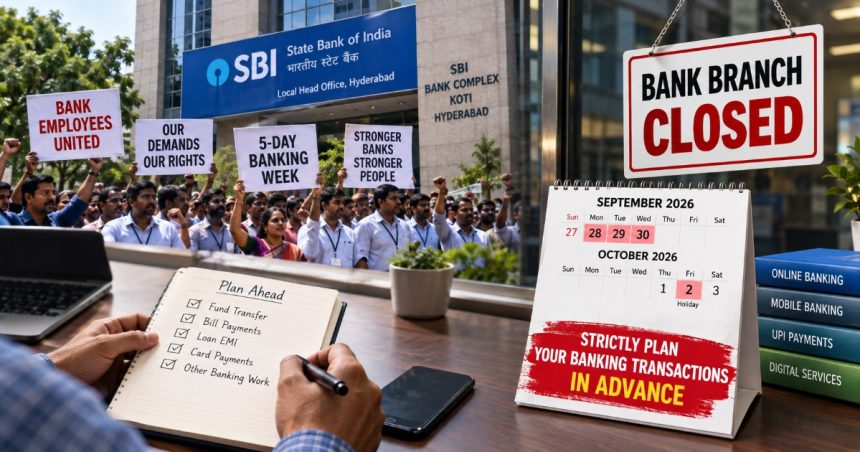
September 28 Bank Strike: Customers May Face 5 Days Without Normal Branch Services
A three-day bank strike from September 28 to 30 could create a much longer disruption for customers, with the preceding weekend potentially taking the total period without normal branch services to five days. The State Level Bankers’ Committee (SLBC) Telangana has therefore advised customers to complete important banking transactions in advance.
The development comes as bank unions intensify their campaign for a five-day banking week, while also raising pension and dearness allowance-related demands.
Track Live : Bank Nifty Levels Today | Nifty Levels Today
September 28 Bank Strike: Why bank employees are demanding a five-day work week
The central demand behind the bank strike is implementation of a five-day banking week. Currently, banks remain closed on Sundays and the second and fourth Saturdays.
The Indian Banks’ Association and employee and officer unions had recommended declaring all Saturdays as holidays, with additional working time on other weekdays.
L. Chandrasekhar, general secretary of the National Confederation of Bank Employees, said, “The Central government, Reserve Bank of India, insurance sector and Securities and Exchange Board of India follow a 5-day work week.”
Other demands include restoration of the old pension scheme and changes to the Dearness Allowance formula for pensioners.
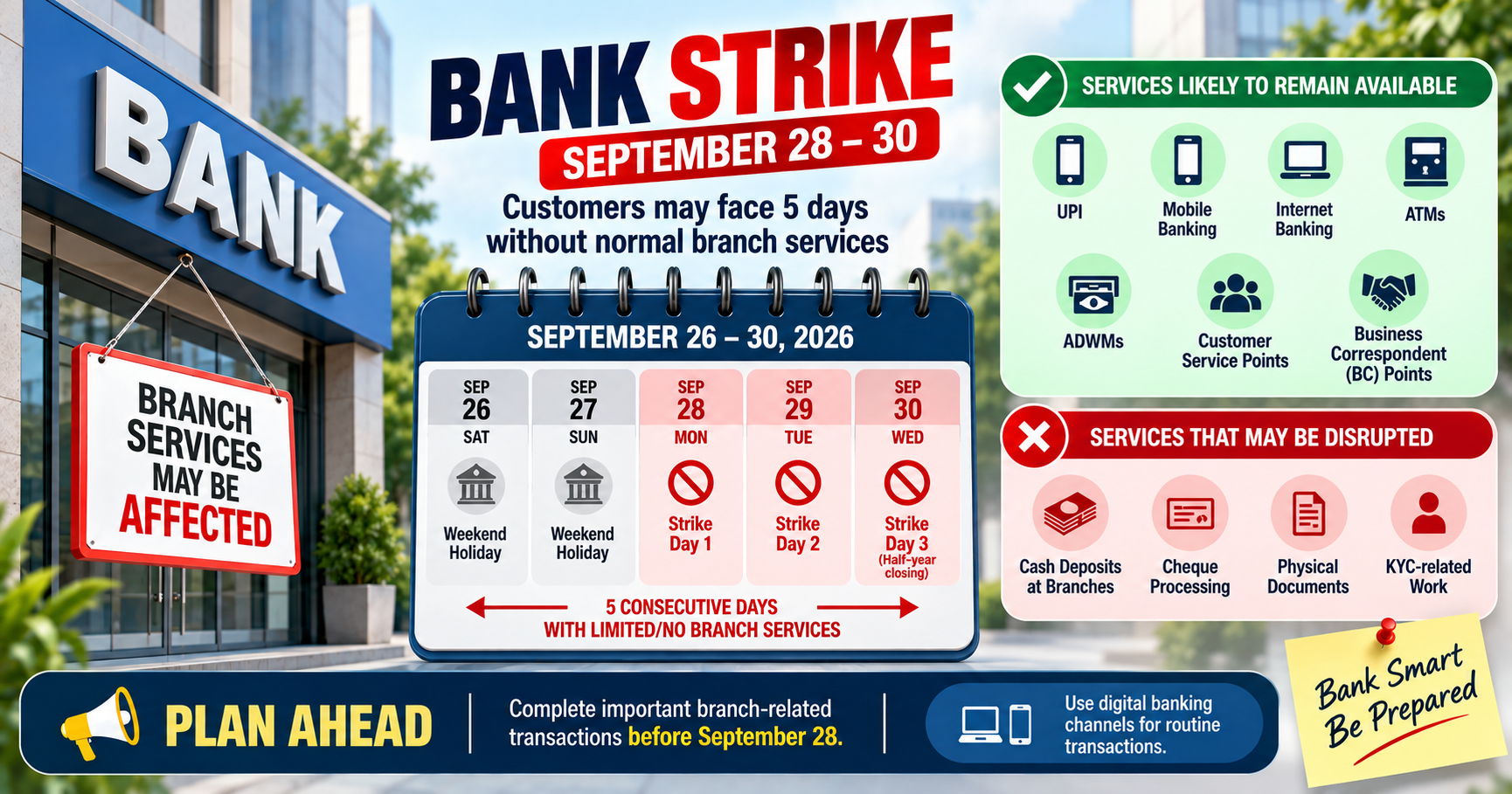
Strike and Closure Timeline: September 26–30, 2026
Your timeline is correct, with one important wording distinction: September 26–27 are regular bank holidays, while September 28–30 are the proposed three-day strike dates. So it is more precise to describe this as five consecutive days of limited/closed branch access, rather than a five-day strike.
| Date | Day | Status | What it means |
|---|---|---|---|
| September 26 | Saturday | Second Saturday holiday | Bank branches closed |
| September 27 | Sunday | Weekly holiday | Bank branches closed |
| September 28 | Monday | Proposed strike – Day 1 | Branch operations may be disrupted |
| September 29 | Tuesday | Proposed strike – Day 2 | Branch operations may be disrupted |
| September 30 | Wednesday | Proposed strike – Day 3 | Branch operations may be disrupted; also half-year closing |
The Finance Ministry has confirmed that the UFBU’s three-day strike is scheduled for September 28–30, while also urging employees to refrain from striking and resolve the remaining issues through dialogue.
Track Live : NSE Option Chain — Live
What Stays Open vs. Closed During the Bank Strike
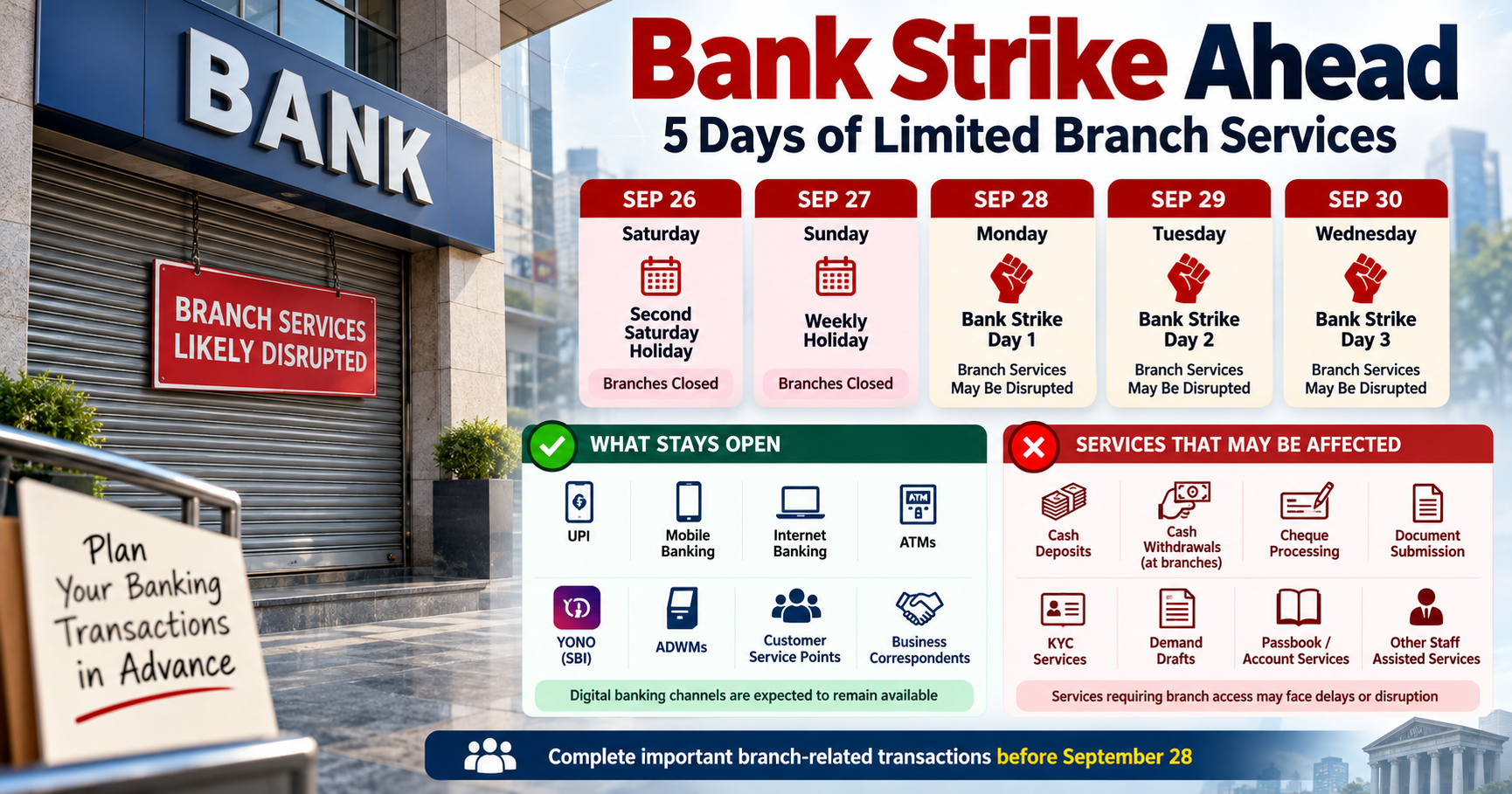
The latest bank advisories show that digital and alternative banking channels are expected to remain available, while services requiring branch staff, physical documents or in-person processing may be disrupted if the proposed strike goes ahead.
Digital and alternative channels expected to remain available
Customers should generally be able to use:
- UPI — routine payments and fund transfers
- Mobile banking — account and payment-related transactions
- Internet banking — transfers, bill payments and other online services
- YONO — for SBI customers
- ATMs — cash withdrawals and other available ATM services
- ADWMs — automated deposit and withdrawal machines, where available
- Customer Service Points (CSPs) — selected banking services
- Business Correspondent (BC) points — services available through participating banks
SBI and Union Bank have specifically advised customers to use these alternative channels during the proposed September 28–30 strike.
Branch-dependent services could face disruption
The following services may be affected because they require physical branch access, documents or staff assistance:
- Cash deposits at branches
- Cash withdrawals at branches
- Cheque-related processing and clearance
- Physical document submission
- KYC-related work requiring branch assistance
- Demand drafts and similar branch services
- In-person passbook/account-related services
- Other transactions requiring staff intervention or physical documentation
SBI has specifically warned that branch-dependent services and cheque-related processes could face delays or disruption if branch operations are affected.
Digital banking channels such as UPI, mobile banking, internet banking and ATMs are expected to remain available for routine transactions if the proposed September 28–30 bank strike goes ahead. SBI has also advised customers to use ADWMs, Customer Service Points and other alternative channels. However, services requiring physical branch access—including cash deposits, certain cash withdrawals, cheque-related work, document submission, KYC and other staff-assisted services—could face delays or disruption. Customers have therefore been advised to complete important branch-dependent transactions before the strike dates.
Read More : JSW Energy to Raise Rs.1,500 Crore, JSW Steel Rs.1,350 Crore via Bonds
Why the Bank Strike Is Happening
The main unresolved demand behind the September 28–30, 2026 bank strike is the implementation of a five-day banking week. The United Forum of Bank Unions (UFBU) has been pressing for all Saturdays to become holidays, alongside Sundays, with the proposal linked to the 2024 wage settlement. The unions say the proposal has remained pending despite an agreement in principle.
Pension and dearness allowance issues
The unions have also raised pension-related demands, including pension updation and an option for eligible employees covered by the National Pension System to return to the Old Pension Scheme.
Another demand concerns a uniform dearness allowance (DA) formula for pensioners/retirees. These are part of the broader set of unresolved service and pension issues cited by the unions.
What happened with the PLI demand?
The Performance Linked Incentive (PLI) issue was initially one of the two principal demands behind the agitation.
The government says it has already kept the PLI scheme in abeyance, following representations from employees. The Finance Ministry therefore considers this major demand addressed for now, although the unions have continued to raise concerns about the scheme and its structure.
Reports on the unions’ position say they objected particularly to the revised PLI structure for senior officers and wanted the matter discussed bilaterally.
Why September 30 is particularly significant
The timing of the proposed strike adds another dimension. September 30 is the half-year closing date for banks, making it important for reconciliation, provisioning, treasury and market operations.
The Finance Ministry has warned that a three-day strike combined with the preceding weekend could create an effective five-day disruption in normal branch banking services at a particularly sensitive point in the financial calendar.
What investors should watch in bank stocks
For bank investors and traders, the immediate impact is more likely to be operational than fundamental. A temporary branch disruption does not automatically change a bank’s earnings outlook.
However, prolonged industrial action could become relevant if it affects customer transactions, cheque clearing, loan processing or half-yearly closing activities.
Stocks of major public-sector banks could therefore remain sensitive to further developments surrounding the September 28 bank strike and the threatened October 26 indefinite strike. SBI and Bank of Baroda have already flagged the possibility of operational disruption from the strike calls.
For investors, the key question now is whether negotiations produce a resolution before September 28 or whether the planned bank strike proceeds as scheduled.