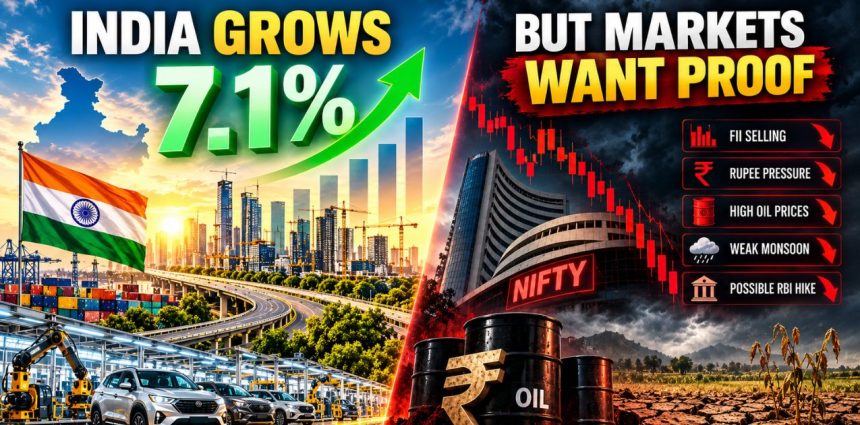
The World Bank has raised India’s FY2026-27 growth forecast to 7.1%, but financial markets are sending a more cautious signal. Manufacturing, GST collections, bank credit and auto demand point to resilience, while weak rainfall, expensive oil, a near-record-low rupee, foreign investor selling and the prospect of higher RBI rates complicate the outlook. The bigger question for Nifty investors is whether strong economic growth can translate into equally strong corporate earnings.
India’s economic outlook has just received a significant upgrade.
The stock market, however, still wants more proof.
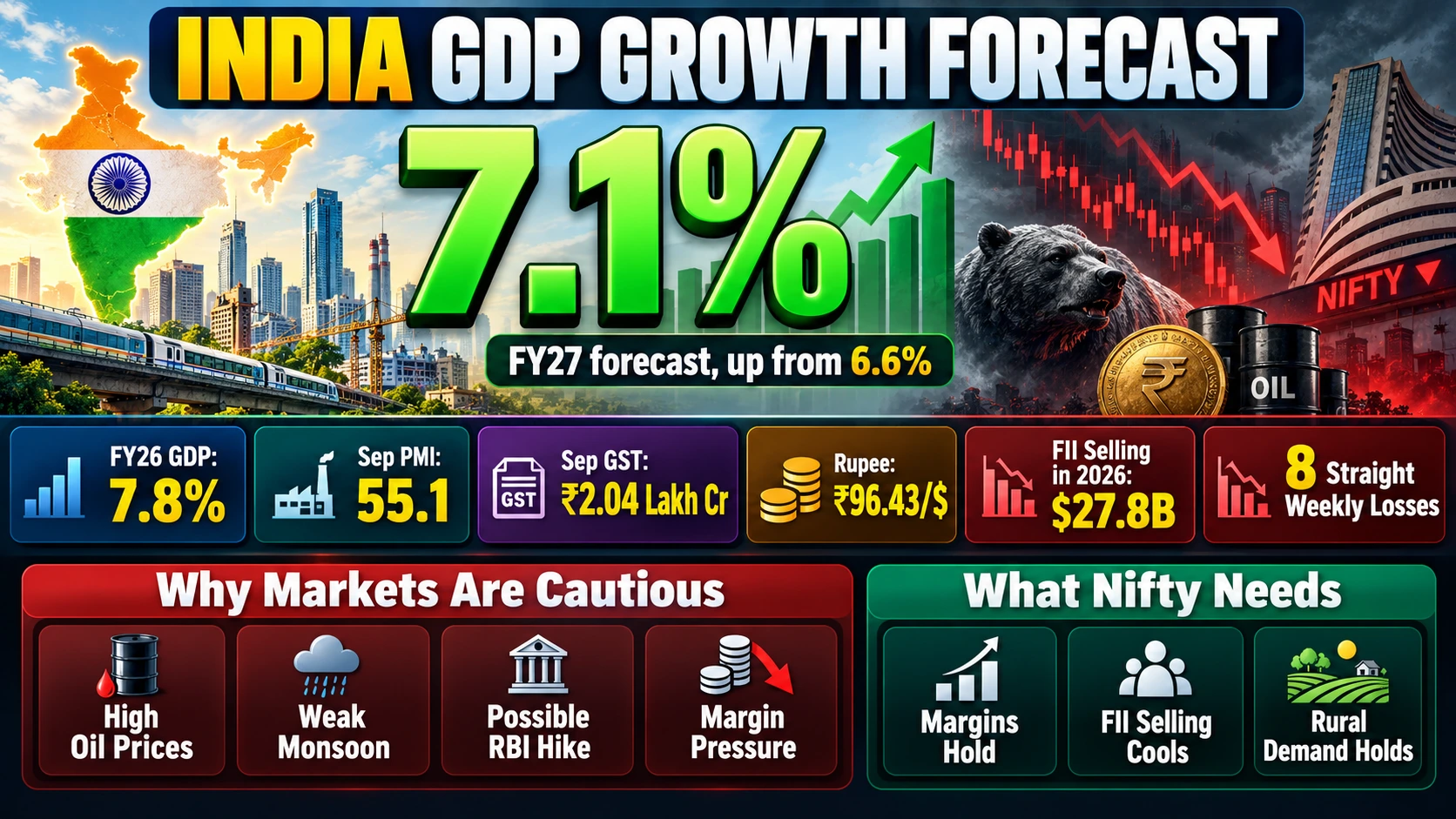
The World Bank now expects India’s economy to grow 7.1% in FY2026-27, up from its previous forecast of 6.6%—a sizeable 50-basis-point upgrade.
Its latest South Asia Economic Update projects India’s real GDP growth at 7.1% in FY27 and 7.2% in FY28, after an estimated 7.8% expansion in FY26. The Bank says momentum in industry and services remains strong enough to offset at least part of the weakness developing in agriculture.
That sounds bullish.
But it creates a more interesting question for investors:
If India is proving stronger than expected, why have the rupee, foreign investor flows and the recent behaviour of Nifty been considerably less optimistic?
The answer lies in the gap between economic growth and corporate profitability.
India is still growing strongly. But expensive energy, currency weakness, weather risk, higher input costs and potentially tighter monetary policy could determine how much of that growth ultimately reaches company earnings.
India’s 7.1% Growth Story at a Glance
| Indicator | Latest Signal |
|---|---|
| World Bank FY27 GDP forecast | 7.1% |
| Previous World Bank forecast | 6.6% |
| Forecast upgrade | +50 bps |
| FY26 real GDP growth | 7.8% |
| World Bank FY28 forecast | 7.2% |
| September Manufacturing PMI | 55.1 |
| September gross GST | ₹2.04 lakh crore |
| Rupee on October 6 | around ₹96.43/$ |
| Recent equity trend | 8 straight weekly declines before rebound attempt |
| Next major trigger | RBI policy on October 7 |
India’s revised official national accounts also put FY2025-26 real GDP growth at 7.8%, up from the earlier 7.7% estimate, while FY25 growth was revised to 7.2%.
So the World Bank’s numbers now broadly align with the stronger picture emerging from India’s revised national accounts.
But there is one important distinction.
The 7.1% forecast still represents a slowdown from FY26’s 7.8%.
What has changed is the expected severity of that slowdown.
The World Bank previously expected growth of only 6.6%. It now believes India can remain above 7% despite the energy shock, weaker rainfall and difficult global conditions.
That is meaningful.
For stock investors, though, GDP is only the beginning of the story.
Manufacturing Data Explain Why the World Bank Turned More Optimistic
India’s latest factory data support the resilience argument.
The manufacturing PMI rose to 55.1 in September from 52.8 in August, its strongest reading in seven months, supported by stronger domestic and overseas demand. A PMI reading above 50 indicates expansion.
This matters because the World Bank specifically expects strength in industrial and services activity to help compensate for weaker agriculture.
Manufacturing momentum also suggests the economic shock from high energy prices has not yet translated into a broad collapse in business demand.
But another high-frequency indicator requires slightly more interpretation.
GST Is Strong — But Imports Are Part of the Story
India’s gross GST collections rose 14.7% year-on-year to around ₹2.04 lakh crore in September.
The headline is impressive, but the composition matters.
Domestic GST revenue increased about 10.1%, while revenue linked to imports jumped 25.9% to ₹65,525 crore.
That means the entire 14.7% increase should not be treated as a pure household-consumption signal.
A better interpretation is that GST is showing continued strength in formal economic and transaction activity, while imports contributed significantly to the headline growth rate.
Combined with manufacturing and vehicle sales, however, the data still point to an economy that remains considerably more resilient than the earlier 6.6% World Bank forecast implied.
Also Read: GST Council October 7: 9.5 Lakh Sellers, ITC and Arrest Rules in Focus
HDFC Bank Shows Credit Activity Remains Healthy
Banking data offer another useful signal.
HDFC Bank’s provisional September-quarter business update showed period-end deposits rising 18.8% year-on-year to around ₹33.28 lakh crore, while gross advances increased 16.3% to approximately ₹32.20 lakh crore.
That suggests credit activity remains strong.
But again, the headline deserves context.
The bank also mobilised about $11.5 billion through the RBI’s FCNR(B) swap facility, meaning part of the period-end deposit growth was supported by an unusual foreign-currency liquidity channel.
The broader lesson is useful for investors:
Strong headline data can be genuine while still requiring a closer look at what is driving them.
The same principle applies to corporate earnings.
Maruti Shows Why Strong Demand Does Not Guarantee Stronger Profits
Maruti Suzuki offers perhaps the clearest example of the difference between economic demand and shareholder earnings.
During Q1 FY27, Maruti’s total vehicle sales increased 29.3% year-on-year. SUV volumes jumped 44.6%, domestic small-car sales increased 34.1% and exports grew 28.6%.
Net sales rose 36% to ₹49,959 crore.
Those are exceptionally strong demand numbers.
Yet Maruti also said material costs had risen during the quarter and were significantly aggravated by geopolitical disruption.
Quarterly net profit stood at about ₹3,352 crore, down from ₹3,758 crore in the comparable period.
That captures one of the most important risks behind the 7.1% GDP story:
Companies can sell substantially more while still struggling to convert that demand into higher profits.
For Nifty, revenue growth is helpful.
But earnings growth, margins and valuation ultimately matter more.
September Auto Data Reveal a Two-Speed Economy
The latest vehicle numbers show that demand has remained healthy in important parts of the economy.
Maruti Suzuki sold 236,013 vehicles in September, including 185,252 units in the domestic market.
Mahindra & Mahindra sold 64,092 SUVs domestically, up 14% year-on-year.
But Mahindra’s tractor business produced a very different headline.
Domestic tractor volumes fell 23% to 50,208 units in September.
That decline should not be interpreted as evidence of an outright rural collapse.
Mahindra said September was affected by the festive season shifting into October and a difficult comparison with September 2025. More importantly, cumulative domestic tractor sales through September were still 6% higher year-on-year.
Still, the difference between strong SUV demand and weaker monthly tractor sales becomes more important when viewed alongside India’s rainfall problem.
The Monsoon Is the Biggest Domestic Risk to the Upgrade
The World Bank’s weather assessment contains one of the most striking numbers in its report.
India experienced its fourth-driest June-August period since 1960.
The Bank notes that on the two previous occasions when June-September monsoon rainfall was roughly 20% below normal, agricultural output fell around 4%-5% below trend.
Its latest outlook explicitly expects the current monsoon deficit to reduce agricultural output and rural demand while putting additional upward pressure on food inflation.
That creates an important economic chain:
Weak rainfall → weaker farm output → pressure on rural income → higher food prices → weaker discretionary consumption → greater inflation pressure.
This is why the monsoon matters well beyond agriculture.
A prolonged rural slowdown could eventually affect FMCG volumes, tractors, two-wheelers, rural lenders and consumer discretionary businesses.
For now, urban-facing indicators remain relatively resilient.
The key question is whether that strength can continue offsetting rural weakness.
RBI Could Turn Strong Growth Into a Rate Problem
The next test arrives almost immediately.
The Reserve Bank of India announces its monetary-policy decision on October 7.
A Reuters survey found that nearly 60% of economists expected a 25-basis-point rate increase, which would lift the repo rate from 5.25% to 5.50%.
That creates an unusual setup:
Stronger growth is good for earnings.
But stronger growth also gives the RBI more room to tackle inflation aggressively.
If the central bank believes oil, food prices and currency weakness could keep inflation elevated, it may have less reason to protect growth through easier policy.
Higher rates can raise borrowing costs and influence valuations across banks, NBFCs, autos, real estate and other rate-sensitive sectors.
So paradoxically, the World Bank’s growth upgrade can coexist with a more difficult near-term equity environment.
The Rupee Is Sending a More Cautious Signal
The currency market is already reflecting some of those concerns.
The rupee weakened to around ₹96.43 per US dollar on October 6, its weakest level in more than two months and close to the record low of ₹96.96 reached in May.
Foreign portfolio outflows and elevated global bond yields have contributed to the pressure.
The currency matters because expensive oil becomes even more expensive in rupee terms when the dollar strengthens.
That can create a difficult combination:
higher energy costs + weaker rupee = greater imported inflation and margin pressure.
Brent crude was still trading around $99.49 per barrel on October 6, even after declining during the session.
For an energy-importing economy such as India, sustained oil near these levels remains a meaningful risk.
Why Nifty Has Not Fully Followed the GDP Story
This is where the economic and market narratives clearly diverge.
Indian benchmark indices recently completed eight consecutive weekly declines—the longest losing streak in about 25 years. The Nifty lost around 8.7% over that eight-week stretch.
Indian equities were attempting a rebound on October 6, but the pressure from foreign investors remains substantial.
Foreign investors have sold roughly $27.8 billion of Indian equities in 2026, according to Reuters.
That produces a striking expectation gap:
| Economy | Market |
|---|---|
| GDP outlook upgraded to 7.1% | Recent 8-week losing streak |
| Manufacturing PMI at 55.1 | Heavy foreign selling |
| GST at ₹2.04 lakh crore | Rupee near record lows |
| Passenger-vehicle demand strong | High global yields |
| Bank credit expanding | Possible RBI tightening |
| Services/industry resilient | Input costs threatening margins |
Neither side is necessarily wrong.
GDP measures economic activity.
Corporate earnings measure how much of that activity businesses convert into profit.
Stock prices reflect expected future profits, liquidity, interest rates and valuations.
Those variables can diverge for considerable periods.
The Three Confirmations Nifty Still Needs
The World Bank has delivered the growth upgrade.
For that upgrade to become a more convincing stock-market signal, investors may need three additional confirmations.
1. Corporate Margins Need to Hold
Q2 earnings now become particularly important.
Investors should focus less on headline revenue and more on gross margins, EBITDA margins, pricing power, input costs and management guidance.
If companies maintain strong volumes while margins stabilise, the 7.1% forecast becomes much more supportive for Nifty earnings.
If sales remain strong but profitability weakens, GDP and the stock market could continue telling different stories.
2. Foreign Selling and the Rupee Need to Stabilise
India’s domestic investment base has become an important source of market support, but sustained foreign selling still affects valuations and currency sentiment.
A slowdown in FII outflows combined with a stabilising rupee would be one of the clearest signs that global investors are becoming more comfortable with India’s macro outlook.
3. Rural Demand Must Survive the Weather Shock
October festive sales will become particularly important because of the calendar shift highlighted by Mahindra.
Tractor sales, two-wheeler demand, FMCG rural volumes and food inflation should provide clearer evidence of whether the weak monsoon is beginning to damage household spending.
If rural demand remains resilient despite the rainfall deficit, India’s domestic-growth story becomes substantially stronger.
Track Live: NIFTY50, SENSEX, FII DII DATA | NIFTYTRADER
What Investors Should Watch Next
The next few weeks could matter more to Nifty than another GDP forecast revision.
The most important signals are likely to be the October 7 RBI decision, Brent crude, USD/INR, FII-DII flows, Q2 corporate margins, October auto sales and food inflation.
Those indicators will reveal whether India’s strong economic activity is beginning to translate into a better combination of inflation, earnings and market liquidity.
India’s Growth Problem Has Changed
A few months ago, the central concern was whether expensive energy and global disruption would push Indian economic growth sharply lower.
The World Bank’s new forecast suggests that risk has diminished.
India appears capable of maintaining growth above 7% despite substantial external pressure.
But the market now faces a different question:
Can companies convert that growth into profits while oil, the rupee, food inflation and interest rates remain under pressure?
Manufacturing says the economy remains resilient.
GST collections show strong formal activity.
Auto sales show consumers are still spending.
Bank data show credit continues to expand.
But foreign investors, the rupee and recent equity-market performance are demanding additional evidence.
For the 7.1% growth upgrade to become a stronger Nifty signal, corporate margins need to stabilise, foreign selling needs to cool and rural demand needs to survive the weather shock.
Until then, India’s economy and its stock market may continue telling two different stories.
And that gap—not the 7.1% headline alone—may be the more important market story to watch.
Read Next: SEBI CAS Update: 30-Minute VWAP May Return for Derivatives Settlement
Disclaimer: This article is for informational and educational purposes only and does not constitute investment advice. Economic forecasts, corporate results and financial-market conditions can change as new data and policy decisions emerge.