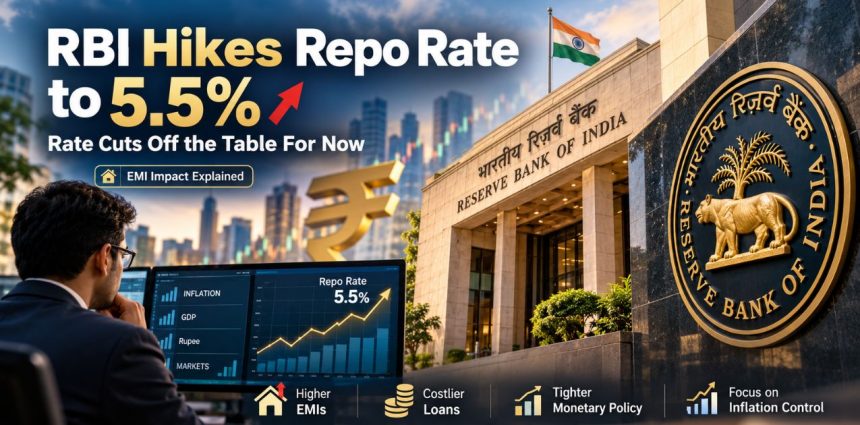
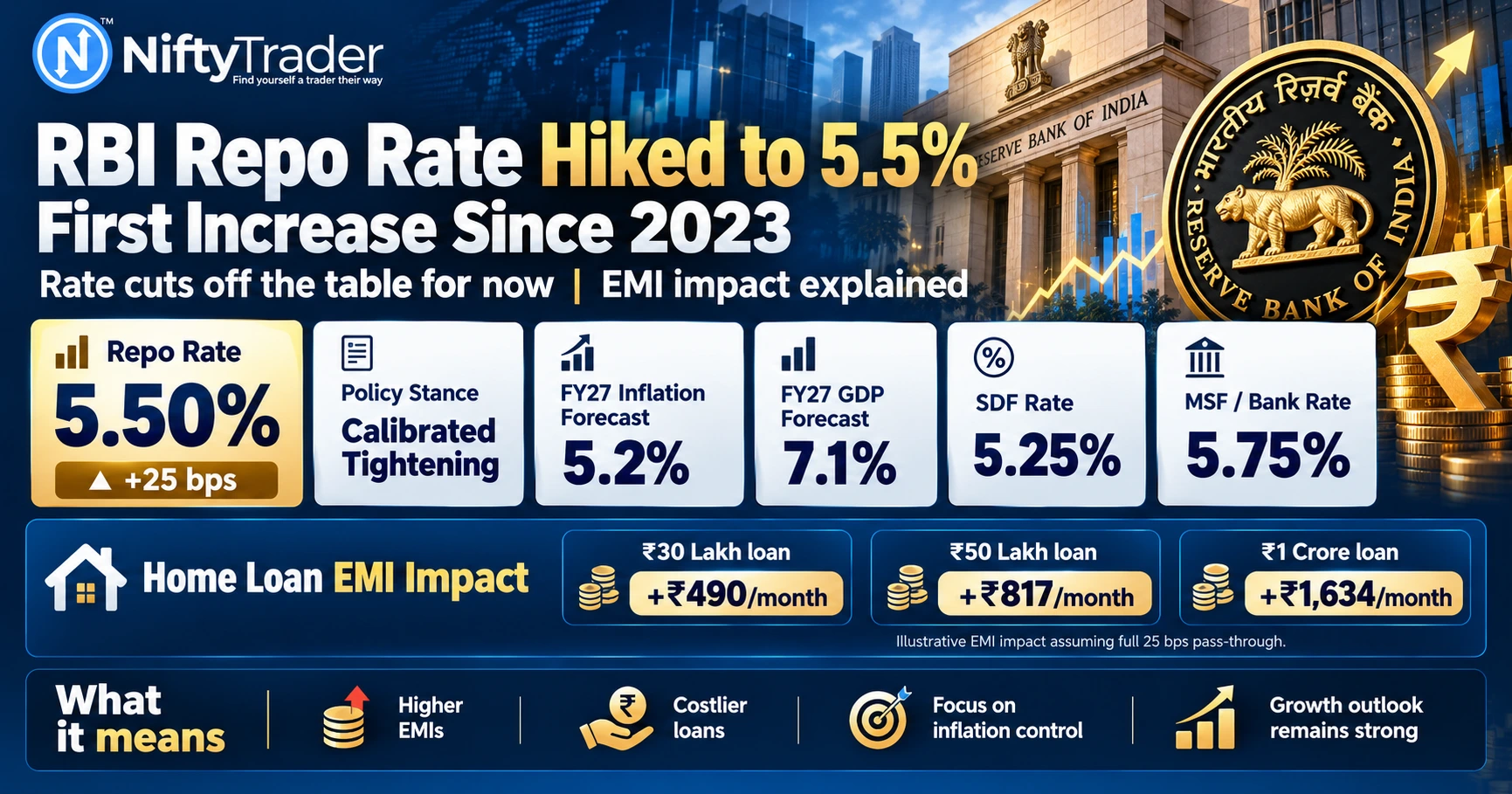
RBI Repo Rate Hike October 2026: The Reserve Bank of India has raised the repo rate by 25 basis points to 5.50%, delivering its first rate increase since February 2023 and ending a long period without monetary tightening.
But the bigger message from the October policy may not be the 25-bps increase itself.
The RBI also shifted its policy stance from “neutral” to “calibrated tightening”, while Governor Sanjay Malhotra indicated that rate cuts are off the table in the near term.
That changes the policy debate for borrowers and markets.
Instead of asking when interest rates could start falling again, the more important question now is:
Will a 5.50% repo rate be enough to contain inflation — or will the RBI eventually need to do more?
Reuters reported that the rate increase was the first in nearly four years and that the calibrated-tightening stance leaves room for further action depending on how inflation and growth evolve.
RBI MPC October 2026: Key Numbers
| Indicator | Latest RBI decision/outlook |
|---|---|
| Repo rate | 5.50% |
| Change | +25 bps |
| Previous repo rate | 5.25% |
| SDF rate | 5.25% |
| MSF rate | 5.75% |
| Bank Rate | 5.75% |
| Policy stance | Calibrated tightening |
| Repo-rate decision | Unanimous |
| FY27 CPI inflation forecast | 5.2% |
| FY27 real GDP growth forecast | 7.1% |
| Previous FY27 GDP forecast | 6.7% |
The message from these numbers is important: the RBI is tightening monetary policy even while expecting the Indian economy to grow above 7%.
That gives the central bank more room to prioritise inflation control without immediately worrying that a modest increase in borrowing costs will derail growth.
Track Live: GIFT NIFTY, NIFTY50, SENSEX, FII DII DATA, INDIA VIX
Why Did RBI Raise the Repo Rate Now?
The main pressure is inflation.
India’s consumer inflation rose to 4.82% in August, staying above the RBI’s 4% medium-term target for a third consecutive month.
At the same time, the inflation environment has become more complicated because of elevated energy prices, weather-related food risks and broader global uncertainty.
Reuters said the RBI is increasingly concerned about rising inflation expectations and price pressures spreading beyond isolated categories.
That distinction is critical.
A temporary spike in one food item is very different from inflation spreading through:
- fuel and transportation costs,
- services,
- manufactured goods,
- wages,
- household inflation expectations,
- and business input costs.
If price pressures become broad-based and persistent, monetary policy has a stronger role to play.
That helps explain why the RBI has moved from simply watching inflation to actively tightening policy.
The 25-Bps Hike Was Expected — The Bigger Surprise Is the Message
Today’s rate increase itself was not completely unexpected.
A Reuters poll ahead of the meeting found that 35 of 61 economists — nearly 60% — expected a 25-bps increase to 5.50%. Financial markets had also priced in a significant probability of a hike.
That means traders are likely to focus less on the fact that rates went up by 25 bps and more on what the RBI has signalled about the next few meetings.
Three developments stand out:
1. The stance has changed to calibrated tightening.
2. Near-term rate cuts are effectively off the table.
3. Growth remains strong enough for RBI to focus more aggressively on inflation.
Financial Express reported Governor Malhotra’s message that rate cuts are unlikely in the near term.
That makes the policy path more important than today’s single rate increase.
RBI Raises FY27 GDP Growth Forecast to 7.1%
Perhaps the most important counterpoint to the rate hike is the RBI’s stronger growth outlook.
The central bank has raised its FY27 real GDP growth forecast to 7.1% from 6.7%.
India’s economy had already expanded by 7.8% in Q1 FY27, stronger than previously expected.
Reuters said the RBI lifted its full-year growth estimate by 40 basis points, highlighting the resilience of domestic economic activity.
This matters for monetary policy.
Central banks have less room to raise interest rates when growth is weak because higher borrowing costs can further hurt consumption, housing and business investment.
But when growth is running above 7%, the RBI has more flexibility to focus on inflation.
In simple terms:
Strong growth gives RBI room to tighten.
Higher inflation gives RBI a reason to tighten.
That is the central tension behind the October policy.
Also Read: India GDP Growth Forecast Raised to 7.1% by World Bank: Why Nifty Still Needs More Proof
What Does the RBI Rate Hike Mean for Your Home Loan EMI?
For millions of borrowers, this is the most practical part of the decision.
A higher repo rate can eventually make some floating-rate loans more expensive, particularly loans linked to external benchmarks.
But one point is crucial:
A 25-bps increase in the repo rate does not automatically mean every borrower’s interest rate rises by exactly 25 bps immediately.
The actual impact depends on:
- the benchmark linked to your loan,
- your bank’s pricing and spread,
- the interest-rate reset frequency,
- your outstanding principal,
- remaining tenure,
- and how your lender adjusts the loan after a rate reset.
Illustrative Home Loan EMI Impact
Assume:
- remaining tenure: 25 years
- existing interest rate: 7.50%
- new interest rate: 7.75%
- entire 25-bps increase is passed through
- tenure remains unchanged
| Outstanding Loan | EMI at 7.50% | EMI at 7.75% | Monthly Increase |
|---|---|---|---|
| ₹30 lakh | ₹22,170 | ₹22,660 | ~₹490 |
| ₹50 lakh | ₹36,950 | ₹37,766 | ~₹817 |
| ₹1 crore | ₹73,899 | ₹75,533 | ~₹1,634 |
For a ₹50 lakh loan under these assumptions, the increase works out to roughly ₹9,800 more per year.
For a ₹1 crore outstanding loan, the monthly increase could be around ₹1,634.
These calculations are illustrations, not a prediction of what every borrower will pay.
Your EMI May Not Change Immediately
Borrowers should also avoid assuming that today’s RBI announcement automatically changes tomorrow’s EMI.
Floating-rate loans are generally repriced according to the benchmark and reset schedule specified in the loan agreement.
A lender may respond to a higher interest rate by:
- increasing the EMI,
- extending the remaining tenure,
- or using a combination of the two.
So borrowers should check three things first:
Current loan interest rate
Benchmark and spread
Next interest-rate reset date
This will give a much clearer picture of the actual impact than the repo-rate headline alone.
Why Even a Small Rate Increase Matters on a Long Home Loan
A 25-bps increase sounds small.
But a home loan can run for 15, 20 or even 25 years.
That means even a modest monthly increase can add up over a long period.
For borrowers with large outstanding balances, the impact becomes more noticeable because interest is calculated on a much bigger principal.
And if this is followed by another rate increase later, the cumulative effect could become significantly larger.
That is why the RBI’s future policy path matters more to borrowers than today’s 25-bps move in isolation.
What Does the Rate Hike Mean for Fixed Deposits?
The rate increase is negative for borrowers but could eventually help savers.
Banks may offer higher interest rates on new fixed deposits if their funding requirements and deposit competition increase.
However, there is no rule saying a 25-bps RBI hike must produce a 25-bps FD-rate increase.
Deposit pricing depends on individual banks’ liquidity, deposit growth, credit demand and funding requirements.
Existing fixed deposits will normally continue at the contracted rate until maturity.
So depositors should compare actual bank rates instead of assuming every FD rate will rise immediately.
Also check: FD Interest Rates – Check Current Fixed Deposit Rates online
What Does the RBI Rate Hike Mean for Nifty and Bank Nifty?
The immediate equity-market reaction was negative but relatively contained.
Reuters reported that stocks moved lower following the policy decision, while India’s 10-year government bond yield moved higher and the rupee remained relatively stable.
Rate-sensitive areas are likely to stay in focus.
Banks
The impact on banks is mixed.
Higher loan rates can increase asset yields, but banks may eventually have to pay more for deposits as well.
The effect on margins will therefore depend on whether lending rates or deposit costs rise faster.
NBFCs
Non-banking financial companies can face pressure if their own borrowing costs rise faster than the rates they earn on loans.
Highly leveraged lenders may be more sensitive.
Real Estate
Home affordability can weaken if mortgage rates increase, particularly for buyers already stretching their monthly budgets.
Automobiles
Higher financing costs can affect demand for cars and other vehicles purchased using loans.
Broader Nifty
The most important issue for the overall market is not a single 25-bps hike.
It is whether investors begin pricing in higher interest rates for longer.
That can affect equity valuations because higher bond yields increase the return investors can earn outside the stock market.
Why the Policy Stance Matters More Than One Rate Hike
“Calibrated tightening” is arguably the most important phrase in today’s RBI announcement.
It does not mean the RBI has promised another hike at the next meeting.
It does mean the policy bias has shifted.
The RBI now has more flexibility to raise rates again if inflation stays high or price pressures spread.
Reuters described the shift as signalling the possibility of further tightening depending on incoming inflation and economic-growth data.
That is why it would be premature to describe October as the start of a confirmed multi-meeting hiking cycle.
A more accurate interpretation is:
another hike is now a meaningful possibility, but not a certainty.
What Could Make RBI Hike Rates Again?
Five developments will matter most from here.
1. Inflation
If headline inflation moves closer to or above the upper end of the RBI’s comfort zone, pressure for further action will increase.
2. Breadth of Inflation
RBI will watch whether price pressures remain concentrated in food and fuel or spread into services and other categories.
3. Crude Oil
India imports a large share of its energy requirement.
Persistently high crude prices can affect transportation costs, the trade balance, the rupee and eventually consumer inflation.
4. The Rupee
Currency weakness can increase the rupee cost of imported goods and energy, adding to inflation pressure.
5. Economic Growth
If growth stays strong, RBI has more room to fight inflation.
A sharp slowdown would make further tightening a more difficult decision.
What Could Make RBI Pause?
A second rate hike is not inevitable.
The RBI could pause if:
- inflation starts easing convincingly,
- crude oil prices fall,
- food-price pressures improve,
- the rupee stabilises,
- or economic activity weakens materially.
So the next phase is likely to remain data-dependent.
This is precisely why the wording of the October policy matters.
Rate cuts may be off the table for now, but that does not automatically mean the RBI has committed itself to repeated hikes.
NiftyTrader Take: The Real Question Is Whether 5.50% Is Enough
The biggest mistake would be to look at the October RBI policy only as a 25-bps rate hike.
Today’s decision sends a broader message.
The RBI is facing stronger inflation risks, but the economy is still growing fast enough to give the central bank room to respond.
That has produced a significant shift in the policy narrative.
A year ago, the question was how much monetary easing the economy might receive.
Today, the question has changed:
Will a 5.50% repo rate be enough?
For borrowers, the immediate focus should be on their own loan reset terms rather than assuming an automatic EMI increase.
For equity investors, the key risk is whether markets begin pricing a prolonged period of higher rates.
For bond investors, inflation data and expectations around the next MPC meeting will be increasingly important.
And for the RBI, the next few inflation prints, crude prices, the rupee and the breadth of price pressures could determine whether October’s increase remains a single adjustment or is followed by another move.
Read Next: Stocks to Watch Today, October 7: RBI Decision, Titan, Ola Electric, Utkarsh SFB
RBI Repo Rate Hike FAQs
What is the RBI repo rate today?
The RBI repo rate is 5.50% after the Monetary Policy Committee raised it by 25 basis points on October 7, 2026.
Was this the first RBI rate hike since 2023?
Yes. It was the RBI’s first repo-rate increase since February 2023. Reuters described it as the first increase in nearly four years.
Why did RBI hike the repo rate?
The RBI is responding to increased inflation risks, including broader price pressures, elevated energy costs and uncertainty around the inflation outlook.
What does calibrated tightening mean?
It signals a shift toward tighter monetary policy while allowing the RBI to decide the timing and size of any future action based on incoming economic data.
Are RBI rate cuts now over?
Governor Sanjay Malhotra indicated that rate cuts are off the table in the near term. That does not mean rates can never fall again; it means easing is unlikely under current conditions.
Will my home loan EMI increase?
It may, particularly if your loan is floating-rate and linked to a benchmark affected by the repo rate. The timing and size of the increase depend on your lender and reset terms.
How much can a ₹50 lakh home loan EMI increase after a 25-bps rise?
In an illustrative 25-year loan moving from 7.50% to 7.75%, EMI increases from around ₹36,950 to ₹37,766 — roughly ₹817 per month.
Will FD rates rise after the RBI repo-rate hike?
Some banks may eventually offer higher rates on new deposits, but there is no automatic one-for-one link between the RBI repo rate and FD rates.
What is RBI’s FY27 GDP growth forecast?
The RBI has raised its FY27 real GDP growth forecast to 7.1% from 6.7%.
Could RBI hike rates again?
Yes, another increase is possible if inflation remains elevated or broadens further. However, the RBI has not committed to another hike, so future decisions will depend on incoming data.
Disclaimer: This article is for informational and educational purposes only. It does not constitute investment, lending or financial advice. EMI examples are illustrative and actual borrowing costs depend on the lender, benchmark, spread, reset date, outstanding principal and remaining tenure.