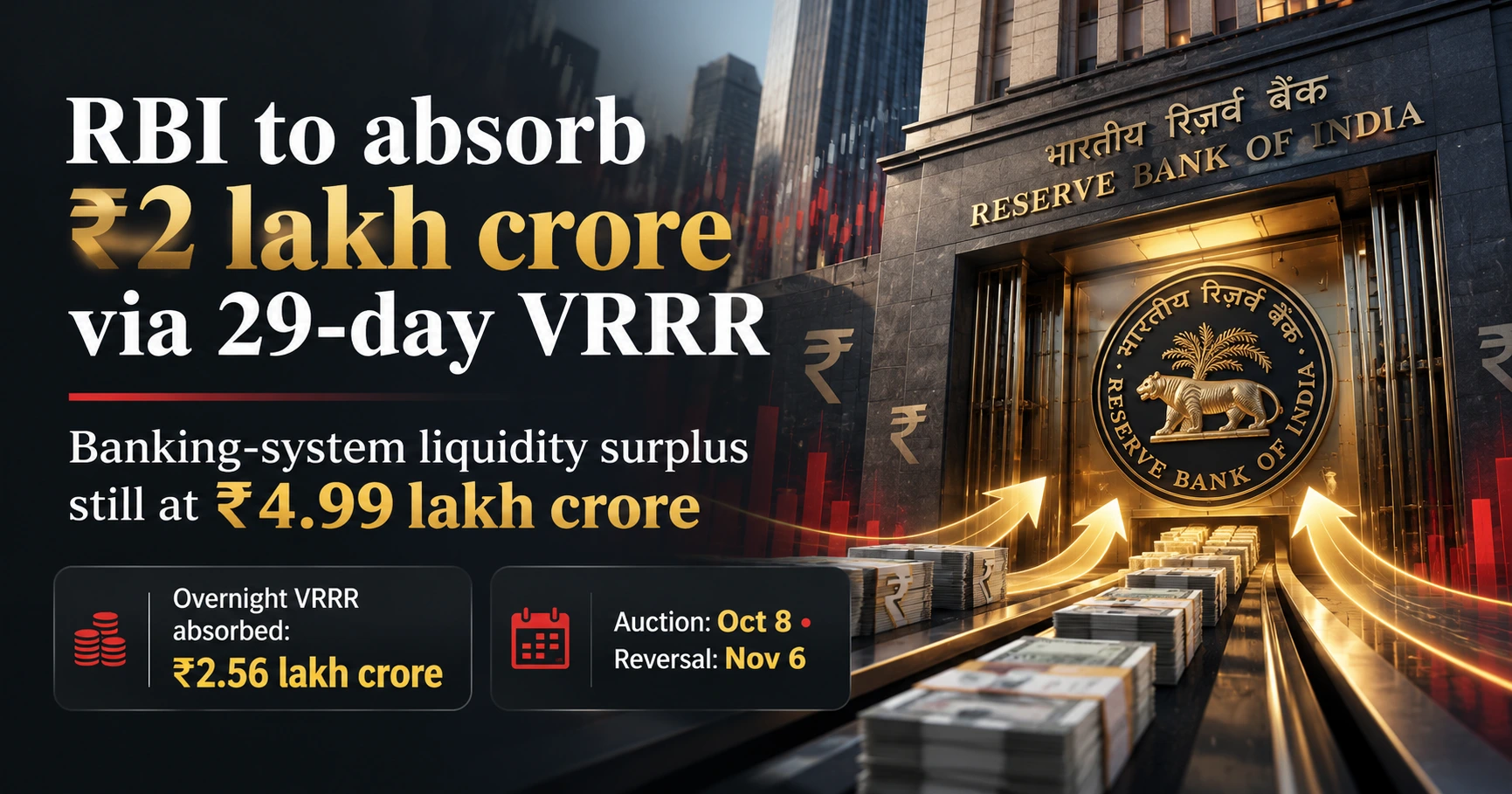
The RBI will absorb up to ₹2 lakh crore through a 29-day VRRR auction on October 8, even as banking-system liquidity remains in a ₹4.99 lakh crore surplus. The move comes a day after the central bank absorbed ₹2.56 lakh crore through an overnight VRRR operation, putting the focus on how quickly excess liquidity will drain and what it means for money-market conditions.
The Reserve Bank of India is stepping up its liquidity management operations, but the bigger market signal is not the ₹2 lakh crore VRRR auction itself. It is the size of the cash surplus still sitting in the banking system.
The RBI will conduct a 29-day Variable Rate Reverse Repo (VRRR) auction for a notified amount of ₹2 lakh crore on October 8, with bidding scheduled between 9:30 am and 10:00 am. The funds parked with the central bank are scheduled to reverse on November 6, 2026.
The operation comes just one day after the RBI absorbed ₹2.56 lakh crore through an overnight VRRR auction, against a notified amount of ₹3 lakh crore. The cut-off rate in that operation was 5.49%.
At the same time, RBI data showed banking-system liquidity in a surplus of around ₹4.99 lakh crore as of October 7.
That combination is important: the RBI is actively absorbing liquidity even though a substantial surplus remains in the system.
Why the ₹4.99 Lakh Crore Surplus Matters
The latest liquidity number needs to be viewed in context.
The banking-system surplus had climbed above ₹11 lakh crore in early September, according to market reports, before falling as tax outflows and other liquidity movements reduced the excess.
The surplus has therefore already declined materially.
Yet the RBI is still conducting large VRRR operations.
The message for the market is that the central bank wants to prevent the temporary liquidity glut from translating into persistently easier short-term money-market conditions.
The ₹2 lakh crore notified amount is roughly 40% of the ₹4.99 lakh crore reported surplus, although the actual amount absorbed will depend on banks’ bids in the auction.
This is why the October 8 operation should not be interpreted as a permanent ₹2 lakh crore liquidity drain.
Instead, it is another tool for temporarily parking surplus funds with the RBI while the underlying liquidity position adjusts.
RBI Absorbed ₹2.56 Lakh Crore Just One Day Earlier
The timing of the latest operation makes the RBI’s liquidity-management strategy more visible.
On October 7, banks parked ₹2.56 lakh crore with the RBI through an overnight VRRR operation.
The next day, the central bank is offering another ₹2 lakh crore, but for 29 days.
The difference in tenor matters.
An overnight operation provides short-term liquidity management, while the 29-day operation keeps accepted funds parked for substantially longer.
That gives the RBI greater control over excess liquidity during a period when the banking system is still carrying a sizeable surplus.
It also gives the market a fresh indication of how much surplus cash banks are willing to park with the central bank at prevailing rates.
Why Did Liquidity Rise So Sharply?
A major part of the recent liquidity build-up has been linked to foreign-currency inflows and the RBI’s operations in the foreign-exchange market.
The RBI has been dealing with a temporary liquidity injection associated with FCNR(B) deposit mobilisation and related foreign-exchange operations.
But that liquidity does not necessarily remain permanently available to banks.
Natural liquidity leakage can occur through:
- Currency in circulation
- Government cash balances and tax flows
- Reserve requirements
- Foreign-exchange operations
- Seasonal demand for cash around the festive period
- Agricultural and harvesting-related cash movements
Market estimates cited in current reporting suggest these channels could absorb a significant portion of the surplus over the coming months.
That is important because the RBI may not need to permanently remove the entire current surplus through market operations.
The Bigger Question: How Fast Will the Surplus Disappear?
This is where the market expectation becomes more complicated.
On one side, system liquidity has already fallen sharply from its September peak.
On the other, the RBI is still conducting sizeable absorption operations.
The RBI’s own assessment is that the current surplus is likely to decline over time rather than remain a permanent feature of the banking system.
Governor Sanjay Malhotra has indicated that currency leakage, reserve requirements and RBI operations should gradually reduce the excess liquidity.
That creates an important expectation gap for markets:
Will liquidity normalise naturally, or will the RBI need repeated VRRR operations to keep short-term rates aligned with its policy framework?
The answer will depend on how quickly the temporary sources of surplus liquidity unwind.
What Does This Mean for Bank Funding?
For banks, surplus liquidity can provide a comfortable funding cushion.
But excessive liquidity can also push overnight and short-term money-market rates lower.
The RBI’s VRRR operations allow banks to earn a return on surplus funds while temporarily removing those funds from active circulation.
This makes VRRR an important instrument for keeping short-term rates consistent with the RBI’s broader monetary-policy framework.
That is especially relevant after the RBI’s 25-basis-point repo-rate increase to 5.50%.
The policy rate and system liquidity are currently sending different signals:
Repo rate: higher
System liquidity: still substantially surplus
The RBI’s liquidity operations are therefore helping bridge that gap.
Will the VRRR Auction Make Loans More Expensive?
Not directly.
The October 8 VRRR auction should not be interpreted as an automatic increase in home-loan or corporate-loan rates.
VRRR is primarily a liquidity-management operation.
However, if the banking-system surplus falls significantly over the coming months, short-term funding conditions could gradually become tighter.
That could matter for banks’ marginal funding costs and money-market rates.
The more important variable is therefore the direction of system liquidity, rather than the ₹2 lakh crore headline amount alone.
Also Read: RBI ₹7 Lakh Crore VRRR: Banks Face a New Liquidity Test
Why November 6 Is Important
The funds accepted in the October 8 VRRR auction are scheduled to return to participants on November 6.
That creates a useful forward-looking checkpoint for the market.
If the banking-system surplus has declined significantly by then, the return of the parked funds may have a relatively limited effect on overall liquidity conditions.
But if the surplus remains elevated, the reversal could temporarily add liquidity back into the system.
In other words, the November 6 reversal is not necessarily a fresh liquidity injection shock. Its impact will depend on the liquidity environment prevailing at that time.
That is one of the key uncertainties investors should monitor.
What Banks and Traders Should Watch Next
The October 8 auction will provide several signals beyond the headline ₹2 lakh crore amount.
Market participants will be watching:
- How much banks actually bid for and park with the RBI
- The auction cut-off rate
- Whether surplus liquidity continues falling after the operation
- Overnight money-market rates relative to the 5.50% repo rate
- The RBI’s next liquidity-management operation
- How much liquidity returns when the 29-day operation reverses on November 6
A strong subscription would indicate that banks continue to have substantial excess funds available for parking.
A weaker response could indicate that surplus liquidity is already becoming less abundant.
What This Means for Investors
For equity investors, the immediate impact of the VRRR auction is likely to be indirect rather than a direct trigger for a broad market move.
The bigger relevance is for banks, money-market instruments, short-term rates and overall financial conditions.
If liquidity remains abundant, funding conditions can stay relatively comfortable.
If the surplus contracts faster than expected, the market could begin pricing tighter short-term financial conditions.
That makes the RBI’s liquidity operations worth watching alongside the repo rate, government cash balances, foreign-exchange operations and banking-system deposits.
Track Live: NIFTY 50, SENSEX, FII DII DATA
Bottom Line
The RBI’s ₹2 lakh crore, 29-day VRRR auction is not simply another liquidity announcement.
The more important story is the gap between the ₹4.99 lakh crore banking-system surplus today and the more than ₹11 lakh crore surplus seen earlier in September.
Liquidity is already moving lower, but the RBI is still actively absorbing excess funds.
The immediate question is therefore not whether the RBI can remove ₹2 lakh crore.
It is how quickly the remaining surplus disappears—and whether the central bank needs more VRRR operations before that happens.
The October 8 auction and the November 6 reversal will provide two important checkpoints for that liquidity transition.
Read Next: RBI CAS Update: Bank Deposit Details Could Appear With Demat Holdings by Dec 31
Disclaimer: This article is for informational purposes only and does not constitute investment, trading or financial advice. Liquidity conditions, RBI operations and market reactions can change, and investors should verify official RBI announcements before making financial decisions.