Korea’s $1 Trillion Tech Bet Gwangju Chip Hub Could Reshape the Semiconductor Industry
South Korea is planning a massive semiconductor manufacturing hub in Gwangju, bringing Samsung Electronics and SK Hynix into a project that could reshape the country’s technology industry. However, the ambitious plan faces a major challenge: expanding domestic chip production without provoking fresh trade tensions with US President Donald Trump.
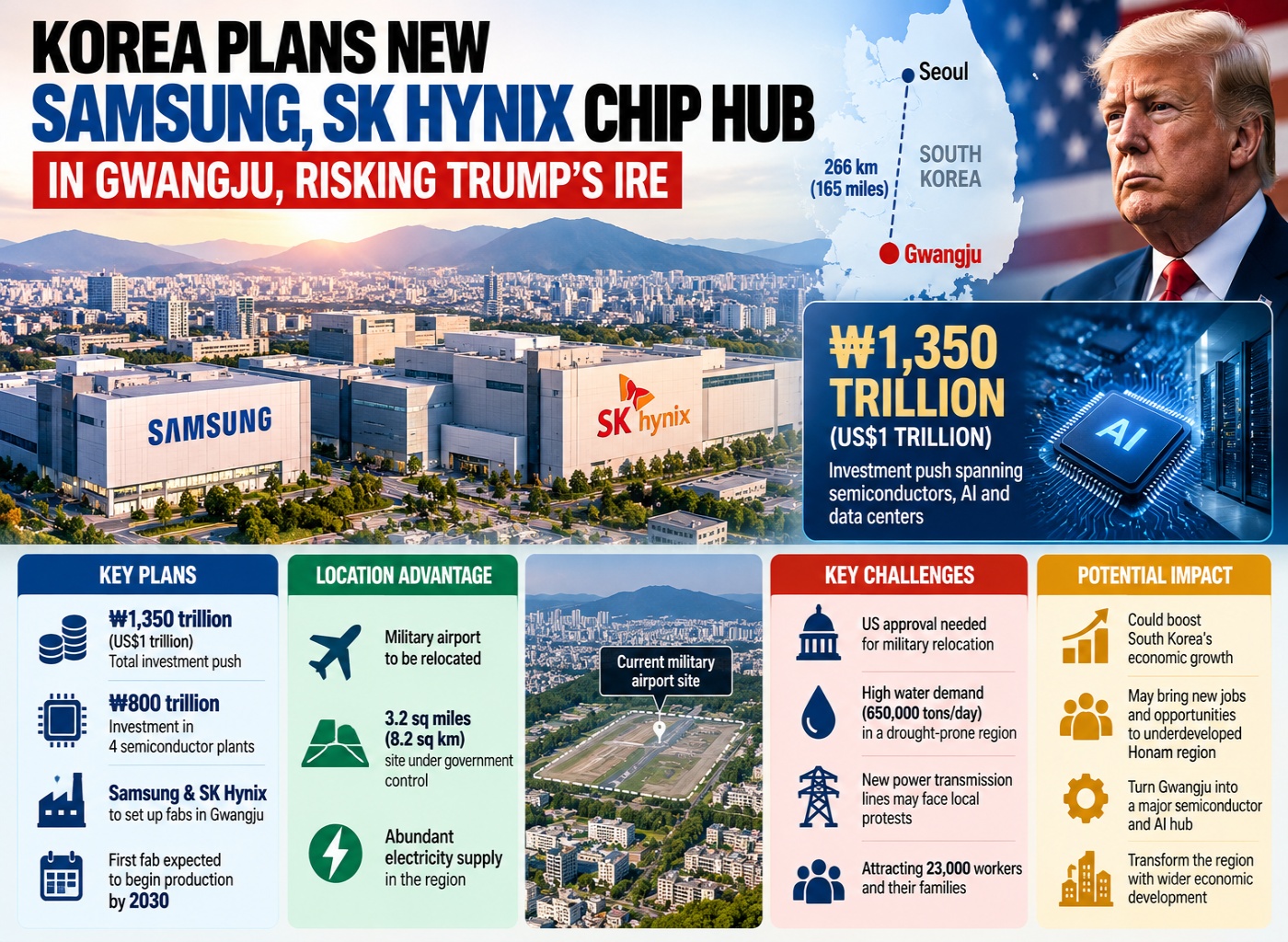
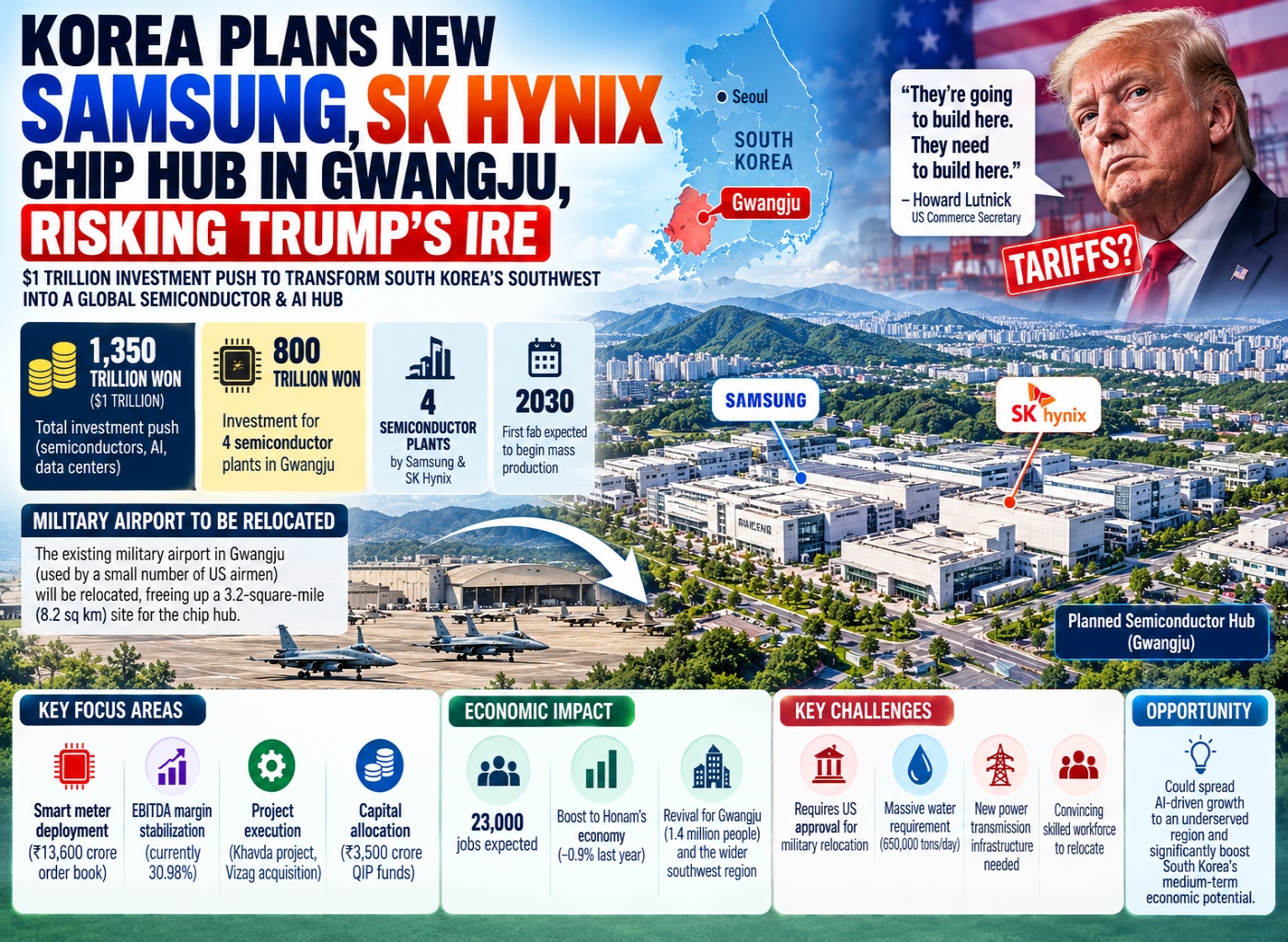
The proposed development forms part of a broader 1,350 trillion won ($1 trillion) investment push covering semiconductors, physical artificial intelligence (AI) and data centres. At its centre is an 800 trillion won investment plan for four semiconductor fabrication plants, or fabs, at a site currently occupied by a military airport.
For investors, the project raises important questions about future chip manufacturing capacity, AI-related demand, infrastructure costs and the possibility of new US trade restrictions.
Track Live : Nifty Levels Today | Sensex Levels Today
Korea’s $1 Trillion Tech Bet : Samsung and SK Hynix Face a Major Investment Opportunity
President Lee Jae Myung wants to transform the southwestern Honam region into a major semiconductor hub. The plan could bring industrial investment and employment to an area that has historically lagged behind South Korea’s main industrial centres.
The first of the four fabs is expected to begin mass production by 2030. The wider Gwangju cluster is projected to require around 23,000 workers, potentially attracting employees and businesses from other regions.
However, the scale of the proposed investment should not be confused with confirmed spending already under way. Construction timelines, the pace of investment and the eventual expansion of production remain uncertain.
Economist Jeong-Woo Park of Nomura Holdings said the broader investment programme could raise South Korea’s medium-term growth potential, although uncertainty over execution makes it difficult to incorporate the full impact into forecasts.
What is South Korea planning?
- A new semiconductor hub: President Lee Jae Myung’s government plans to establish a major semiconductor manufacturing cluster in Gwangju and the wider Honam region in southwestern South Korea.
- 800 trillion won for four chip factories: Samsung Electronics and SK Hynix are expected to invest approximately 800 trillion won in four semiconductor fabrication plants, commonly called fabs. The investment was reported at around $592 billion in September 2026, although the dollar equivalent varies with exchange rates.
- A broader 1,350 trillion won investment push: The semiconductor project forms part of a wider government-backed investment strategy covering semiconductors, physical artificial intelligence (AI) and AI data centres.
- A second major production base: The objective is to establish a second major semiconductor manufacturing centre outside the Seoul metropolitan region, expanding South Korea’s capacity to meet growing demand for chips used in AI systems.
Trump’s Tariff Threat Adds Uncertainty to South Korea’s Chip Strategy
Washington wants South Korean companies to expand manufacturing in the United States rather than concentrate more investment at home.
US Commerce Secretary Howard Lutnick told Bloomberg Television that South Korean companies need to build in the US and warned of possible fresh tariffs if Seoul does not comply.
The comments create a difficult balancing act for the South Korean government. It wants to develop domestic manufacturing while maintaining strong economic and security ties with Washington.
The US State Department said South Korea has been among the leading investors in the United States, adding that Korean investments support efforts to revitalise American manufacturing.
The relocation of Gwangju’s military airport also requires careful coordination. The site has a role in contingency military planning and includes facilities reserved for US military use. Seoul has not confirmed whether Washington has approved the proposed relocation.
Track Live : NSE Option Chain — Live | BSE Option Chain — Live Sensex & Bankex Options Data Today
Why has Gwangju been selected?
- Location: Gwangju is approximately 266 kilometres from Seoul and has a population of around 1.4 million people.
- Government-owned land: The proposed site is the existing military airport, covering approximately 8.2 square kilometres. Government ownership could reduce the difficulty of acquiring thousands of privately owned plots.
- Transport connectivity: The location offers access to high-speed rail, roads and regional transport infrastructure, helping companies move workers, equipment and materials.
- Regional development: The Honam region has historically attracted less large-scale industrial investment than South Korea’s capital region and southeastern industrial belt.
- Economic revival: The proposed chip cluster could create new industrial activity, attract supporting businesses and provide employment opportunities in an area that has experienced economic stagnation and the departure of younger workers.
The government selected the Gwangju airport site in July 2026, according to The Korea Times.
What role will Samsung and SK Hynix play?
- Samsung Electronics: The South Korean technology giant is expected to participate in developing the new semiconductor manufacturing capacity.
- SK Hynix: The company, a major supplier of memory chips used in AI infrastructure and computing systems, is also expected to establish manufacturing facilities.
- Four semiconductor fabs: The plan envisages four chip plants to expand the country’s manufacturing capacity and support demand associated with AI development.
- AI-driven demand: Advanced computing systems require substantial quantities of memory and other semiconductors. The proposed cluster is intended to help South Korea maintain its position in the global semiconductor industry.
Water and Power Infrastructure Could Delay the Gwangju Project
The proposed semiconductor complex will require substantial resources. The fabs are expected to need approximately 650,000 tonnes of water every day, raising concerns in a region that has experienced severe drought.
The government plans to draw water from nearby reservoirs and recycle treated wastewater. However, environmental experts have questioned whether sufficient backup arrangements would be available during emergencies.
Electricity is another important consideration. South Jeolla province generates roughly twice as much electricity as it consumes, but delivering that power to the proposed chip hub will require additional transmission infrastructure.
New power lines could face resistance from rural communities concerned about environmental damage and the impact of high-voltage towers near their homes.
Why is the project creating tensions with the United States?
- Washington wants more chip production in America: US Commerce Secretary Howard Lutnick has argued that South Korean chipmakers should expand manufacturing in the United States and warned that companies failing to do so could face additional tariffs.
- Potential tariff exposure: The Trump administration is considering semiconductor tariff policies linked to domestic manufacturing investment. Such measures could affect the cost competitiveness of Samsung and SK Hynix if they cannot secure favourable treatment.
- A difficult investment decision: Both companies must weigh the benefits of expanding manufacturing in South Korea against the commercial and trade advantages of investing in the US.
- National-security considerations: The Gwangju airport is associated with military operations and is designated to receive US air assets during contingencies. Relocating the facilities therefore requires coordination with Washington.
- A balancing act for Seoul: South Korea wants to strengthen domestic manufacturing and regional development while maintaining its security partnership and economic relationship with the United States.
Why must the military airport be relocated?
- The land is central to the project: The existing airport site is intended to accommodate the proposed semiconductor complex.
- Relocation plans have faced delays: Governments have discussed moving the military facilities for years, but the process has remained unresolved.
- The original timeline: The government had planned to relocate or temporarily disperse military facilities by mid-2028.
- The president wants to accelerate the process: Lee Jae Myung has directed officials to examine ways to move faster.
- US coordination is essential: Some parts of the site are reserved for US military use in an emergency, making the relocation more complicated than a normal land-development project.
- Construction depends on execution: Government ownership simplifies land acquisition, but it does not eliminate the need to resolve military, security and infrastructure issues.
Read More : IPO Rulebook Set for a Clean-Up? SEBI’s New Panel Could Make Going Public Easier
What Samsung and SK Hynix Investors Should Watch Next
Beyond construction, Gwangju must attract thousands of workers and provide suitable housing, education, healthcare and other services. Local residents have welcomed the proposal, but some remain sceptical after decades of delayed airport relocation plans.
For investors, the key developments to watch are confirmation of funding, approval for military relocation, progress on water and electricity infrastructure, and the response from Washington.
The Gwangju semiconductor hub could support South Korea’s long-term economic growth and expand domestic chip production. Yet its eventual impact on Samsung Electronics, SK Hynix and investor portfolios will depend on whether the government can turn its ambitious investment plan into operating factories without significant delays or additional trade barriers.