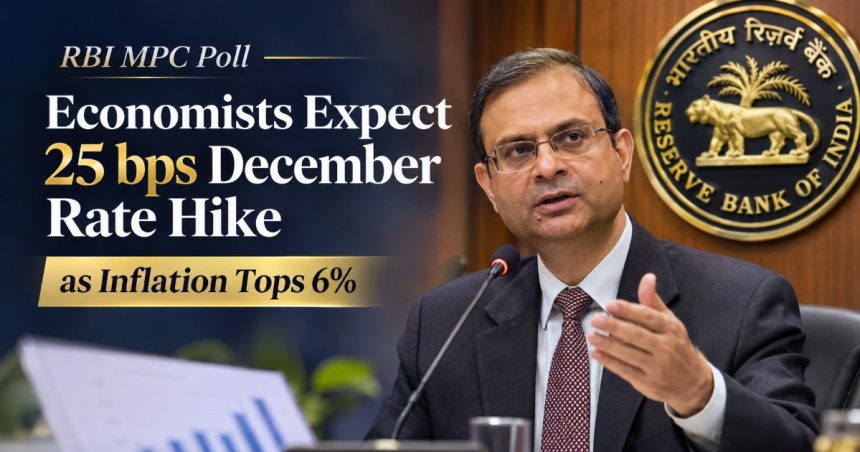
Home Loan EMI Alert: RBI December Policy Could Bring Another Rate Hike as Inflation Crosses 6%
Will rising inflation force the Reserve Bank of India (RBI) to make borrowing more expensive just as India’s economic growth faces signs of moderation? This is the key question facing investors ahead of the central bank’s December monetary policy meeting.
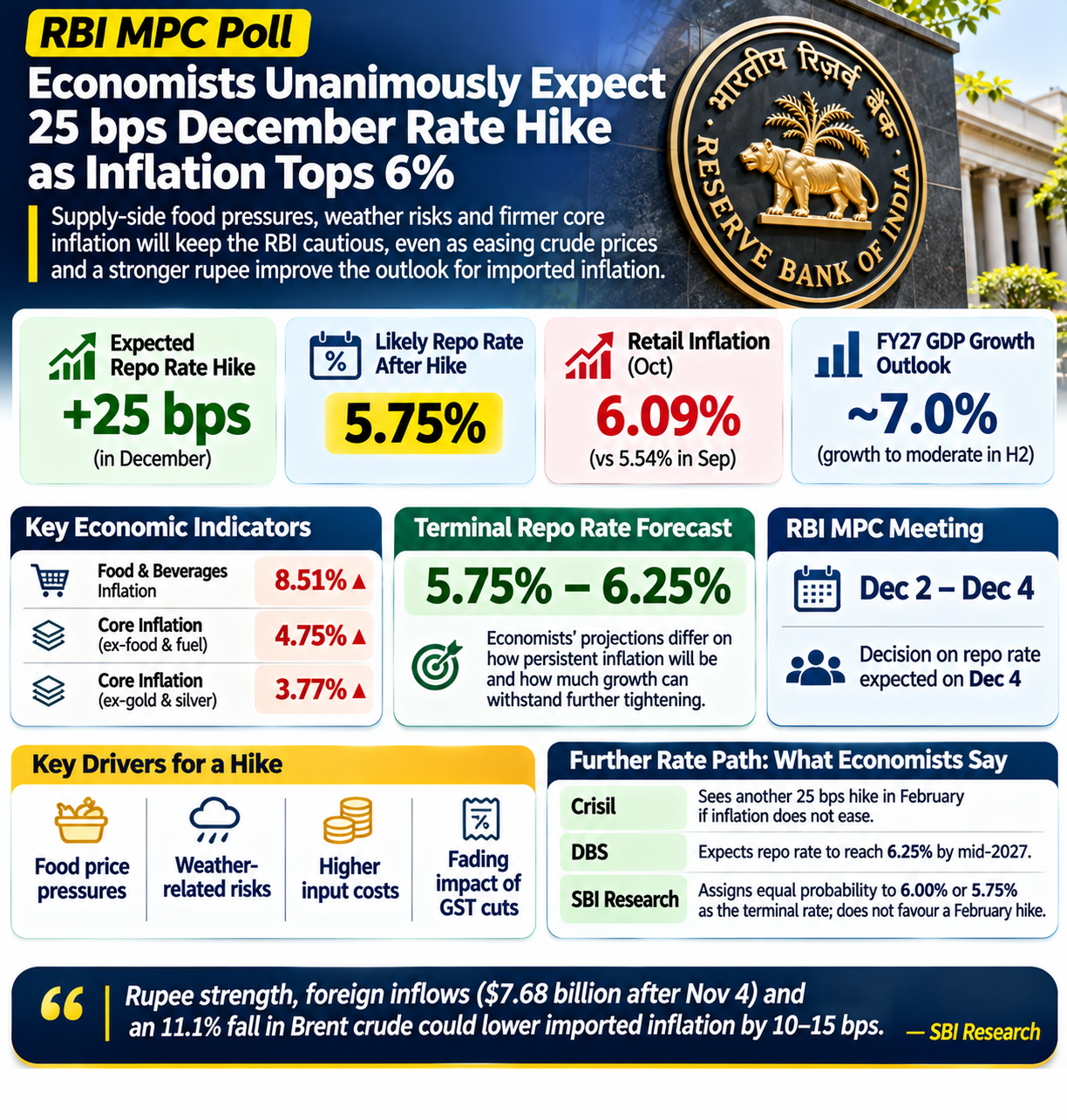
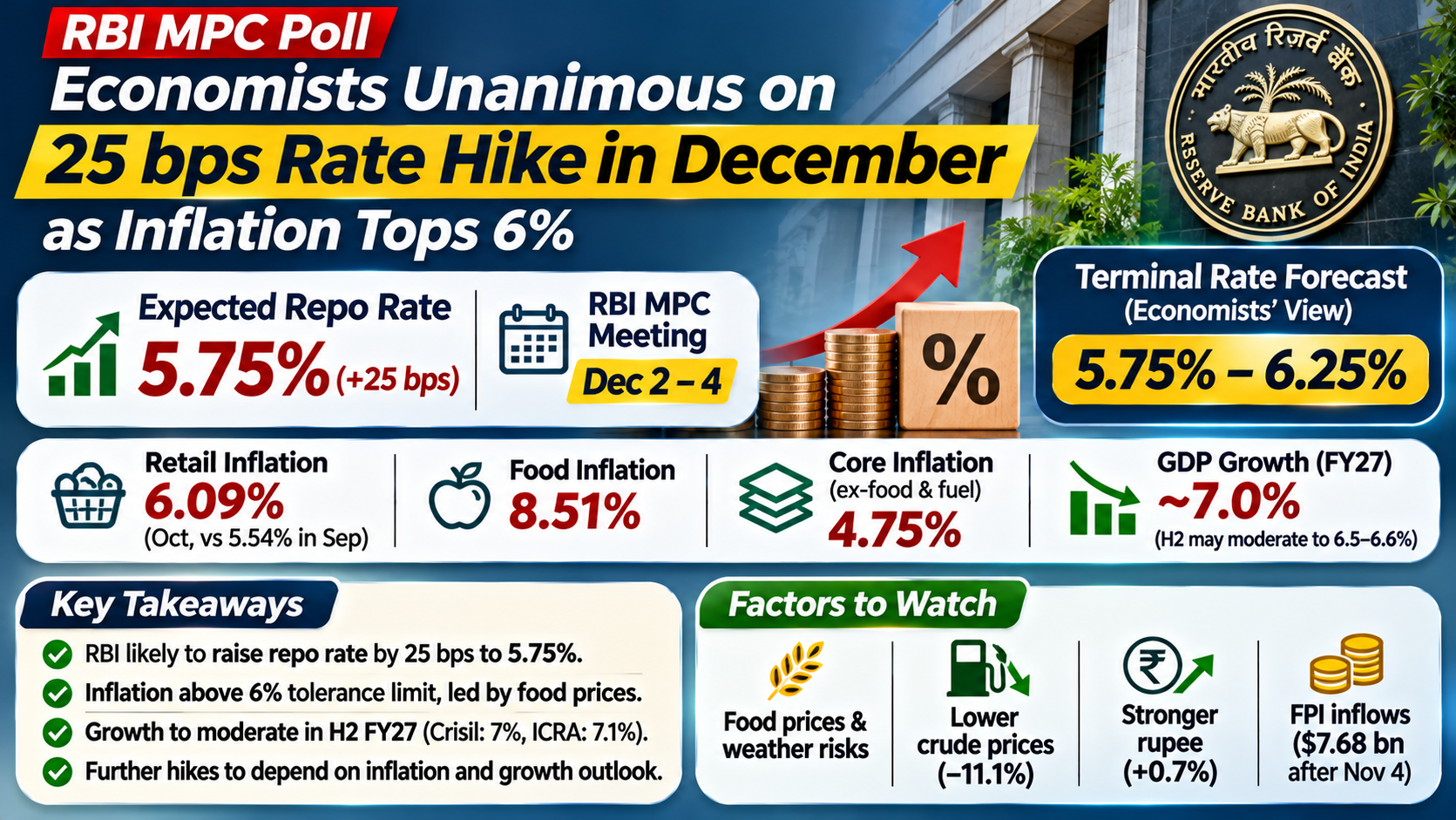
Economists are increasingly expecting another interest rate hike after retail inflation breached the RBI’s upper tolerance limit of 6% in October. According to a Moneycontrol poll, all 14 economists surveyed expect the central bank to increase the repo rate by 25 basis points (bps) to 5.75% in December.
The expected move reflects growing concerns over food inflation, weather-related risks and firmer underlying price pressures. However, falling crude oil prices and a stronger rupee could limit the need for further aggressive monetary tightening.
The RBI’s Monetary Policy Committee (MPC) will meet from December 2 to 4, with Governor Sanjay Malhotra expected to announce the policy decision.
Track Live : Nifty Levels Today | Sensex Levels Today | Bank Nifty Levels Today
Home Loan EMI Alert: October Retail Inflation at 6.09% Strengthens the Case for an RBI Rate Hike
India’s retail inflation increased to 6.09% in October from 5.54% in September, moving above the RBI’s 2–6% tolerance band.
Food and beverages inflation accelerated to 8.51%, putting additional pressure on household budgets. Core inflation, which excludes food and fuel, also increased to 4.75% from 4.60%.
SBI Research highlighted another concern: core inflation excluding gold and silver rose to 3.77% in October from 3.22% in September.
These numbers suggest that inflationary pressures are becoming broader rather than remaining concentrated in food prices.
Track Live : NSE Option Chain — Live | BSE Option Chain — Live Sensex & Bankex Options Data Today
RBI December MPC meeting: Why are economists expecting another rate hike?
The Reserve Bank of India is expected to increase the benchmark repo rate by 25 basis points in December, taking it from 5.50% to 5.75%.
The expectation follows October’s retail inflation reading of 6.09%, which crossed the RBI’s upper tolerance limit of 6%.
According to Moneycontrol’s November 23 poll, all 14 economists surveyed expect a 25-basis-point increase.
The key monetary policy details are:
| Particulars | Details |
|---|---|
| Central bank | Reserve Bank of India |
| RBI Governor | Sanjay Malhotra |
| Upcoming MPC meeting | December 2–4, 2026 |
| Current repo rate | 5.50% |
| Expected increase | 25 basis points |
| Expected December repo rate | 5.75% |
| Economists surveyed by Moneycontrol | 14 |
| Economists expecting a hike | 14 |
| Main reason | Retail inflation crossed 6% |
| Next policy outlook | Data-dependent |
A 25-basis-point increase means an increase of 0.25 percentage points.
October retail inflation crosses RBI’s upper tolerance limit
India’s retail inflation accelerated to 6.09% in October 2026, compared with 5.54% in September.
This is particularly important because the RBI follows a flexible inflation-targeting framework with a 4% target and a tolerance band of 2% to 6%.
October’s inflation reading therefore moved above the upper tolerance limit.
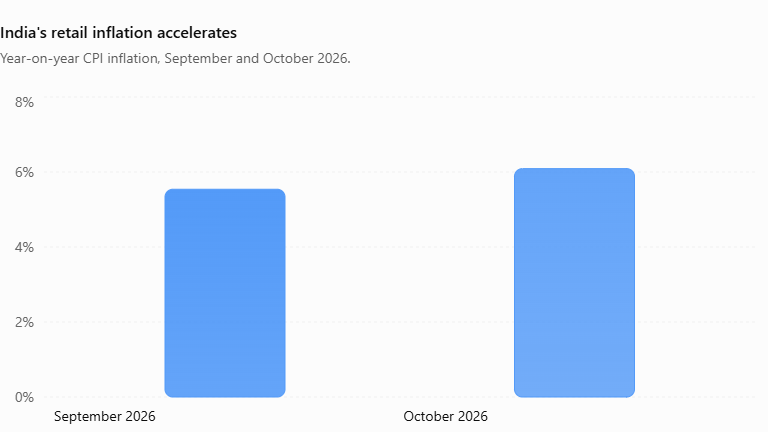
The increase has strengthened expectations of additional monetary tightening because higher inflation can reduce household purchasing power and increase business costs.
Another important point is that the increase was not limited to one geographical region.
| Region | September 2026 | October 2026 |
|---|---|---|
| Rural inflation | 6.08% | 6.63% |
| Urban inflation | 4.88% | 5.41% |
| Combined inflation | 5.54% | 6.09% |
Rural inflation remained higher than urban inflation.
Food Prices and Weather Risks Could Keep Inflation Elevated
Supply-side pressures remain a major concern for economists. Food prices, potential weather disruptions, higher production costs and the fading impact of GST rate reductions could keep inflation elevated in the coming months.
Dipti Deshpande, Principal Economist at Crisil, expects average CPI inflation to increase to 5.3% in FY27 from 2% in FY26.
She attributed the pressure to agricultural output risks, elevated global food prices, higher input costs being passed on to consumers and the fading benefits of GST cuts.
SBI Research also warned that El Niño-related weather conditions could affect selected agricultural commodities, including oilseeds, sugarcane and pulses. Its analysis suggests retail inflation could rise to around 6.3% in November before easing.
ICRA expects inflation at 6.2% in Q3 and 5.8% in Q4, while DBS Bank projects Q3 inflation at 6.3–6.4%.
| Commodity | September inflation | October inflation |
|---|---|---|
| Onion | 108.13% | 116.22% |
| Garlic | 54.62% | 60.74% |
| Ginger | 62.85% | 48.32% |
| Lemon | 36.41% | 47.30% |
The sharp increase in onion and garlic prices is particularly important because these commodities have a direct impact on household food expenditure.
The government data also showed that certain items, including potatoes and cauliflower, continued to record negative inflation.
Track Live : NSE F&O Lot Size | FII DII Data Today
El Niño, deficient rainfall and weather risks could keep food prices elevated
Weather conditions are another important factor behind the RBI’s inflation concerns.
Economists expect food prices to remain under pressure because of:
-
Deficient and uneven rainfall.
-
Potential El Niño-related weather disruptions.
-
Risks to agricultural production.
-
Higher global food prices.
-
Rising input costs for producers.
-
Possible increases in transportation and distribution expenses.
SBI Research’s November 12 Ecowrap report highlighted the possibility that El Niño’s impact could be concentrated in particular agricultural regions.
The report identified oilseeds, sugarcane and pulses as crops that could face weather-related risks.
However, SBI Research also indicated that the overall impact on food inflation could remain contained.
Its analysis of weekly price data suggested that inflation could increase to approximately 6.3% in November before easing.
What are Crisil, ICRA and DBS forecasting for inflation?
Economists differ on how long inflation will remain elevated.
Their projections suggest that price pressures could remain uncomfortable through the second half of FY27.
| Institution | Inflation forecast |
|---|---|
| Crisil | FY27 average: 5.3% |
| ICRA | Q3: 6.2%; Q4: 5.8% |
| ICRA | FY27 average: 5.2% |
| DBS Bank | Q3: 6.3–6.4% |
| DBS Bank | Expects inflation to remain above 6% over the next two quarters |
Dipti Deshpande, Principal Economist at Crisil, expects inflation to remain elevated because of agricultural production risks, higher global food prices and producers passing on cost pressures.
ICRA Chief Economist Aditi Nayar also expects inflation to remain elevated in Q3 before moderating in Q4.
DBS Bank’s Radhika Rao expects a more persistent inflation problem, with inflation remaining above 6% over the next two quarters.
RBI’s GDP growth outlook: Economic activity may moderate in H2 FY27
Inflation is not the only factor influencing the December monetary policy decision.
The RBI must also consider whether higher interest rates could slow economic activity.
The central bank’s October 2026 monetary policy projections estimated India’s FY27 real GDP growth at 7.1%.
However, it expects growth to moderate during the second half of the financial year.
| Period | RBI’s GDP growth projection |
|---|---|
| FY2026-27 | 7.1% |
| Q2 FY27 | 7.2% |
| Q3 FY27 | 6.9% |
| Q4 FY27 | 6.8% |
| Q1 FY28 | 7.1% |
The RBI’s projections indicate that economic growth could gradually moderate from the earlier quarters.
The central bank identified several factors supporting economic activity:
-
Private consumption.
-
Government infrastructure expenditure.
-
Recovery in private capital expenditure.
-
Strong credit growth.
-
Services exports.
-
Manufacturing activity.
Economists disagree on how far the RBI will increase interest rates
While economists are unanimous about the expected December increase in Moneycontrol’s survey, their views differ on the terminal repo rate.
The terminal rate refers to the level at which the central bank is expected to stop increasing interest rates during a particular tightening cycle.
The forecasts range from 5.75% to 6.25%.
| Institution | Interest-rate outlook |
|---|---|
| Crisil | 25 bps increase in February if inflation does not ease |
| DBS Bank | Repo rate could reach 6.25% by mid-2027 |
| ICRA | Has flagged a possible 50 bps December increase under a stronger-growth, persistent-inflation scenario |
| SBI Research | Equal probability of terminal rates at 5.75% and 6% |
There is an important difference between a central forecast and a conditional possibility.
ICRA’s 50-basis-point December scenario is not the same as its base-case expectation. It is a risk scenario if growth and inflation conditions are stronger than anticipated.
Similarly, Crisil’s February increase is conditional on inflation remaining elevated.
Read More : Brookfield Buys Indian Perfume Bottle Maker From Rival Blackstone for $1.7 Billion
Economic Growth May Moderate in H2 FY27 as Inflation Remains Elevated
While inflation is increasing, economists are also watching signs of moderation in India’s economic growth during the second half of FY27.
Higher input costs, deficient rainfall, elevated inflation and a high comparison base following GST rationalisation could weigh on economic activity.
Crisil expects India’s GDP to grow 7% in FY27, while ICRA forecasts growth of 7.1%. Both expect economic growth to slow to around 6.5–6.6% in H2 FY27.
The RBI’s October projection also estimates GDP growth of 7.1% for FY27, with quarterly growth moderating from 6.9% in Q3 to 6.8% in Q4.
However, consumption demand, government capital expenditure and a gradual recovery in private investment could provide support to the economy.
Economists Differ on How Far the RBI Could Increase Interest Rates
Although economists unanimously expect a December rate hike, their expectations for the terminal repo rate differ, ranging between 5.75% and 6.25%.
Crisil expects another 25-bps increase in February if inflation fails to moderate. DBS Bank expects the repo rate to reach 6.25% by mid-2027.
ICRA has also highlighted the possibility of a larger 50-bps December increase if Q2 economic growth exceeds its 7.5% forecast and inflation remains elevated.
However, SBI Research has revised its December hike expectation from 50 bps to 25 bps. It assigns equal probability to the terminal repo rate settling at 5.75% or 6%.
SBI Research said, “Expectations of three to four successive rate hikes, which had gained traction earlier, now appear to be an outlier.”
The changing outlook suggests that the RBI may adopt a more data-dependent approach rather than committing to multiple consecutive rate increases.
Falling Crude Prices and a Stronger Rupee Could Ease Inflation Pressure
Improving external conditions could provide some relief to the RBI.
SBI Research estimates that foreign portfolio inflows reached $7.68 billion after November 4. Meanwhile, the rupee appreciated 0.7% against the US dollar and Brent crude prices declined 11.1%.
These developments could reduce imported inflation by around 10–15 bps.
Separately, market participants expect the RBI to review its special dollar window for public sector oil-marketing companies, including Indian Oil Corporation, Hindustan Petroleum and Bharat Petroleum.
The facility, introduced on October 12, allows these companies to meet their daily dollar requirements through the RBI via designated banks rather than purchasing dollars directly from the regular spot market.
The rupee closed at 92.66 per dollar on November 20. If the RBI withdraws the facility, OMC dollar demand could return to the regular foreign exchange market.
Here’s What Happened Today and Why Traders Reacted
The December RBI policy outlook has become an important trigger for financial markets because interest rate decisions directly influence borrowing costs, bond yields, currency movements and equity valuations.
The possibility of a 25-bps repo rate hike could make traders more cautious, particularly in interest-rate-sensitive sectors.
Banks, NBFCs, real estate companies and automobile manufacturers could remain in focus as investors assess the potential impact of higher borrowing costs.
For equity traders, the bigger concern is whether the RBI signals further tightening beyond December or indicates that the expected hike could be a one-time adjustment.
What Should Investors and Traders Watch Before the December RBI Policy?
The expected December repo rate hike could influence several investment categories.
-
Banking stocks: Investors will monitor lending margins, deposit costs and loan demand.
-
Real estate and automobiles: Higher borrowing costs could affect housing and vehicle financing demand.
-
Bond markets: Expectations of tighter monetary policy could influence government bond yields.
-
Rupee and currency markets: Crude prices, foreign inflows and RBI dollar interventions will remain important triggers.
For investors, the key issue is not simply whether the RBI raises rates by 25 bps, but how strongly it signals further tightening.
A cautious policy outlook could support market sentiment, while persistent inflation and indications of additional hikes could increase volatility.
The December 2–4 MPC meeting will therefore be an important event for traders, borrowers and investors tracking India’s interest rate outlook.