SEBI Looks at Tata Steel-APL Apollo Rs 28,000 Crore Deal: Why Proxy Firms Want 4 Transactions Judged as One
A major corporate governance controversy is emerging around the proposed Tata Steel-APL Apollo transaction, with market regulator SEBI examining whether the companies’ interconnected deals could have bypassed related-party transaction (RPT) requirements.
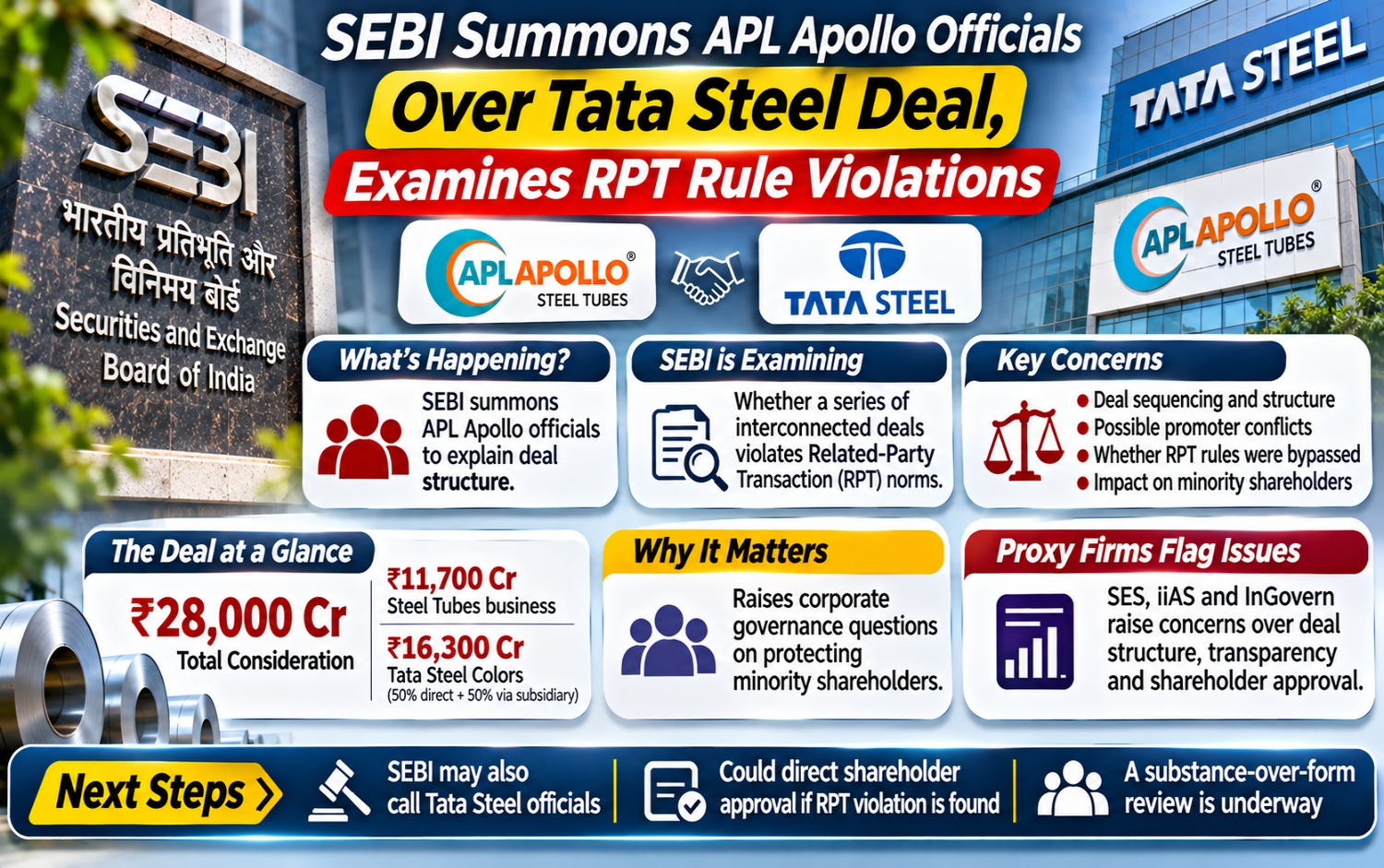
SEBI has reportedly summoned key officials of APL Apollo Tubes to explain the structure of the proposed transactions. The regulator may also call Tata Steel officials as part of its examination, according to people familiar with the development cited by Moneycontrol.
The investigation has attracted investor attention because the outcome could determine whether minority shareholders should have been given an opportunity to approve parts of the transaction.
For shareholders of both companies, the bigger question is whether the proposed arrangement was structured as separate agreements despite being commercially interconnected.
Track Live : NSE Option Chain — Live | BSE Option Chain — Live Sensex & Bankex Options Data Today
Rs 28,000-crore Tata Steel-APL Apollo deal faces governance scrutiny
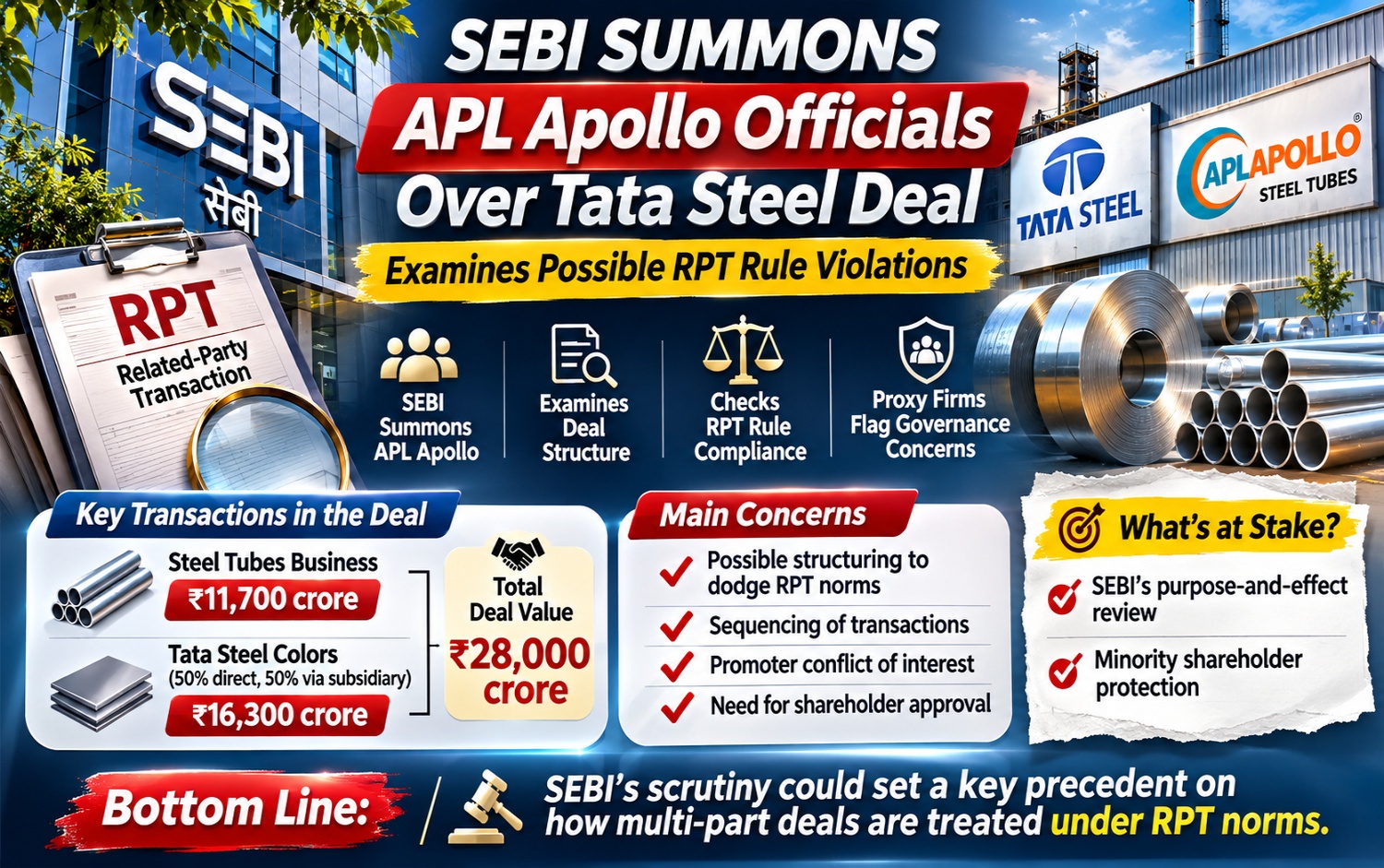
The proposed transaction involves Tata Steel’s Steel Tubes business, valued at Rs 11,700 crore, and Tata Steel Colors Private Limited, valued at Rs 16,300 crore.
APL Apollo is set to acquire these businesses for a combined consideration of Rs 28,000 crore.
Tata Steel holds a 50% stake in Tata Steel Colors directly, with the remaining 50% held through its wholly owned subsidiary, Tata Steel Downstream Products Limited.
The wider arrangement also includes Tata Steel’s acquisition of a 9.91% stake in APL Apollo and a proposed manufacturing arrangement involving SG Tech Engineering, an entity associated with the outgoing promoter group.
SEBI is examining whether these transactions should be considered together when determining their regulatory treatment.
Track Live : Nifty Levels Today | Sensex Levels Today | Bank Nifty Levels Today
Why has SEBI summoned APL Apollo officials?
SEBI is examining whether APL Apollo’s proposed acquisition of two Tata Steel businesses and Tata Steel’s subsequent acquisition of control in APL Apollo should be assessed together under the RPT framework.
The regulator is particularly interested in whether the transaction structure could have allowed the companies to avoid minority shareholder approval requirements.
According to Moneycontrol, SEBI has summoned key APL Apollo officials and may subsequently seek explanations from Tata Steel.
If the regulator determines that the arrangement was structured to circumvent RPT requirements, it could direct the companies to obtain shareholder approval, as applicable. This remains an investigation, not a finding of regulatory wrongdoing.
Key details of the SEBI investigation
| Particulars | Details |
|---|---|
| Market regulator | SEBI |
| Companies involved | Tata Steel and APL Apollo Tubes |
| Latest regulatory development | APL Apollo officials summoned |
| Possible next step | Tata Steel officials may also be called |
| Main issue | Possible avoidance of RPT regulations |
| Relevant regulation | Regulation 23 of SEBI LODR |
| Legal principle | Purpose-and-effect test |
| Main concern | Protection of minority shareholders |
| Regulatory outcome | Yet to be determined |
Track Live : NSE F&O Lot Size | FII DII Data Today
Understanding the ₹28,000-crore Tata Steel–APL Apollo deal
The proposed transaction involves Tata Steel transferring two steel-related businesses to APL Apollo for a combined consideration of ₹28,000 crore.
The two businesses include Tata Steel’s Steel Tubes business and Tata Steel Colors Private Limited.
The transaction is part of a broader arrangement under which Tata Steel will also acquire a controlling stake in APL Apollo from its existing promoter group.
Breakdown of the ₹28,000-crore asset acquisition
| Business being acquired | Transaction value |
|---|---|
| Tata Steel’s Steel Tubes business | ₹11,700 crore |
| Tata Steel Colors Private Limited | ₹16,300 crore |
| Total consideration | ₹28,000 crore |
The deal is particularly significant because APL Apollo will need to finance the acquisition of these businesses, while Tata Steel is simultaneously moving towards acquiring control of APL Apollo.
This raises an important question for minority investors: why should APL Apollo’s balance sheet finance the acquisition of assets from a company that is subsequently becoming its controlling shareholder?
That is one of the central governance concerns raised by proxy advisory firms.
Track Live : NSE Commodity Option Chain — Live MCX Options Data for Crude Oil, Gold, Silver & More
The four interconnected transactions under SEBI’s scrutiny
The proposed arrangement involves more than the ₹28,000-crore business acquisition. It includes four commercially connected transactions that could collectively change APL Apollo’s ownership, business structure and financial obligations.
SEBI is examining whether these transactions should be assessed together rather than independently.
| Transaction | Details | Financial value |
|---|---|---|
| 1. Business acquisition | APL Apollo to acquire Tata Steel’s Steel Tubes business | ₹11,700 crore |
| 2. Colour-coated business acquisition | APL Apollo to acquire Tata Steel Colors Private Limited | ₹16,300 crore |
| 3. Promoter stake acquisition | Tata Steel to acquire approximately 26.38% stake from APL Apollo’s existing promoters | ₹15,510 crore |
| 4. Open offer and manufacturing arrangement | Open offer for up to 26% of APL Apollo, alongside a contract-manufacturing arrangement with promoter-linked SG Spectra | ₹2,301.40 per share in open offer; manufacturing value not disclosed |
Article 121 is not the issue as SEBI examines RPT approval requirements
Under Regulation 23 of the SEBI LODR Regulations, material related-party transactions and subsequent material modifications require prior shareholder approval, with related-party promoters restricted from voting.
The materiality threshold is linked to a company’s annual consolidated turnover.
The regulatory framework becomes particularly important when multiple agreements form part of a broader commercial arrangement.
SEBI’s examination could therefore have implications beyond the individual Tata Steel-APL Apollo transaction, especially for companies that structure complex acquisitions through multiple agreements.
Proxy advisers flag minority shareholder concerns over deal sequencing
Proxy advisory firms have raised questions about the transaction’s structure, timing and potential conflicts of interest.
Stakeholders have particularly questioned the sequence of business transfer agreements signed on November 22 and Tata Steel’s acquisition of a 9.91% stake in APL Apollo on November 23.
Stakeholders expressed different concerns:
- SES: Questioned whether the transaction structure was designed to keep asset transfers outside the RPT framework and highlighted potential promoter conflicts.
- IiAS: Said the deal made commercial sense but questioned the decision to present one broader transaction as several separate agreements.
- InGovern: Called for a substance-over-form review, an independent fairness opinion, transparent disclosures and shareholder approval.
InGovern also warned that shareholders who do not tender their shares in the Rs 2,301.40 open offer could remain exposed to acquisition debt, integration risks and related-party arrangements.
| Proxy adviser | Main concern | Suggested action |
|---|---|---|
| SES | Transaction sequencing and potential RPT avoidance | Examine interconnected agreements collectively |
| IiAS | Debt burden on minority shareholders and differential treatment | Apply purpose-and-effect test and review shareholder safeguards |
| InGovern | Potential promoter benefit and lack of transparency | Independent valuation, fairness opinion and shareholder approval |
Tata Steel’s acquisition of APL Apollo: Promoter stake and open offer explained
Another important component of the arrangement is Tata Steel’s proposed acquisition of control over APL Apollo.
Tata Steel has agreed to acquire approximately 26.38% of APL Apollo from its existing promoter group, the Gupta family, for ₹15,510 crore.
The acquisition is structured in three tranches.
The first tranche involved approximately 9.91% of APL Apollo through a block deal.
Following the acquisition, Tata Steel is also required to make an open offer to public shareholders.
Important acquisition details
| Particulars | Details |
|---|---|
| Existing promoter group | Gupta family |
| Promoter stake proposed for acquisition | Approximately 26.38% |
| Total promoter stake purchase value | ₹15,510 crore |
| First tranche | Approximately 9.91% |
| First tranche purchase price | ₹2,100 per share |
| Open offer size | Up to 26% |
| Open offer price | ₹2,301.40 per share |
| Expected Tata Steel holding after completion | Approximately 52.38% |
| Result | Tata Steel could become controlling shareholder |
What is the SG Spectra manufacturing arrangement, and why has it raised concerns?
A further issue involves SG Spectra, an entity associated with APL Apollo’s outgoing promoter group.
Tata Steel and the promoter-linked entity are proposed to enter into an exclusive contract-manufacturing arrangement.
The arrangement has attracted attention because the Gupta family is expected to relinquish its promoter position in APL Apollo while remaining connected to a manufacturing arrangement.
Proxy advisers have questioned the commercial rationale, transparency and financial terms of this arrangement.
| Particulars | Details |
|---|---|
| Entity | SG Spectra |
| Association | APL Apollo’s outgoing promoter group |
| Proposed arrangement | Exclusive contract manufacturing |
| Commercial purpose | Manufacturing-related cooperation |
| Financial value | Not disclosed in the cited reports |
| Governance concern | Potential continuing economic relationship with outgoing promoters |
What are the materiality thresholds for related-party transactions?
An important detail missing from the original report is the revised materiality framework under SEBI’s LODR regulations.
SEBI introduced a graded materiality threshold through its November 18, 2025, amendment, effective December 19, 2025.
The threshold depends on the listed company’s annual consolidated turnover.
Revised materiality thresholds
| Annual consolidated turnover | Material RPT threshold |
|---|---|
| Up to ₹20,000 crore | 10% of annual consolidated turnover |
| Above ₹20,000 crore to ₹40,000 crore | ₹2,000 crore + 5% of turnover exceeding ₹20,000 crore |
| Above ₹40,000 crore | ₹3,000 crore + 2.5% of turnover exceeding ₹40,000 crore, capped at ₹5,000 crore |
These thresholds are calculated using the listed entity’s latest audited annual consolidated turnover.
Read More : Swiggy Instamart Reportedly Cutting 340 Jobs Despite Rs 13,500 Crore in Cash. What Is Going Wrong?
What should Tata Steel and APL Apollo investors watch next?
The SEBI examination could become an important governance trigger for both companies.
Investors should monitor whether the regulator directs the companies to obtain shareholder approval, whether additional disclosures are required and whether the proposed transactions face any changes.
For APL Apollo shareholders, the key concerns include the open offer, acquisition financing and potential promoter-related conflicts. Tata Steel investors will be watching the financial and strategic implications of the proposed business transfers.
An email sent to SEBI and APL Apollo seeking comments did not receive a response before publication, according to the report.