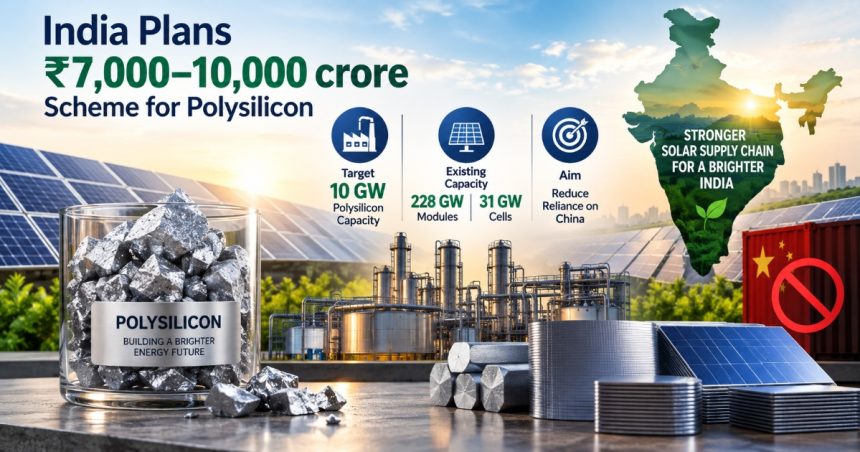
India Targets 10 GW Polysilicon Push to Reduce Dependence on China for Solar Components
India has built a massive solar manufacturing base. But there is still one major piece missing.
The government is now considering a ₹7,000–10,000 crore polysilicon scheme aimed at creating at least 10 GW of domestic polysilicon manufacturing capacity. The move could reshape India’s solar supply chain and bring chemical and renewable-energy companies into sharper focus.
For investors, the bigger question is: which companies could benefit if India finally moves upstream in solar manufacturing?
Track Live : Opening Price Clues – What Pre-Market Data Says Today
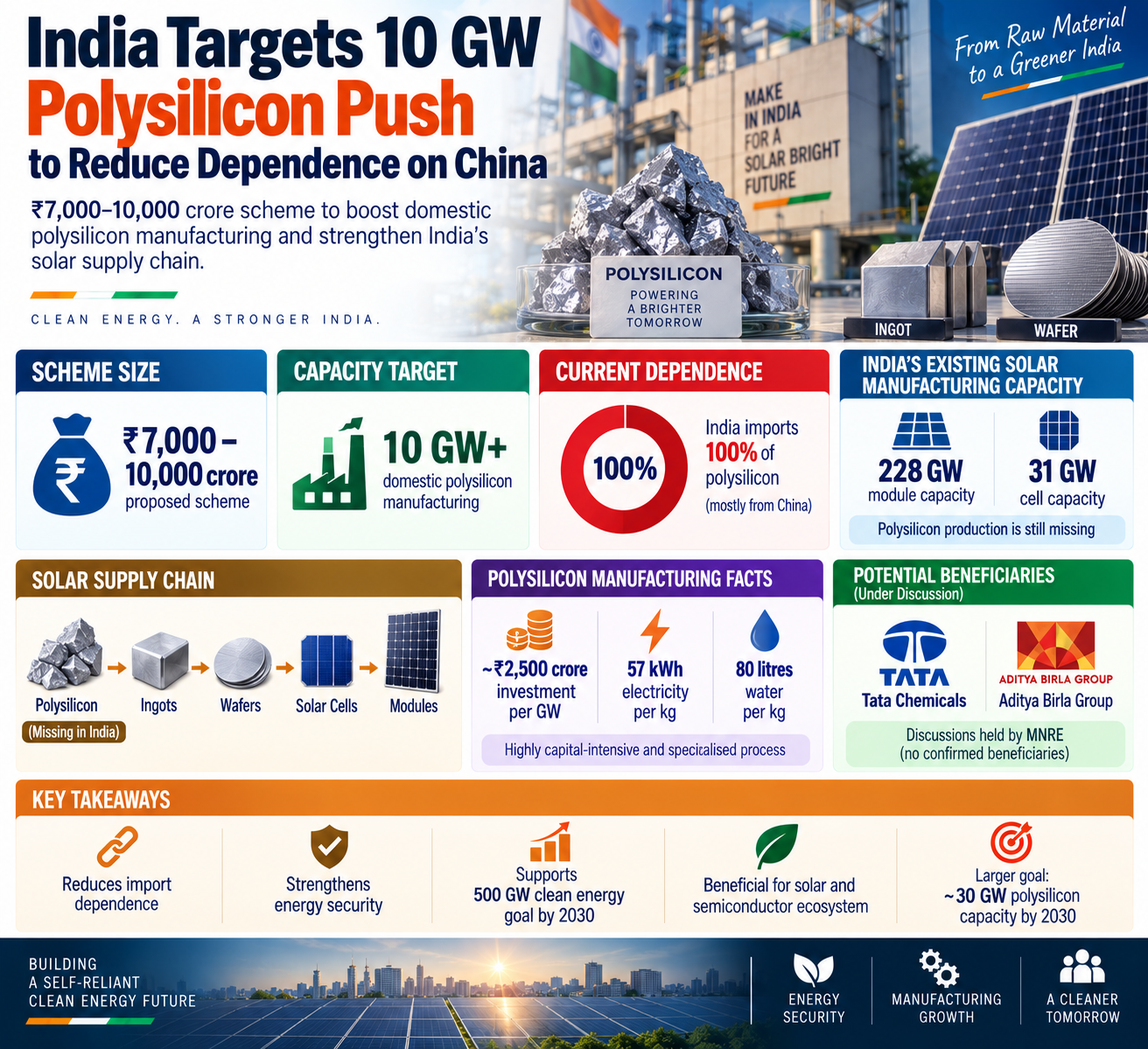
India Targets 10 GW Polysilicon Push : Why polysilicon has suddenly become important for India
Polysilicon sits at the beginning of the crystalline-silicon solar manufacturing chain.
It is converted into ingots and wafers, which are then used to manufacture solar cells and modules.
India has rapidly expanded the downstream part of this industry. The country now has around 228 GW of solar module capacity and 31 GW of cell manufacturing capacity.
But commercial polysilicon production has yet to begin, creating a major gap in the domestic supply chain.
India currently remains heavily dependent on imports from China for polysilicon, making the upstream segment a strategic priority.
The High Barriers to Polysilicon Production
- Capital Intensity: Establishing polysilicon capacity requires an estimated investment of ₹2,500 crore per GW.
- Energy Consumption: Producing just 1 kg of polysilicon requires ~57 kWh of electricity—equivalent to the power consumed by an average Indian household over 18 days.
- Resource Dependency: Every single kilogram produced demands 80 litres of water.
The government already tried to support polysilicon manufacturing
Polysilicon was included in India’s existing ₹24,000 crore solar PV PLI scheme.
The programme was designed to encourage integrated manufacturing covering polysilicon, ingots and wafers, cells and modules. The second tranche has an outlay of ₹19,500 crore, while the overall programme has a ₹24,000 crore outlay.
However, polysilicon manufacturing requires significantly more capital and specialised expertise than downstream module manufacturing.
The government is therefore considering a separate mechanism specifically for polysilicon.
Key Facts of the Plan
- Budget Outlay: The government estimates a financial support package between ₹7,000 crore and 10,000 crore.
- Production Target: The program aims to create over 10 GW of local polysilicon production capacity.
- Policy Type: The Ministry of New and Renewable Energy (MNRE) is working on a Production-Linked Incentive (PLI) structure to support the sector.
- Dual Benefit: Polysilicon is also a vital material for the semiconductor industry used to make computer chips.
Read More : Nestle India Shares Fall 2% as FSSAI Files Cases Over Biotin-Deficient Baby Formula
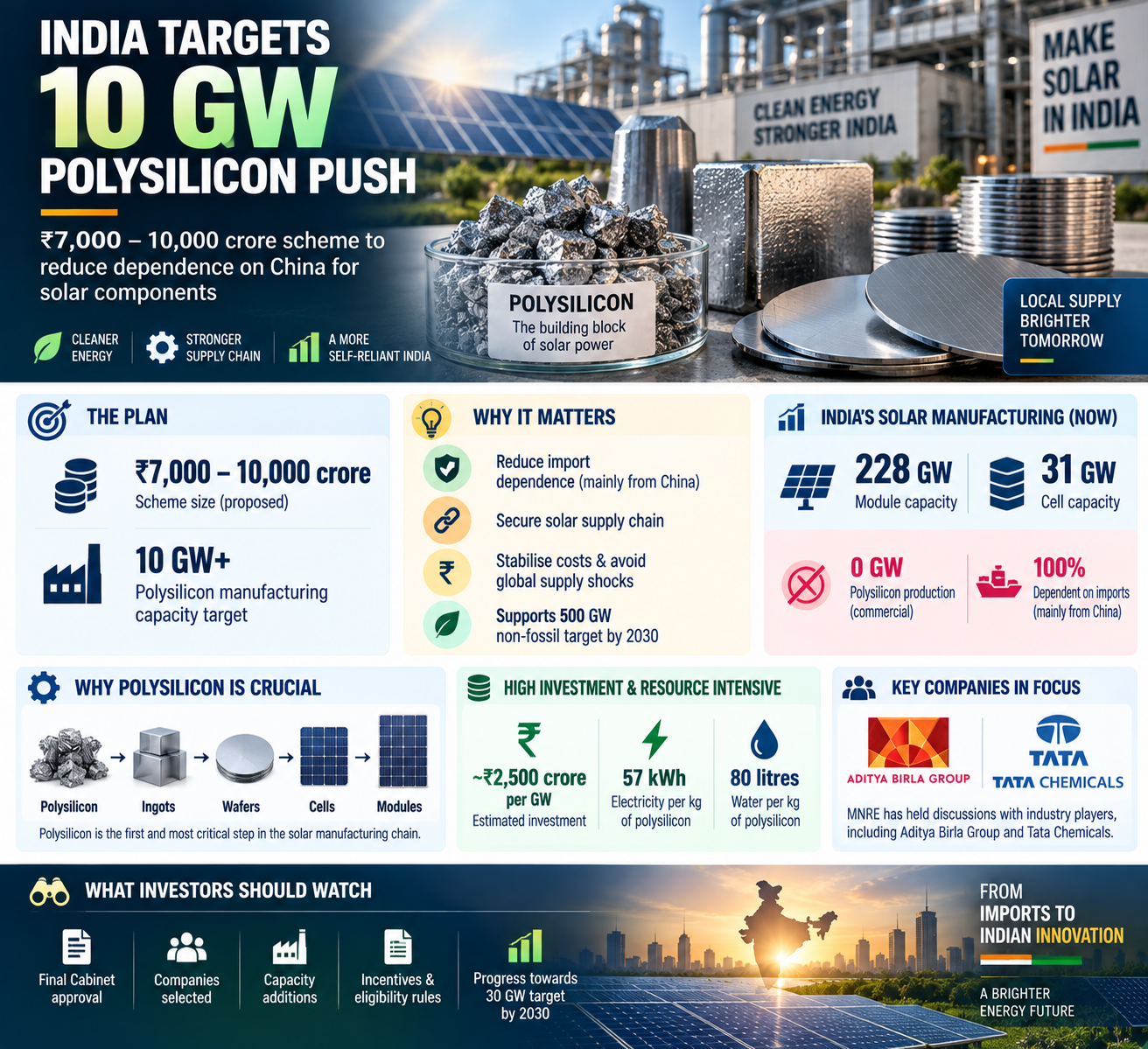
Why the new scheme could change the solar manufacturing story
Industry estimates cited in the latest report put investment requirements for polysilicon manufacturing at around ₹2,500 crore per GW.
The manufacturing process is also highly energy- and water-intensive.
According to the report, producing one kilogram of polysilicon requires around 57 kWh of electricity and 80 litres of water.
A government official explained the challenge:
“Polysilicon manufacturing is a highly specialised chemical process that requires different technology, expertise and significantly higher investment than downstream solar manufacturing.”
That is why the government is now looking at a dedicated scheme.
- Total Reliance: India currently imports 100 percent of its polysilicon, mostly from China.
- Upstream Gap: While India has large capacity for making final solar modules and cells, it lacks the foundational raw material base.
- Supply Security: Building local production helps protect Indian solar companies from global price spikes and supply shortages.
- Long-Term Goals: The move supports India’s target of reaching 500 GW of non-fossil fuel energy by 2030.
Tata Chemicals and Aditya Birla Group could be worth watching
The upcoming polysilicon scheme could bring chemical manufacturers into the renewable-energy investment theme.
MNRE has held discussions with industry stakeholders, including Aditya Birla Group and Tata Chemicals, according to Moneycontrol.
However, discussions with companies should not be interpreted as confirmed investments or beneficiaries.
Investors will need to wait for the final scheme, eligibility conditions and Cabinet approval before assessing company-specific opportunities.
Here’s what happened today and why traders reacted
The government’s polysilicon scheme is being reworked by the Ministry of New and Renewable Energy (MNRE) after feedback from other ministries and the Prime Minister’s Office.
The proposal will be sent for Cabinet approval once the changes are finalised, according to officials cited by Moneycontrol.
The proposed scheme is expected to support at least 10 GW of polysilicon capacity.
India’s longer-term target is even larger, with the government aiming for at least 30 GW of domestic polysilicon capacity by 2030.
What the polysilicon scheme means for investors
The immediate market impact could remain limited until the government announces the final structure.
But the long-term implications could be significant.
A successful 10 GW polysilicon manufacturing push could help India reduce import dependence and create a more integrated solar manufacturing ecosystem.
For investors, the key areas to monitor are:
- Final Cabinet approval and scheme size.
- Companies selected under the programme.
- Investment commitments from chemical manufacturers.
- Polysilicon and wafer capacity additions.
- Government incentives and eligibility rules.
- Progress towards the 30 GW polysilicon target by 2030.
The broader solar manufacturing theme is already expanding. India’s existing PLI programme aims to build a domestic high-efficiency solar PV manufacturing ecosystem and reduce import dependence.
For traders, the next major trigger could be the government’s final announcement.
For long-term investors, however, the bigger story is whether India can move from manufacturing solar modules and cells to controlling more of the raw-material supply chain itself.