First RBI Rate Hike in 3.5 Years? Rupee Slides Ahead of RBI Policy as Oil and FPI Outflows Weigh
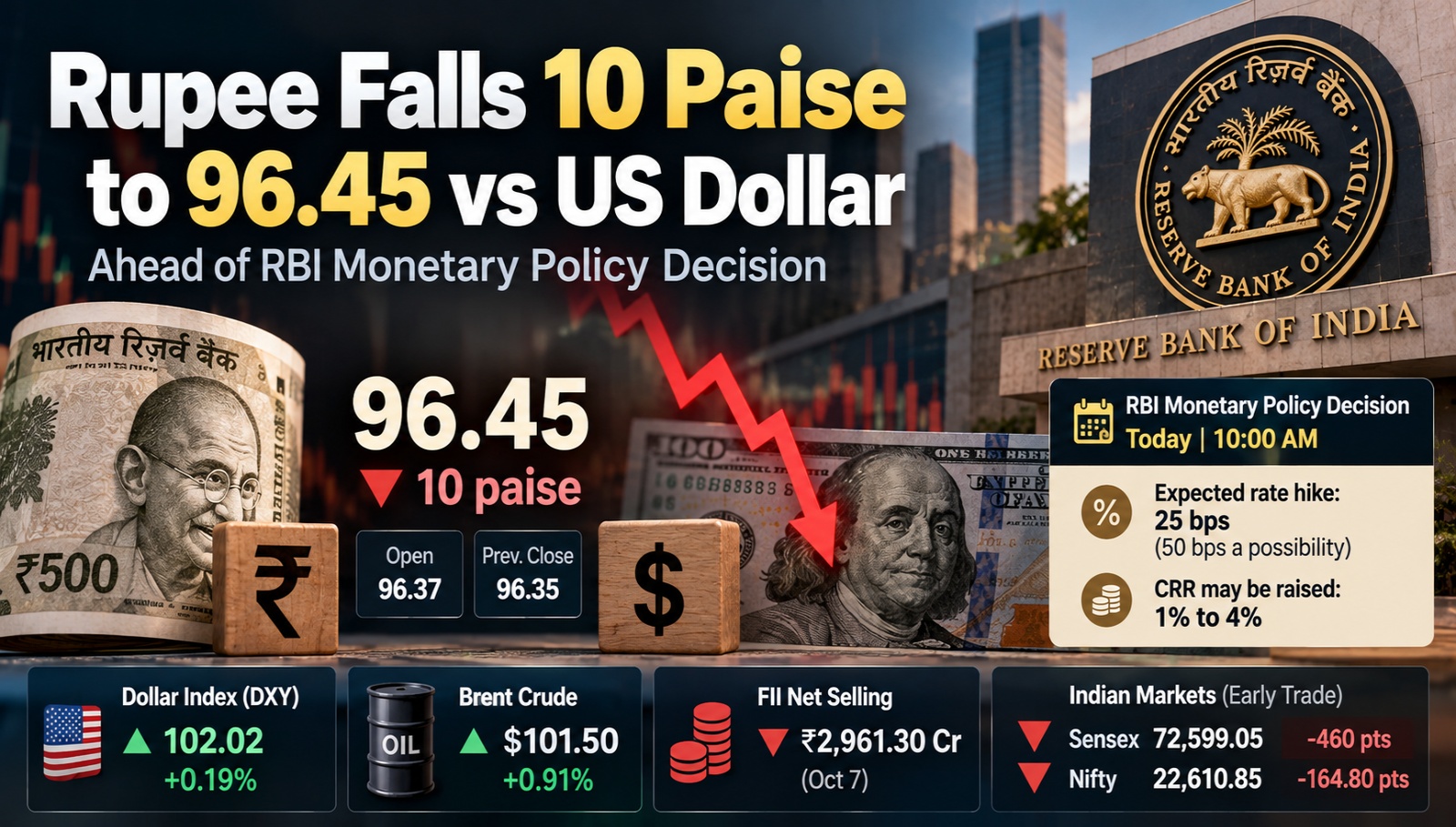
The Indian rupee came under fresh pressure on Wednesday, falling 10 paise to ₹96.45 against the US dollar as traders waited for the Reserve Bank of India’s monetary policy decision. With the dollar staying firm and foreign investors continuing to sell Indian equities, the currency market entered the RBI decision with a cautious tone.
The bigger question for investors now is whether the RBI can provide enough support to the rupee while also responding to rising inflation risks and higher oil prices.
Track Live : FII DII Data Today | NSE F&O Lot Size
First RBI Rate Hike in 3.5 Years? What the RBI Policy Decision Means for the Rupee
The RBI’s monetary policy decision is the key event for markets today. The central bank is scheduled to announce its decision at 10 am, with expectations building around a possible rate hike.
Market participants are reportedly expecting a 25-basis-point rate increase, while a 50-basis-point hike remains an outside possibility. Traders are also watching whether the RBI increases the cash reserve ratio (CRR) to absorb excess liquidity.
“The RBI may also raise the CRR by 1 per cent to 4 per cent to absorb the excess liquidity,” said Anil Kumar Bhansali, Head of Treasury and Executive Director at Finrex Treasury Advisors LLP.
Bhansali also pointed to the rupee’s recent weakness, noting that it has lost more than 2% over the past month amid oil demand and FPI demand for US dollars.
Rupee at ₹96.45: What is happening?
The Indian rupee weakened 10 paise to ₹96.45 per US dollar in early trading on October 7, 2026, after closing at ₹96.35 on Tuesday. It opened at ₹96.37 before slipping to ₹96.45.
The weakness was driven by a combination of:
- Foreign fund outflows from Indian equities
- A strong US dollar, with the DXY around 102
- Brent crude above $100/barrel, increasing India’s import-cost pressure
- Demand for dollars from importers and foreign investors
- Uncertainty ahead of the RBI’s monetary policy announcement
RBI’s decision has now been announced
An important update to the article you provided: the RBI has since announced its October 2026 policy decision.
The Monetary Policy Committee unanimously raised the repo rate by 25 basis points, from 5.25% to 5.50%, marking the first repo-rate hike since February 2023. The RBI also shifted its policy stance to “calibrated tightening.”
| RBI Policy Parameter | Before | After |
|---|---|---|
| Repo rate | 5.25% | 5.50% |
| Change | — | +25 bps |
| SDF | — | 5.25% |
| MSF/Bank Rate | — | 5.75% |
| CRR | 3% | Unchanged |
| Policy stance | Neutral | Calibrated tightening |
The CRR was not increased to 4% as had been speculated before the announcement; it remained at 3%.
Rising crude prices add another challenge for investors
Crude oil is emerging as another important pressure point for the Indian market. Brent crude futures were up 0.91% at $101.50 a barrel.
Higher oil prices can increase India’s import bill and put additional pressure on the rupee. For investors, this creates a broader concern because sustained currency weakness and expensive crude can influence inflation, corporate costs and market sentiment.
The ongoing West Asia conflict has also increased uncertainty around inflation and global energy prices.
Track Live : Opening Price Clues – What Pre-Market Data Says Today
Stock market falls as FIIs continue selling
The pressure was not limited to the currency market. Indian equities also opened sharply lower, with the Sensex falling 460 points to 72,599.05 and the Nifty declining 164.80 points to 22,610.85.
Foreign institutional investors remained sellers in the previous session, offloading Indian equities worth ₹2,961.30 crore on a net basis on Tuesday.
For investors, continued FII selling is an important signal because sustained foreign outflows can weigh on both equities and the rupee.
Read More : ICICI Bank Q2 Results FY27: NII, NIM and Asset Quality in Focus Before Oct 17
Key Market Impacts & Indicators
- Rupee under pressure: The Indian rupee opened at ₹96.37 per US dollar and remained under pressure amid foreign portfolio outflows, elevated crude oil prices and a stronger US dollar. The currency’s weakness remains a key concern for investors because a weaker rupee can increase the cost of imported commodities and add to inflationary pressures.
- FII selling weighs on equities: Persistent foreign investor selling has added pressure to both the rupee and Indian equities. Continued overseas outflows could remain a key market risk if crude oil stays above $100 a barrel and global bond yields remain elevated.
- Equity markets remain volatile: Indian benchmark indices came under pressure after the RBI’s rate hike, with rate-sensitive sectors such as autos, FMCG and real estate among those facing selling pressure. However, banking and financial stocks later recovered some of their early losses.
- RBI raises repo rate: The RBI’s Monetary Policy Committee unanimously raised the policy repo rate by 25 basis points to 5.50%, marking the first rate hike since February 2023. The central bank also changed its policy stance from “neutral” to “calibrated tightening.”
- Growth outlook remains strong: Despite the tightening policy, the RBI raised its FY27 real GDP growth forecast to 7.1%, signalling that it continues to expect strong underlying economic activity.
- Inflation forecast raised: The RBI increased its FY27 CPI inflation forecast to 5.2%, from 5.0% previously, reflecting risks from higher crude oil prices, food prices and the weaker rupee. The RBI’s quarterly projections point to inflation of 6% in Q3 FY27 and 5.7% in Q4 FY27.
Here’s what happened today and why traders reacted
At the interbank foreign exchange market, the rupee opened at ₹96.37 before slipping to ₹96.45. The currency had closed at ₹96.35 against the US dollar on Tuesday.
The rupee has remained under pressure in recent weeks. Traders are closely watching foreign portfolio investor (FPI) outflows, demand for US dollars and higher crude oil prices, all of which can increase pressure on the Indian currency.
The dollar index was trading at 102.02, up 0.19%, keeping the US dollar relatively strong against major global currencies.
What does the RBI rate hike mean for investors?
The 25-bps hike to 5.50% is potentially supportive for the rupee, because higher domestic interest rates can improve the relative attractiveness of rupee assets and signal that the RBI is prioritising inflation and currency stability.
However, the rupee’s reaction may depend more on what happens next than on today’s hike itself. Reuters reported that traders were particularly focused on the RBI’s future policy guidance.
For stock-market investors, the key areas to watch are:
- Banks/NBFCs: Higher rates can increase funding costs and potentially pressure credit demand.
- IT companies: A weaker rupee can be favourable for exporters because overseas revenue translates into more rupees.
- Oil-importing companies: A weaker rupee plus expensive crude can increase input costs.
- Oil marketing companies: Crude prices and the government’s pricing policy become important.
- Auto and consumer companies: Higher borrowing costs can affect demand for rate-sensitive purchases.
- FMCG: Sustained currency weakness and higher commodity/import costs could affect margins.
- Pharma: Export-oriented pharmaceutical companies may benefit from rupee depreciation, although the impact varies by company.