
Oil Falls Remain Near Three-Month Lows as Supply Concerns Weigh on Sentiment
Crude oil prices are facing pressure from two opposing forces: rising global supply and growing geopolitical risks around one of the world’s most important oil shipping routes.
Oil prices hovered near three-month lows on Tuesday as investors assessed whether improving crude availability could push the global market towards a surplus. However, tensions surrounding shipping through the Strait of Hormuz have prevented prices from declining more sharply.
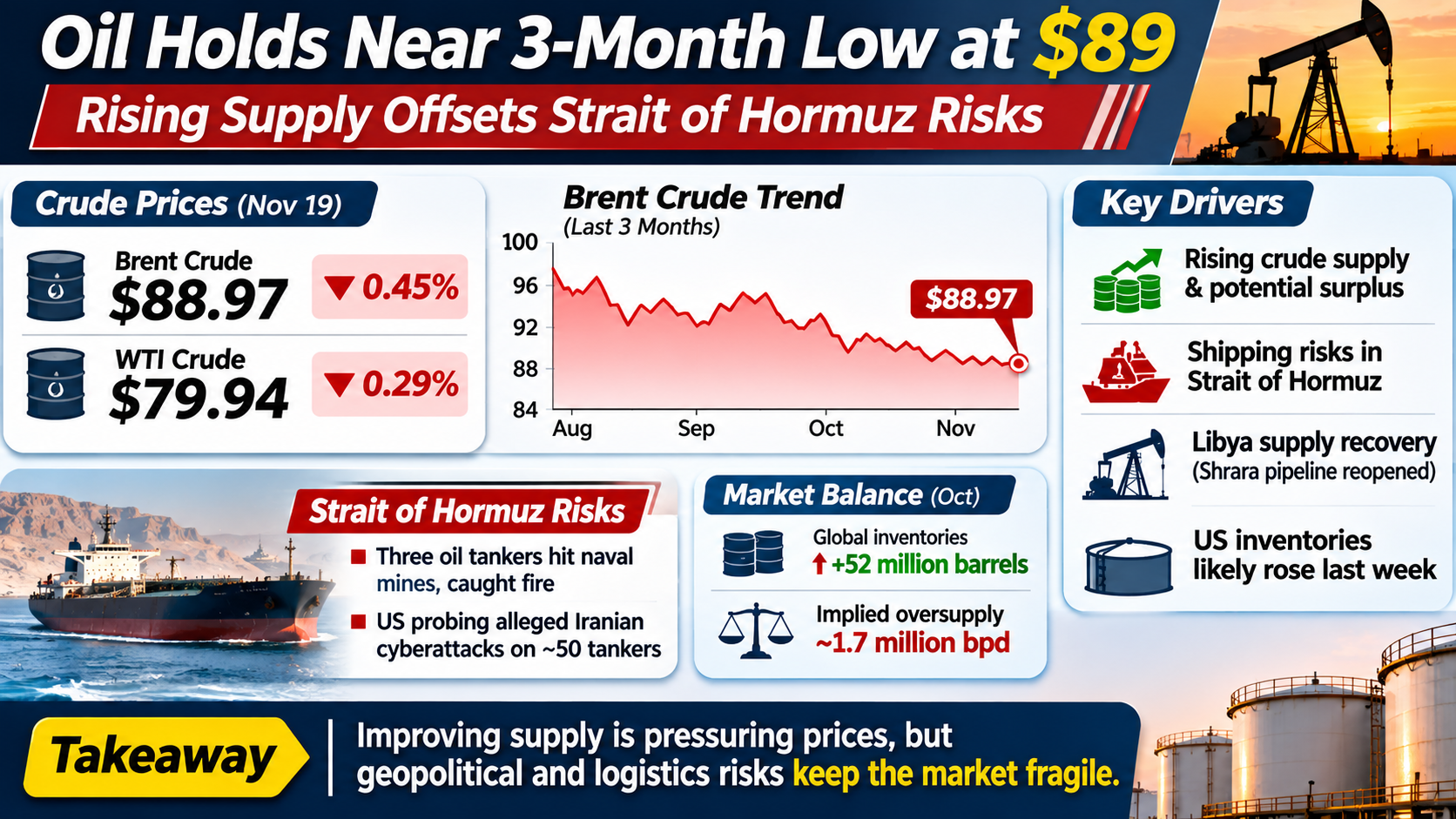
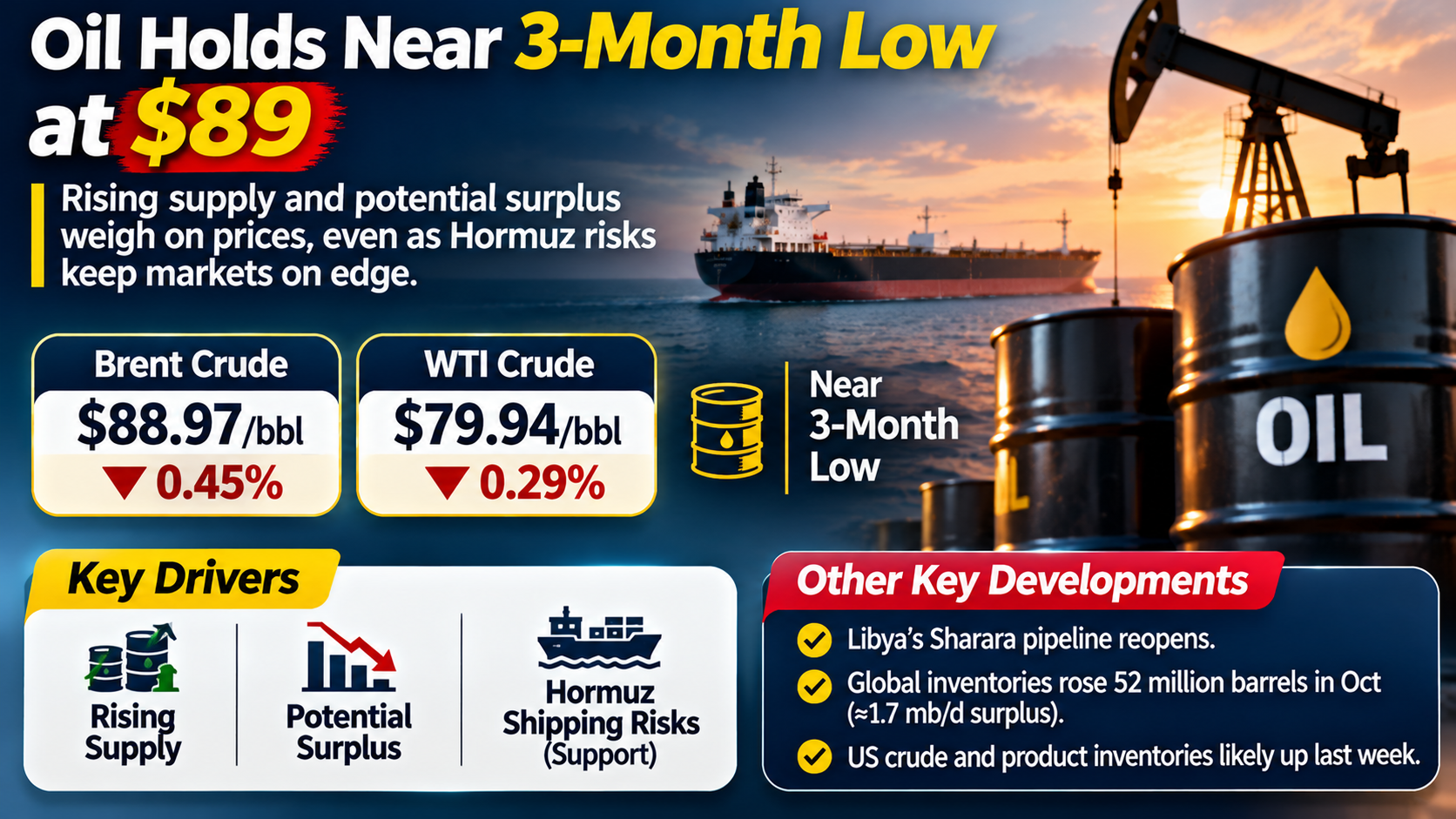
Brent crude futures fell 40 cents, or 0.45%, to $88.97 per barrel by 0147 GMT. The benchmark had recorded its lowest closing level since August 31 on Monday.
Meanwhile, US West Texas Intermediate (WTI) crude futures declined 23 cents, or 0.29%, to $79.94 per barrel after touching their lowest level since August 26 earlier in the session.
The latest movement highlights the uncertainty facing the oil market as traders balance supply recovery against geopolitical disruptions.
Track Live : GIFT Nifty Live – Today Price, Chart, Timings and Nifty Opening Signa
Oil Falls: Rising Global Oil Supply and Surplus Expectations Put Pressure on Brent Crude
Increasing crude availability has become one of the biggest concerns for oil investors.
According to Deutsche Bank, global observed liquids inventories increased by 52 million barrels in October. This indicated an estimated oversupply of approximately 1.7 million barrels per day.
The bank said evidence was accumulating that the global oil market was rebalancing and moving towards surplus conditions, although potential setbacks could delay the process.
Supply recovery in Libya is also adding to the market’s expectations of greater availability.
The country’s Sharara oil pipeline has reopened, with crude beginning to flow into storage tanks at the Akakus facility in Zawiya, according to the National Oil Corporation.
Additionally, a preliminary Reuters poll indicated that US crude oil and refined product inventories were likely to have increased last week.
Together, these developments are strengthening expectations that additional supply could limit any significant recovery in crude oil prices.
Brent crude falls to $88.97 as global oil supply increases
Oil prices declined for a second consecutive session on Tuesday, approaching their lowest levels in approximately three months.
The latest early-trading prices were:
| Crude benchmark | Price | Change |
|---|---|---|
| Brent crude | $88.97/barrel | -0.45% |
| US WTI crude | $79.94/barrel | -0.29% |
These figures represent prices at 0147 GMT, not the final settlement prices for November 24.
On Monday, November 23:
-
Brent crude settled at $89.37 per barrel, down $3.20 or 3.46%.
-
WTI settled at $80.17 per barrel, down $3.24 or 3.88%.
Brent recorded its lowest closing price since August 31, while WTI reached its lowest closing level since August 10.
The decline reflects growing expectations that global oil supplies are recovering faster than previously anticipated.
Track Live : Nifty Levels Today | Sensex Levels Today | Bank Nifty Levels Today
Why are crude oil prices falling despite tensions in the Strait of Hormuz?
The primary reason is that improving supply conditions are currently outweighing geopolitical concerns.
Several developments are contributing to the decline:
-
Higher oil exports from the Middle East.
-
Recovery in Libyan crude production.
-
Increasing global oil inventories.
-
Expectations of higher US crude stocks.
-
Forecasts of a global oil supply surplus.
-
Concerns about relatively weak oil demand.
The International Energy Agency’s November 2026 Oil Market Report provides additional context.
The IEA estimated that global oil supply increased by 2.3 million barrels per day in October, reaching 105.4 million barrels per day.
It also forecast global oil supply to increase by 6.6 million barrels per day in 2027.
Strait of Hormuz Shipping Risks Keep the Oil Market Vulnerable
Despite improving supply conditions, the oil market remains exposed to potential disruptions in global transportation.
The Strait of Hormuz is a critical shipping route for international energy supplies. Any disruption could delay crude shipments, tighten availability and push oil prices higher.
Daniel Hynes, Senior Commodity Strategist at ANZ, said, “The oil system therefore appears to be moving from acute scarcity towards persistent vulnerability, rather than returning to normal.”
He also highlighted that logistics remain constrained and inventory buffers are thin, even as product availability and inventories show improvement.
This suggests that the recent decline in Brent crude prices does not necessarily indicate that supply-related risks have disappeared.
ANZ warns that the oil market remains fragile despite improving supply
One of the most important assessments in the latest report comes from Daniel Hynes, Senior Commodity Strategist at ANZ.
He said that improvements in inventories and product availability had not eliminated the underlying stress in the global oil market.
His assessment highlights a distinction between improving supply and fully normalised market conditions.
There are three important concerns.
First, shipping logistics remain constrained.
Even when additional crude becomes available, it must still be transported through secure and functioning shipping routes.
Second, inventory buffers remain thin.
The increase in global observed inventories does not necessarily mean that all regions have rebuilt adequate onshore reserves.
Third, market expectations may be ahead of actual recovery.
Oil prices, futures spreads, refining margins and investor positioning increasingly suggest that traders expect supply conditions to normalise.
However, physical oil-market conditions remain vulnerable to disruptions.
Track Live : NSE Option Chain — Live | BSE Option Chain — Live Sensex & Bankex Options Data Today
Libya’s Sharara oil pipeline reopens, improving global supply
Another important development putting pressure on crude prices is the reopening of Libya’s Sharara oil pipeline.
The country’s National Oil Corporation confirmed that the pipeline had reopened and crude oil had started flowing into storage tanks at the Akakus facility in Zawiya.
The Sharara oilfield is one of Libya’s major crude production assets.
Its production has historically been affected by political disputes, security disruptions and operational shutdowns.
The reopening is important because it restores additional crude supply to the international market.
The impact extends beyond Libya:
-
Additional Libyan crude can increase export availability.
-
European refiners can benefit from improved Mediterranean supply.
-
Higher production can reduce competition for alternative crude grades.
-
Additional supply can put downward pressure on international benchmarks.
However, the actual impact will depend on how consistently production and exports are maintained.
Global oil inventories increased by 52 million barrels in October
One of the strongest indications that the oil market is moving towards surplus is the increase in global observed liquids inventories.
According to Deutsche Bank’s research note cited by Reuters, global observed liquids inventories increased by 52 million barrels in October.
This represented an implied surplus of approximately 1.7 million barrels per day.
The IEA’s November report also confirmed the 52-million-barrel increase.
| Key Indicator | Volume |
|---|---|
| Barrels added in October | +52 million |
| Daily surplus equivalent | 1.7 million barrels per day |
| Increase in oil on water | +86 million barrels |
| Cumulative observed stock decline since the war began | 462 million barrels |
What does the IEA’s November 2026 oil report reveal about the global market?
The International Energy Agency’s November Oil Market Report provides several important details that were not included in your original content.
| Indicator | IEA assessment |
|---|---|
| Global oil demand in 2026 | 102.3 million bpd |
| 2026 demand growth outlook | Decline of 2.7 million bpd |
| Global oil supply in October | 105.4 million bpd |
| Increase in October supply | 2.3 million bpd |
| Expected 2027 supply growth | 6.6 million bpd |
| Expected average 2027 supply | 108.1 million bpd |
| October observed inventory increase | 52 million barrels |
The IEA expects global oil demand to fall by 2.7 million barrels per day in 2026, reaching 102.3 million barrels per day.
However, it expects demand to rebound by approximately 2 million barrels per day in 2027.
Track Live : NSE F&O Lot Size | FII DII Data Today
OPEC+ meeting on November 29: Why should oil investors watch it?
Another important upcoming event is the OPEC+ meeting scheduled for November 29, 2026.
OPEC+ includes OPEC members and other participating oil-producing countries, including Russia.
The group will discuss its 2027 production policy.
The outcome could influence global crude supply expectations.
There are two broad possibilities:
Scenario A: Production increases
If OPEC+ decides to maintain or increase production, it could add further pressure to oil prices, particularly if global demand remains weak.
Scenario B: Production restrictions
If the group adopts production restrictions or delays planned supply increases, it could help stabilise crude prices.
The meeting is particularly important because the market is already showing signs of a supply surplus.
Read More : Nvidia Surged Up to 37% After Jensen Huang’s Return. The Bigger Story Is Trump’s Role
Which Indian stocks and sectors could benefit from lower crude prices?
For Indian equity investors, the movement in crude oil prices is particularly important because it affects several sectors.
| Sector | Potential beneficiaries | Why it matters |
|---|---|---|
| Oil marketing | Indian Oil Corporation, BPCL, HPCL | Lower crude procurement costs may support marketing margins |
| Aviation | InterGlobe Aviation | Lower aviation fuel costs can improve operating economics |
| Paints | Asian Paints, Berger Paints | Some petroleum-derived raw materials could become cheaper |
| Tyres | MRF, Apollo Tyres | Synthetic rubber and other petroleum-linked input costs |
| Chemicals | SRF, Aarti Industries | Certain petrochemical feedstock costs may decline |
| Logistics | Blue Dart Express | Lower fuel expenses may improve operating costs |