
TVS Family Rift: Why Valuation and Control Are Blocking a Wealth Split
A dispute within the family of TVS Group patriarch Venu Srinivasan has brought questions over business valuations, ownership rights and control of one of India’s leading two-wheeler manufacturers into focus. The disagreement centres on how family wealth should be divided and whether the existing business arrangements reflect an equitable distribution of economic interests.
The outcome could have implications beyond the family, particularly for investors tracking TVS Motor Company, TVS Holdings and the group’s unlisted businesses.
Track Live : Nifty Levels Today | Sensex Levels Today | Fin Nifty Levels Today
TVS Family Rift: TVS Emerald Deal Raises Questions Over Business Valuation
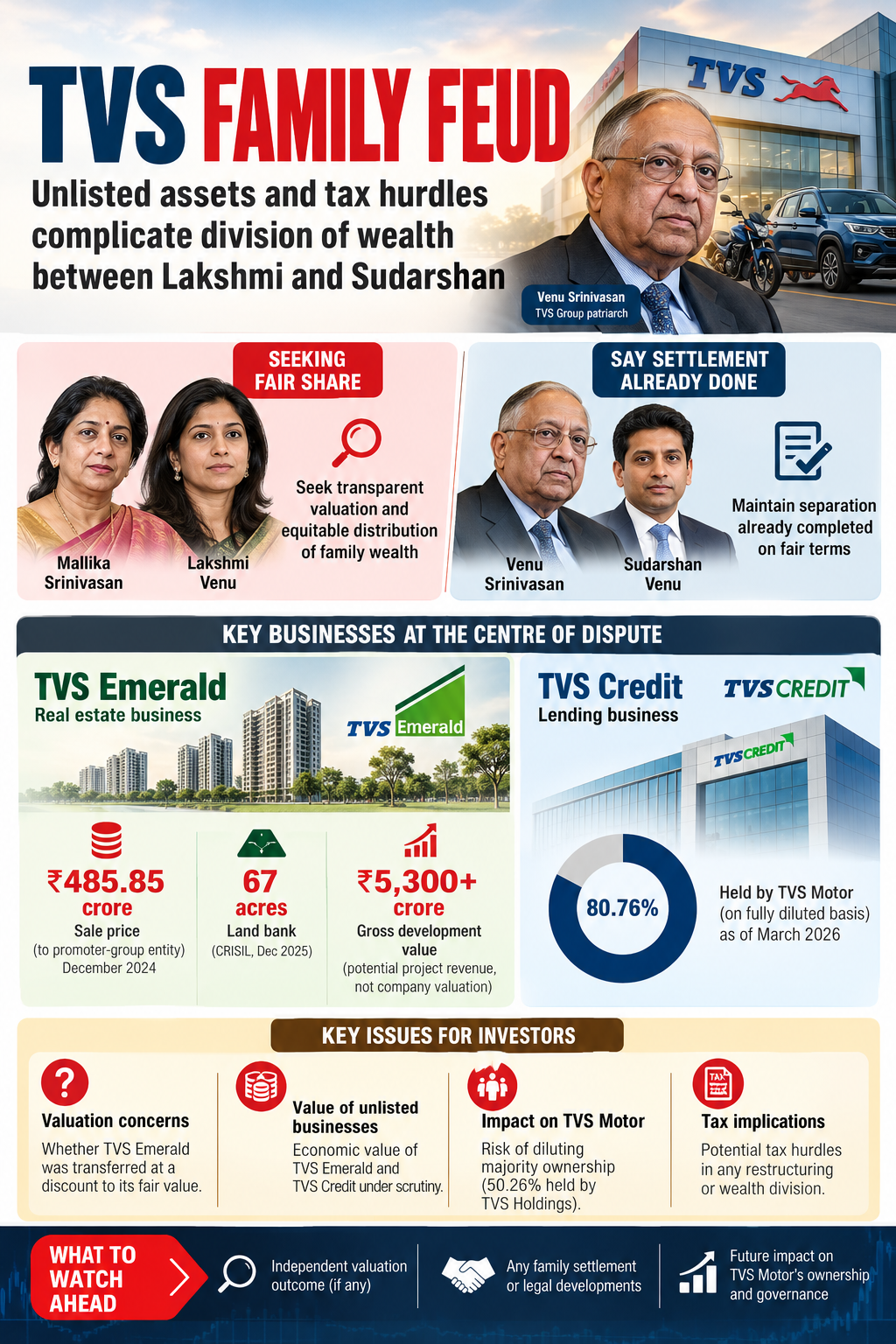
One of the biggest points of contention is TVS Emerald, the group’s real estate business. In December 2024, listed TVS Holdings sold the business to Vee Ess Trading Private Limited, a promoter-group entity, for Rs 485.85 crore.
People familiar with the matter told Moneycontrol that Mallika Srinivasan believes she was not fully informed about the business’s economic potential and has questioned whether the transaction adequately reflected its fair value.
However, the alleged undervaluation has not been independently established. TVS Holdings has described the transaction as being conducted at arm’s length, supported by a valuation report. Its auditors have also said they examined the relevant valuation documents, agreements and approvals.
The business’s growth potential has nevertheless brought the transaction under scrutiny.
According to a December 2025 CRISIL Ratings report, TVS Emerald had a land bank of 67 acres and a gross development value exceeding Rs 5,300 crore. CRISIL projected sales of Rs 1,300–1,400 crore in FY26, rising to Rs 2,000–2,500 crore over the medium term.
Gross development value represents potential project revenue, not the company’s equity valuation. The distinction is important when assessing whether the 2024 sale price adequately reflected the business’s underlying worth.
Who is on each side of the dispute?
Venu Srinivasan and Sudarshan Venu
 Father and son
 Mother and daughter
They argue that no mutually agreed economic settlement has been concluded and that family assets require transparent valuation and equitable distribution.
The two sides disagree about whether the existing family agreements actually settled economic ownership or only established rules for managing businesses, trademarks and competition.
TVS Family Feud: 4 Key Numbers Every Stock Market Investor Should Know
| Metric | Figure | Date / Source | Why it matters |
|---|---|---|---|
| TVS Emerald sale price | ₹485.85 crore | December 2024 | Consideration for the 100% stake sold by TVS Holdings to a promoter-group entity. |
| TVS Emerald land bank | 67 acres | CRISIL, December 2025 | Indicates the land available for real-estate development. |
| TVS Emerald gross development value (GDV) | ₹5,300+ crore | CRISIL, December 2025 | Potential project revenue, not company valuation or net profit. |
| TVS Holdings stake in TVS Motor | 50.26% | CRISIL report | Shows TVS Holdings’ majority ownership of the listed two-wheeler company. |
Key takeaway: The ₹485.85 crore transaction price and ₹5,300+ crore GDV measure different things. The figures raise valuation questions, but do not independently establish that the sale was undervalued.
TVS Credit Valuation Adds Another Layer to the Dispute
TVS Credit Services is another business whose future value has become relevant to the disagreement.
TVS Credit operates within the TVS Motor corporate structure. As of March 2026, TVS Motor held approximately 80.76% of the lender on a fully diluted basis.
Mallika and her daughter, Lakshmi Venu, are understood to believe that the value of unlisted businesses and their future growth prospects must be considered when determining an equitable distribution of family wealth.
Mallika is also understood to have initiated a private valuation exercise to assess the underlying worth of the businesses.
However, no mutually agreed valuation or economic settlement has been concluded.
In a joint statement, Mallika and Lakshmi said, “No agreement dividing these economic interests has been concluded.” They argued that arrangements involving trademarks, brand usage and non-compete obligations should not be mistaken for a settlement of economic ownership.
Venu Srinivasan and his son, Sudarshan Venu, maintain that the separation of business interests was completed on fair terms.
Track Live : Gap Up / Gap Down Stocks – Today’s NSE Opening Gaps
Here’s What Happened Today and Why Traders Reacted
The key development is the growing focus on how the family’s economic interests could be valued and separated without disrupting the existing ownership structure of TVS Motor.
The dispute does not, by itself, establish that TVS Motor’s operations or financial performance have deteriorated. However, uncertainty over ownership, restructuring and promoter control could influence investor sentiment if the disagreement leads to formal corporate actions.
For traders, the important factors to monitor are any official announcements, changes in promoter shareholding, regulatory filings and developments involving TVS Holdings.
For long-term investors, the distinction between family-level disagreements and the operating performance of the listed businesses remains essential.
Read More : Jio Financial Q2 FY27 Results on October 15, 2026: Can Profit Repeat Q1’s 155% Jump?
TVS Motor Majority Ownership Creates a Major Hurdle
TVS Holdings owns approximately 50.26% of TVS Motor, while the total promoter-group holding stood at around 50.27% as of March 31, 2026.
This narrow majority makes a potential restructuring complicated. People familiar with the discussions have cited a possible reverse merger of TVS Holdings with TVS Motor as one route that could simplify the ownership structure.
However, one scenario discussed could reduce the effective promoter holding to around 31%. This figure has not been independently verified and would depend on the final transaction structure and share-exchange ratio.
A holding below 50% would not automatically mean losing management control. Nevertheless, it could reduce the promoters’ ability to pass ordinary resolutions independently and increase their dependence on other shareholders.
Potential tax liabilities present another obstacle. Although certain mergers can qualify for tax-neutral treatment under Indian law, eligibility depends on meeting applicable conditions. No formal reverse-merger proposal has been announced.
What the TVS Family Dispute Means for Investors
The disagreement also reflects different views on wealth creation. Venu Srinivasan and Sudarshan’s side has emphasised Sudarshan’s contribution to TVS Motor’s growth since he became managing director in May 2022 and chairman and managing director in August 2025.
Mallika and Lakshmi argue that management responsibilities should not be confused with economic ownership. They maintain that a transparent valuation and mutually agreed distribution remain necessary.
For investors, the immediate focus should remain on company fundamentals, earnings growth, valuations and official disclosures rather than unverified restructuring scenarios.
Any confirmed changes to promoter ownership, a formal merger proposal or a settlement announcement could become important developments for TVS Motor and TVS Holdings shareholders.
Why This Matters to Investors
1. Corporate Governance and Succession
The dispute raises questions about leadership continuity, promoter decision-making and the effectiveness of succession arrangements across the TVS Group. Investors should watch whether disagreements affect boardroom decisions or business operations. The wider group has also experienced governance-related tensions at Sundaram Clayton.
2. TVS Motor and TVS Holdings Exposure
TVS Holdings owns approximately 50.26% of TVS Motor Company. Any future restructuring that changes promoter ownership or voting rights could influence corporate control and shareholder dynamics. However, no formal reverse-merger proposal has been announced.
3. Unlisted Assets, Valuation and Tax Implications
The ₹485.85 crore sale of TVS Emerald to a promoter-group entity has raised questions about valuation and the allocation of economic interests. Although TVS Holdings described the transaction as conducted at arm’s length with valuation support, the alleged undervaluation has not been independently established. Potential tax consequences would depend on the structure of any eventual settlement or restructuring.
4. What Investors Should Monitor Next
Keep an eye on stock-exchange disclosures, promoter shareholding changes, formal legal proceedings, related-party transactions and official company statements. Any confirmed restructuring or material governance development could influence investor sentiment.