RBI Polymer Notes Plan Could Change India’s Currency System Without Changing ATM Hardware
India could be preparing for an important change in its currency system, but the biggest development may not be the material used to print banknotes. It could be the decision to avoid costly changes to existing ATM infrastructure.
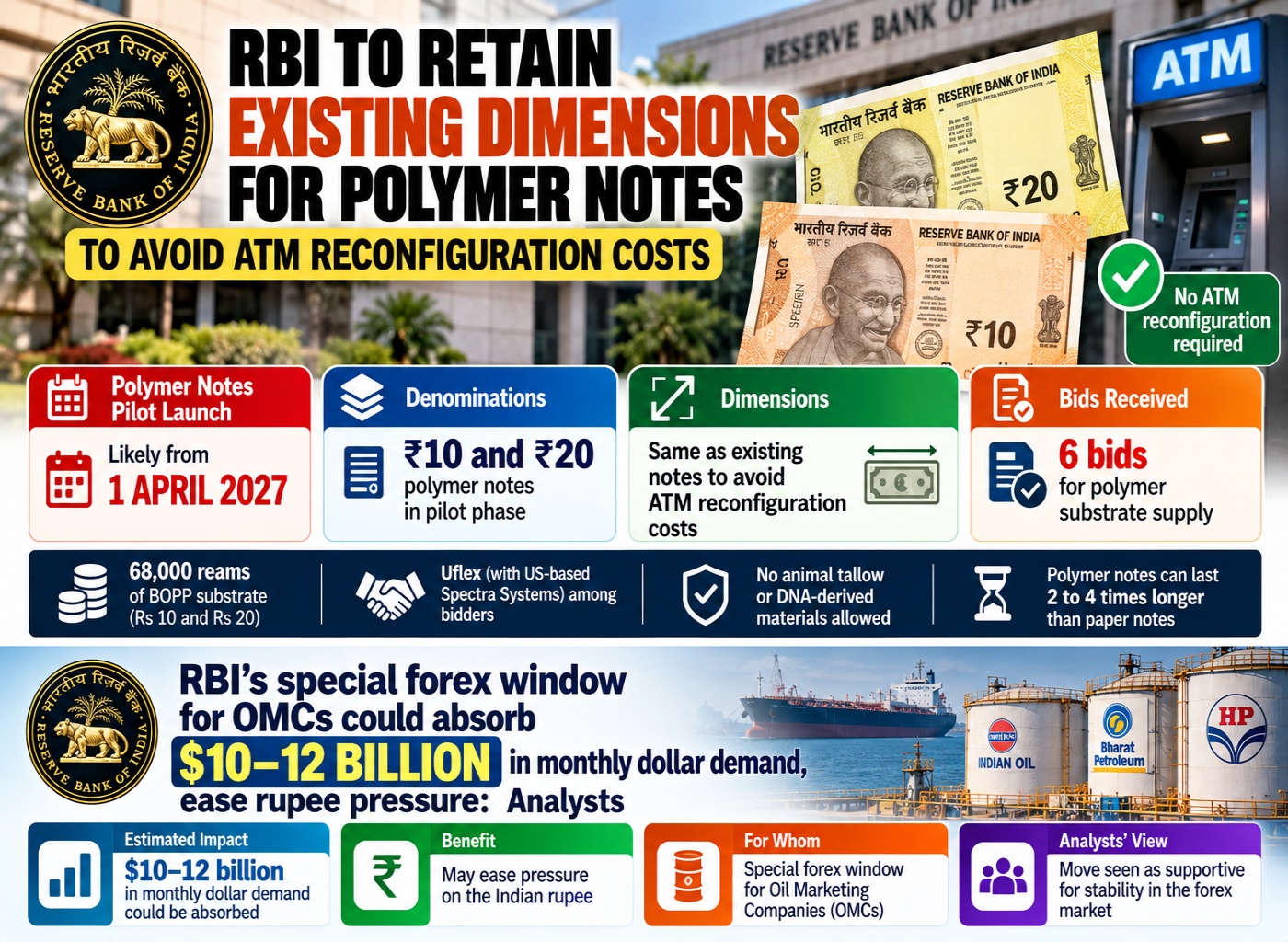
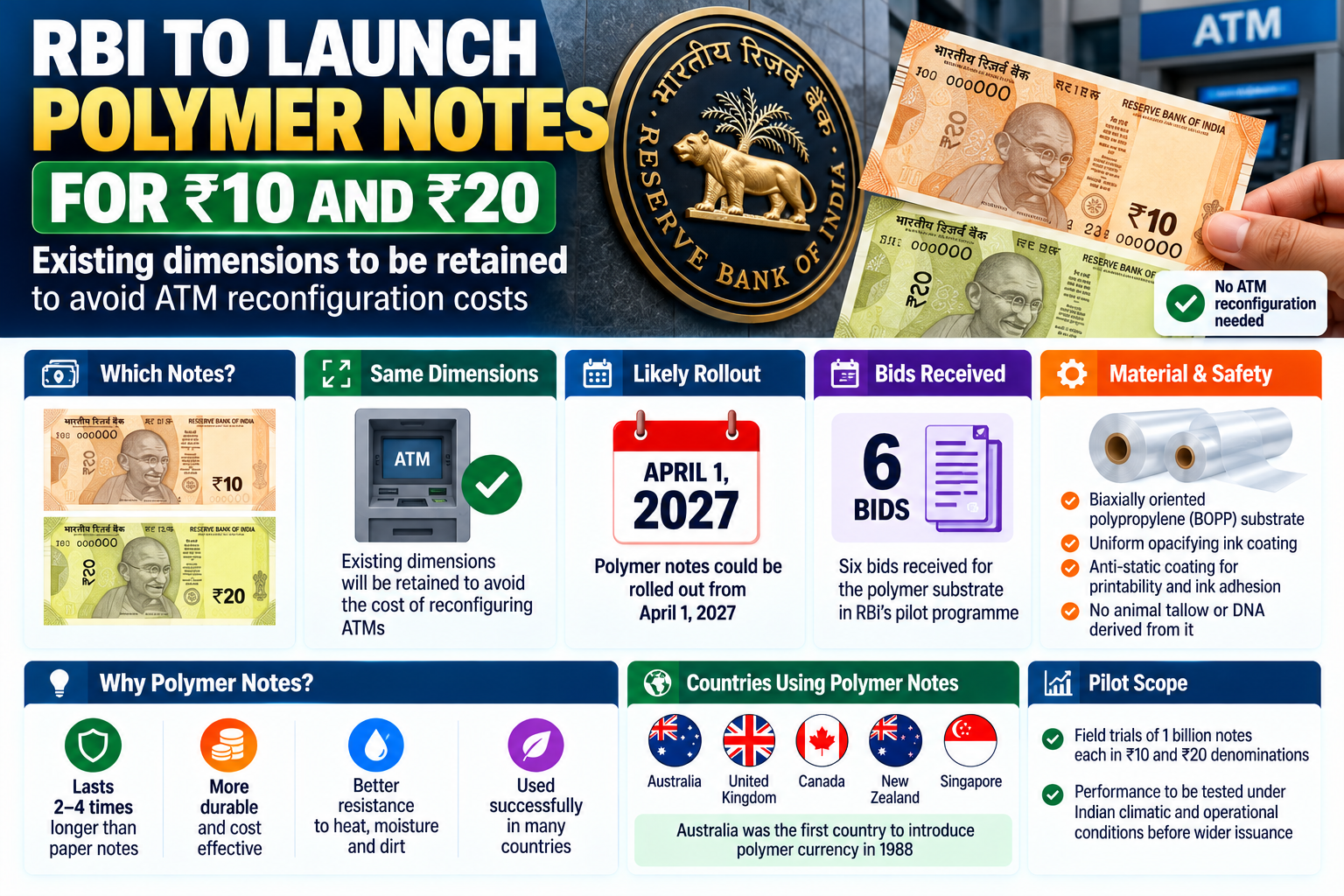
The Reserve Bank of India (RBI) plans to retain the existing dimensions of Rs 10 and Rs 20 banknotes for its proposed polymer currency pilot, potentially helping banks avoid significant ATM reconfiguration expenses.
According to sources familiar with the development cited by Moneycontrol, the pilot rollout could begin on April 1, 2027. The initiative aims to test polymer banknotes under Indian climatic and operational conditions before considering wider issuance.
For banks, ATM operators and investors, the decision could have important cost implications.
Track Live : NSE Option Chain — Live | BSE Option Chain — Live Sensex & Bankex Options Data Today
RBI Polymer Notes : Why RBI Wants to Keep Existing Rs 10 and Rs 20 Note Dimensions
Maintaining the current banknote dimensions could help banks avoid modifying cash-dispensing cassettes, updating sensors and deploying engineers to recalibrate ATMs.
A previous nationwide recalibration exercise following the introduction of new Rs 100 and Rs 200 notes reportedly cost the ATM industry around Rs 100 crore for approximately 2.4 lakh machines.
One senior public sector bank official explained that retaining existing dimensions would help avoid upfront capital expenditure.
For a bank operating 8,500 ATMs, the estimated saving could reach approximately Rs 21.25 crore, assuming a reconfiguration cost of Rs 2.5 lakh per machine.
During the initial pilot, polymer notes could also be distributed over the counter through bank branches without requiring ATM hardware changes.
Key Details of the RBI Polymer Note Plan
| Feature | Details |
|---|---|
| Denominations | ₹10 and ₹20 |
| Trial quantity | 100 crore notes each; 200 crore total |
| Total face value | ₹3,000 crore |
| Material | Biaxially Oriented Polypropylene (BOPP) polymer substrate |
| Target rollout | FY2027–28, subject to successful trials |
| Dimensions | Existing dimensions reportedly retained to avoid ATM reconfiguration costs |
| Existing paper notes | Will remain legal tender and circulate alongside polymer notes |
| Procurement | Tender initiated by BRBNMPL, an RBI subsidiary |
| Final approval | Wider issuance depends on successful field trials |
Important additional points:
-
Polymer notes are expected to last approximately 2–4 times longer than conventional paper notes.
-
The RBI will test durability under Indian climatic and operational conditions.
-
Polymer notes can incorporate transparent windows and advanced anti-counterfeiting features.
-
There is no proposal to completely replace existing paper currency.
The government has approved a trial of 2 billion polymer notes
-
The government has approved field trials of 100 crore ₹10 polymer notes and 100 crore ₹20 polymer notes.
-
The combined trial involves 200 crore banknotes.
-
Their total face value would be approximately ₹3,000 crore.
-
Regular issuance will depend on the successful completion of field trials.
This is important because the April 2027 timeline is a proposed target, not confirmation of an unconditional nationwide launch.
Six Bids Received as RBI Advances Polymer Currency Pilot
The polymer currency programme, initiated by Bharatiya Reserve Bank Note Mudran Pvt Ltd (BRBNMPL), a wholly owned RBI subsidiary, has reportedly received six bids.
Domestic polymer science company Uflex, in partnership with US-based Spectra Systems, is among the bidders.
The tender covers 68,000 reams of biaxially oriented polypropylene (BOPP) substrate, divided equally between Rs 10 and Rs 20 denominations.
The material must meet specific technical requirements, including uniform opacifying ink and anti-static coating to ensure printability and ink adhesion.
Suppliers must also ensure that the substrate contains no animal tallow or DNA derived from it.
Polymer notes will not replace existing paper currency
The government has explicitly clarified that:
-
Polymer banknotes will initially circulate alongside existing paper-based currency.
-
There is currently no proposal to completely replace paper banknotes with polymer notes.
-
The RBI will assess the performance of polymer currency before considering wider issuance.
-
The impact on digital payments, if any, can only be assessed after regular issuance.
Therefore, people should not assume that existing ₹10 and ₹20 paper notes will become invalid after the polymer pilot begins.
Track Live : Nifty Levels Today | Sensex Levels Today
Why Has the RBI Selected ₹10 and ₹20 Notes for Its Polymer Currency Pilot?
The Reserve Bank of India (RBI) has selected ₹10 and ₹20 denominations for its proposed polymer banknote pilot because these notes experience frequent circulation, making them more vulnerable to wear and tear than higher-denomination currency.
According to a report published by The Indian Express on July 27, 2026, ₹10 and ₹20 notes together account for nearly 25% of India’s total banknotes by volume, despite representing only around 1.3% of their total monetary value.
1. High circulation: These notes account for nearly 25% of banknotes in circulation by volume but only around 1.3–1.4% by value.
2. Frequent wear and tear: They are used regularly in small transactions, making them more vulnerable to damage.
3. Lower financial risk: Testing polymer technology in lower denominations limits potential losses if technical problems arise.
4. Avoiding ATM costs: These notes are largely distributed through bank branches, reducing the need for immediate ATM modifications.
| Parameter | Details |
|---|---|
| Denominations selected | ₹10 and ₹20 |
| Share of currency by volume | Approximately 25% |
| Share of currency by value | Approximately 1.3% |
| Proposed pilot quantity | 200 crore notes |
| Expected polymer note lifespan | 2–4 times paper notes |
| Main objective | Durability and operational testing |
India’s First Polymer Currency Experiment (2009–2015):
The RBI’s earlier attempt to introduce polymer currency failed to progress despite plans for a 100-crore ₹10 note pilot.
-
2009: RBI invited bids to procure 100 crore polymer ₹10 notes.
-
2012–13: Field trials were planned in Kochi, Mysuru, Shimla, Jaipur and Bhubaneswar to test different climatic conditions.
-
2014–15: Technical evaluation revealed certain shortcomings, forcing the RBI to halt the procurement process.
-
2015: The procurement process also faced delays due to pending security clearances of some bidders.
The proposed trial never materialised. The RBI’s renewed 2026 initiative is another attempt to introduce longer-lasting polymer currency in India.
Polymer Notes Could Last Longer Than Traditional Paper Currency
RBI Governor Sanjay Malhotra said in August that polymer banknotes could last two to four times longer than conventional paper notes.
However, the central bank wants to evaluate their performance under India’s weather conditions and day-to-day currency handling before deciding on wider circulation.
The government has approved field trials of one billion notes each in Rs 10 and Rs 20 denominations.
Countries including Australia, the United Kingdom, Canada, New Zealand and Singapore already use polymer currency. Australia became the first country to introduce polymer banknotes in 1988.
Read More : Sun Pharma Q2 FY27 Results Oct 30: Will Profit Cross Rs 3,100 Crore?
Here’s What Happened Today and Why Traders Reacted
The key development is RBI’s reported decision to retain existing note dimensions while moving ahead with the polymer currency pilot.
For banks, avoiding ATM modifications could reduce potential capital expenditure. For the ATM industry, the decision could limit demand for certain hardware upgrades that would otherwise be required during a currency transition.
Companies involved in polymer substrates, currency printing and related technologies could attract investor attention as the pilot progresses.
However, the development does not automatically translate into immediate earnings growth for any listed company. The final procurement decisions, contract values and commercial execution will determine the actual business impact.
What RBI’s Polymer Notes Plan Means for Investors and Banks
The proposed polymer currency transition could have implications for several areas of the financial ecosystem.
- Banks: Retaining existing note dimensions could help avoid substantial ATM reconfiguration expenses.
- ATM operators: The decision could reduce the immediate requirement for hardware modifications and recalibration.
- Polymer manufacturers: Successful tender participation could create opportunities in currency substrate supply.
- Investors: Companies connected with polymer materials and currency printing may remain on the watchlist as procurement progresses.
The next important milestones will be the completion of the bidding process, supplier selection and commencement of the pilot in 2027.
For now, RBI’s polymer currency plan is not simply about introducing longer-lasting banknotes. It is also about modernising India’s currency system while limiting the additional financial burden on banks.